

More news on this day
ECU Worldwide is tightening the links between Asia and Europe by elevating Los Angeles into a central multimodal transit hub, aiming to cut transit times, smooth capacity constraints and offer new routing flexibility for shippers across both regions.
Get the latest news straight to your inbox!
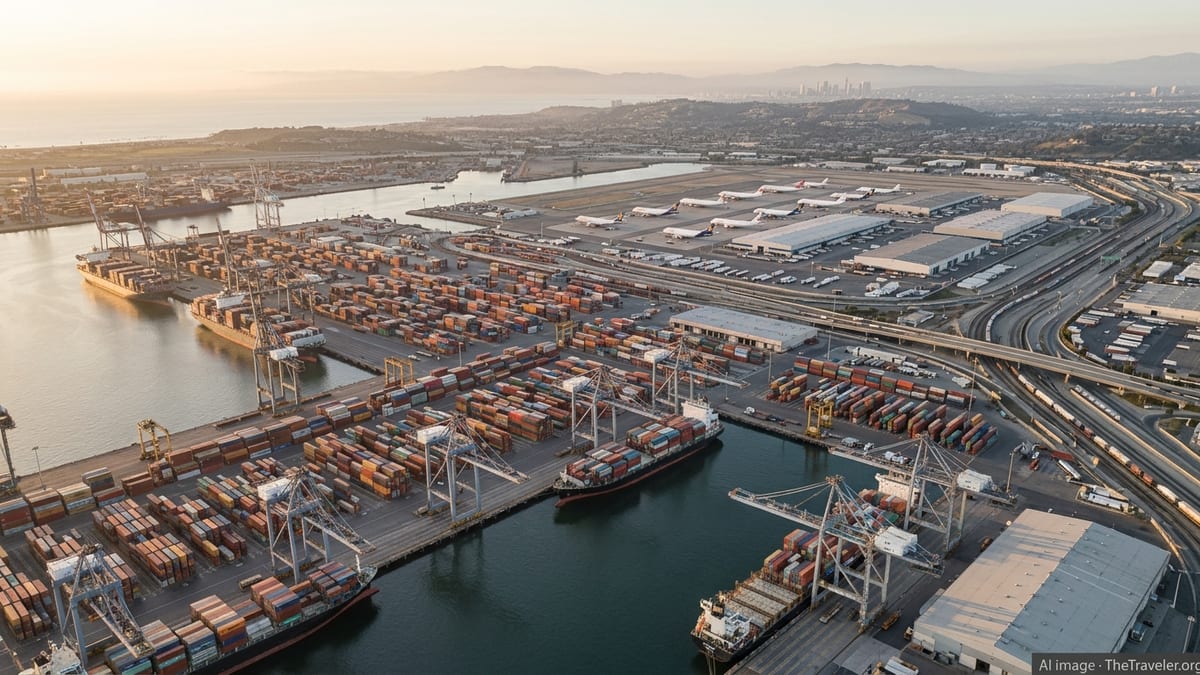
Los Angeles Steps Up as a Strategic Gateway
Los Angeles has long been a crucial gateway for transpacific cargo, and ECU Worldwide is now positioning it more firmly as a through-hub for cargo moving from Asia toward Europe. Publicly available information on the company’s network shows Los Angeles operating as one of several key global hubs, alongside locations such as New York, Miami, Antwerp, Rotterdam and Singapore, providing consolidation and onward connections to hundreds of destinations worldwide.
By concentrating sea arrivals from major Chinese ports and other Asian origins into Los Angeles, ECU Worldwide can tap its existing warehousing and handling infrastructure to sort, reconfigure and dispatch shipments onward by air or sea. This approach is designed to create a smoother flow for time-sensitive and higher-value goods, particularly those that struggle with the longer and more volatile direct ocean routes from Asia to Europe.
The hub strategy is closely linked to the company’s focus on less than container load consolidation and neutral freight services. As LCL volumes are aggregated in Los Angeles, ECU Worldwide can build denser loads for Europe-bound services, strengthening schedule reliability while offering smaller shippers a level of connectivity that would be difficult to achieve on their own.
The result is a model in which Los Angeles acts not only as a destination for Asia to North America cargo but also as a springboard for secondary routes, including alternative corridors into European markets when traditional East–West ocean services face disruption.
XLERATE Service Connects Asia, LAX and European Airports
At the center of ECU Worldwide’s Los Angeles strategy is its XLERATE express product, which combines fast ocean services from Asia to the US West Coast with expedited inland and air connections. Information published by ECU Worldwide’s regional operations indicates that this service takes cargo from ports such as Shanghai, Ningbo, Xiamen, Shenzhen and Guangzhou into Los Angeles on frequent sailings, before moving shipments onward through bonded trucking and air links.
From Los Angeles, the company promotes a sea–air option into Europe that targets total transit times of roughly two weeks from key Chinese gateways to more than 30 or, in some markets, over 80 European airports. The model relies on relatively short transpacific ocean legs followed by carefully timed airfreight departures from the West Coast, creating a hybrid product that sits between the speed of pure air cargo and the cost profile of traditional ocean freight.
This sea–air configuration is particularly relevant for shippers seeking to balance budget constraints with the need for inventory agility. Electronics, fashion, healthcare products and other sectors where product lifecycles are short can gain from the faster door-to-door times, while still avoiding the full cost of airfreight from Asia directly to Europe.
By orchestrating these flows through Los Angeles, ECU Worldwide can apply a common handling, documentation and visibility framework across multiple tradelanes. That, in turn, supports more predictable supply chains for freight forwarders and their customers who are consolidating volumes from several Asian origins into a single European distribution network.
Network Expansion and Inland Reach Strengthen the Hub
The push to use Los Angeles as a more prominent transit platform builds on a broader expansion of ECU Worldwide’s US footprint. Recent network updates highlight additional domestic locations and enhanced inland distribution from US West Coast gateways, with Los Angeles serving as a primary cross-dock and sorting point for LCL cargo moving deeper into the continent.
Over the past several years, the company has extended its inland coverage from Los Angeles to a growing number of container freight stations in major US markets, including key industrial and consumption centers. This web of bonded and express trucking routes gives the Los Angeles hub a dual role: feeding domestic corridors while also aggregating and preparing shipments that will later move on toward Europe.
Service notices and schedules released for 2025 and 2026 underscore how trade lanes from Los Angeles are being tuned to link more tightly with Asia and onward global destinations. Enhanced services from Los Angeles to Southeast Asian ports such as Jakarta, for example, demonstrate how the hub can support both westbound and eastbound flows, offering shippers more routing options when demand patterns or capacity constraints shift.
In this context, Los Angeles functions less as a simple endpoint and more as a dynamic pivot. Cargo can be redirected, delayed for consolidation or advanced through faster modes, depending on market needs and available capacity on the Europe-bound legs.
Responding to Volatile East–West Trade Conditions
The strengthened role of Los Angeles also reflects broader uncertainty along traditional East–West shipping corridors. Carriers and logistics providers have been adjusting networks and schedules in response to changes in port congestion, route security and equipment availability. For forwarders and their customers, this environment has increased interest in alternative routings that can bypass bottlenecks while maintaining service reliability.
By blending ocean and air components and routing via North America, ECU Worldwide’s hub strategy offers one such alternative for Asia–Europe trade. The use of fast transpacific services into Los Angeles, followed by scheduled air links into European gateways, allows some cargo to circumvent disrupted direct Asia–Europe ocean services and to stabilize lead times.
Industry coverage indicates that large container lines are also reshaping their East–West offerings for 2026, placing further emphasis on key nodes such as Los Angeles and other major transshipment points. In this evolving landscape, ECU Worldwide’s decision to deepen its use of Los Angeles aligns with a broader trend toward network flexibility, multimodal connectivity and diversified routings.
For shippers, the presence of an integrated, LCL-focused provider using Los Angeles as a cross-regional hub can provide additional resilience, particularly for supply chains that rely on frequent, smaller shipments rather than full-container volumes.
Implications for European and Asian Shippers
The enhanced Los Angeles hub carries implications for logistics planning on both sides of the Asia–Europe corridor. For exporters in Asia, the availability of scheduled LCL and express products that move via Los Angeles opens another pathway into European markets, particularly when direct sailings or airfreight capacity are constrained or more expensive.
For European importers, a transit via Los Angeles can provide an alternative window into global trade flows, offering better alignment with product launches, seasonal demand and omnichannel distribution. Consolidated cargo arriving at European airports after transiting the West Coast can be fed quickly into regional road and rail networks, supporting just-in-time or near-just-in-time strategies.
Although the Los Angeles routing introduces an additional leg compared with direct Asia–Europe services, ECU Worldwide’s network design is intended to offset that complexity through tighter coordination, standardized processes and digital visibility tools. Tracking platforms and pre-defined handling protocols across hubs such as Los Angeles, Miami, Antwerp and Rotterdam allow shippers to manage multimodal routings as a single integrated journey.
As East–West trade continues to adapt to shifting economic and operational conditions, developments such as ECU Worldwide’s expanded use of Los Angeles as a transit hub illustrate how logistics providers are reconfiguring their networks. The focus on flexible, hub-and-spoke models and hybrid sea–air solutions is likely to remain central to how Asia–Europe cargo moves in the coming years.