

More news on this day
Rail passengers across Scotland faced severe disruption today after a major signalling fault near Edinburgh triggered widespread delays and cancellations, throttling key commuter and intercity routes at one of the network’s busiest times.
Get the latest news straight to your inbox!
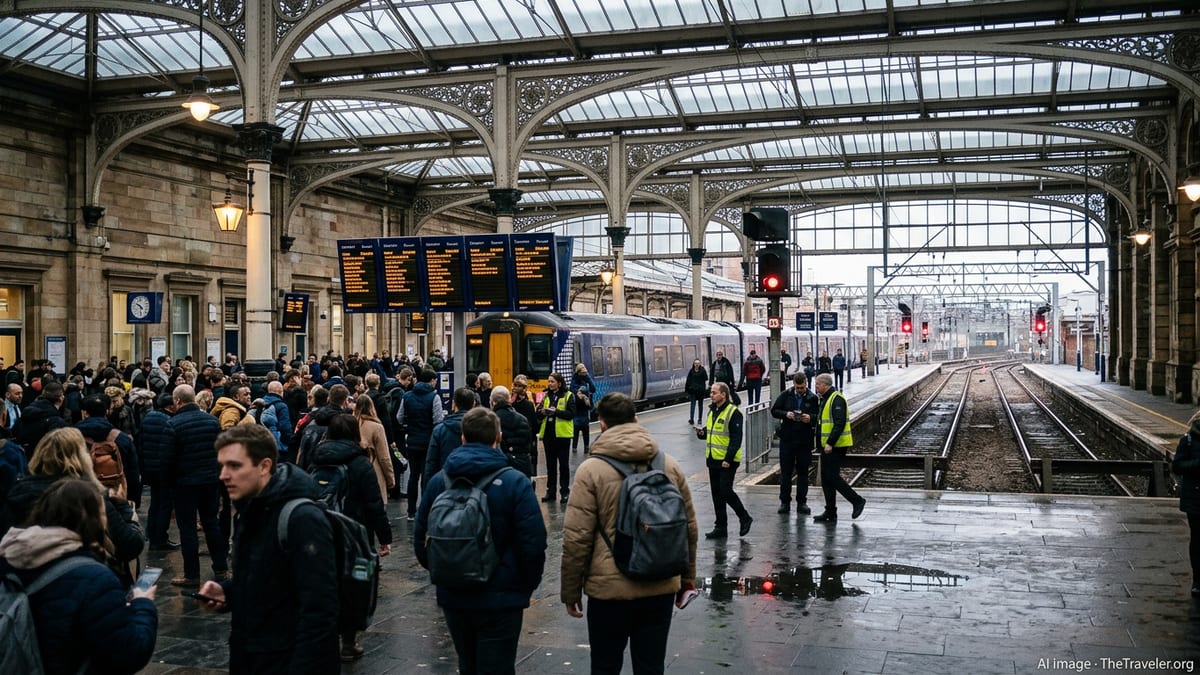
Major fault cripples key routes through Edinburgh
Network Rail engineers reported a significant failure in signalling equipment affecting lines running through the Edinburgh area on Thursday 12 March 2026, forcing trains to be held at signals, diverted or cancelled at short notice. The disruption rippled across much of Scotland’s rail network, with services in and out of Edinburgh Waverley particularly badly hit.
Commuters travelling between Edinburgh and Glasgow, Fife, Aberdeen and the Highlands were warned to expect extended journey times, short-notice platform changes and crowded trains as operators attempted to thread limited services through restricted sections of track. Real-time journey planners showed trains stacked up outside key junctions, with some services terminating early to try to keep parts of the network moving.
ScotRail, which operates most services in the central belt, said services were “severely disrupted” and urged passengers to check live updates before setting off. Cross-border operators, including LNER and CrossCountry, also reported knock-on delays on trains linking Edinburgh with northern England and London as congestion built up around the capital.
The latest incident follows a series of issues on Scotland’s rail network this week, including a major power loss on the route between Lockerbie and Motherwell and earlier signalling problems on lines serving Arbroath and the Highlands, compounding frustration for regular travellers.
Passengers stranded as delays and cancellations mount
At Edinburgh Waverley, long queues formed at departure boards as services were repeatedly retimed or cancelled. Travellers reported announcements advising them not to board some trains due to overcrowding, while substitute buses were drafted in on selected routes where lines were temporarily blocked.
Morning peak services between Edinburgh and Glasgow via Falkirk High saw particular pressure, with some trains reduced in frequency and others starting part way along the route. Commuters heading to offices in both cities faced delays of 30 to 60 minutes, while some chose to work from home after being unable to complete their journeys.
Tourists were also caught up in the disruption, with visitors heading for the Highlands and the east coast reporting missed connections at Perth, Dundee and Aberdeen. Staff at Waverley and Haymarket stations advised passengers with flexible plans to travel later in the day, when engineers hoped more signals would be brought back into normal operation.
Air-rail links were similarly affected, with services between Edinburgh city centre and key interchange stations for onward travel to airports in Glasgow, Newcastle and Manchester operating to amended timetables. Some long-distance operators relaxed ticket restrictions to allow passengers to use later services at no extra cost if they had been unable to travel as booked.
Engineers race to fix complex signalling failure
Network Rail Scotland said specialist teams had been dispatched to investigate the root cause of the fault, focusing on trackside signalling equipment and communications systems controlling routes into and out of Edinburgh. Early indications pointed to a technical failure affecting the way signals and points are controlled, forcing signallers to impose strict safety measures that significantly reduce capacity.
Because modern signalling systems are highly interdependent, a single failure on a critical section can have a disproportionate impact, triggering caution procedures over a wide area. That appeared to be the case on Thursday, with trains slowed or held at red signals well beyond the initial fault location as controllers worked to keep movements safe.
Recent incidents across Scotland, including signalling faults at Arbroath and between Perth and the Highland main line, have highlighted the vulnerability of key corridors when infrastructure problems arise. Industry sources said ongoing renewal programmes, including work on signalling centres and digital upgrades on strategic routes, aim to improve resilience but often require complex testing and integration.
While engineers worked trackside, operators used social media and live maps to keep passengers updated, although many travellers expressed frustration at receiving confirmation of cancellations only minutes before scheduled departure times.
Knock-on impact adds to a difficult week on Scotland’s rails
The latest signalling failure struck as Scotland’s rail network was already under strain from earlier disruption linked to a serious fire beside Glasgow Central and separate overhead power issues on the West Coast Main Line. Those incidents left trains and crew out of position, meaning that even routes not directly affected by the Edinburgh fault experienced gaps in service.
TransPennine Express and other cross-border operators had already been warning of short-notice alterations on Edinburgh to Manchester Airport and Edinburgh to Newcastle services due to displaced rolling stock and staff. Thursday’s signalling problems further complicated that picture, with some services diverted or curtailed south of the central belt to avoid bottlenecks.
Passenger groups said the cumulative effect of multiple incidents in a short period was eroding confidence in rail as a reliable option for commuting and regional travel. They called for clearer communication about recovery times and for robust contingency planning, including pre-arranged mutual ticket acceptance between operators when major faults occur.
Despite the disruption, performance data published in recent months shows that overall punctuality on Scotland’s railways has been gradually improving, even as major infrastructure schemes and renewals continue. The challenge for the industry will be to ensure that high-impact incidents such as Thursday’s signalling fault become rarer and that recovery is faster when they do occur.
Advice for travellers as services gradually recover
By late afternoon, engineers reported that some signalling functionality had been restored on key approaches to Edinburgh, allowing operators to run a limited but more stable timetable. However, residual delays and cancellations were expected to continue into the evening peak as trains and crew returned to their scheduled diagrams.
Passengers were urged to check live journey planners and operator alerts before setting out, to allow extra time for connections, and to be prepared for standing on busier trains. Rail companies reminded customers that those delayed by 15 minutes or more may be eligible for compensation under Delay Repay schemes, and that advance tickets disrupted by the fault could typically be used on later services.
Travellers with critical appointments or onward international connections were advised to consider alternative routes, including intercity coach services or, where practical, road travel. For many regular commuters, though, the priority was simply getting home, with some choosing to wait in stations for later, less crowded trains once more of the signalling system was back online.
With further engineering work and infrastructure upgrades planned in the coming weeks on routes to and from Edinburgh and Glasgow, operators are expected to face continued pressure to keep passengers informed and to demonstrate that lessons from this latest signalling chaos have been learned.