

More news on this day
Egypt is consolidating its position at the center of Africa’s tourism resurgence, with record 2025 arrivals and early 2026 data pointing to sustained growth in flagship destinations such as Luxor, Giza and Cairo, reinforcing a continent-wide recovery led by Tunisia, Morocco, Algeria, Rwanda, Seychelles, Ethiopia and other rapidly expanding markets.
Get the latest news straight to your inbox!
Africa Leads Global Tourism Recovery Into 2026
Across Africa, publicly available figures from UN Tourism and regional industry trackers describe 2025 as a milestone year, with the continent emerging as the fastest-growing tourism region worldwide. International arrivals to Africa climbed into the low‑80‑million range for 2025, up strongly from 2024 and already well above pre‑pandemic benchmarks, underscoring how the continent has shifted from lagging to leading the global travel rebound.
North Africa has been a key driver of this turnaround. Reports on the January to September 2025 period highlight around 10 to 11 percent growth in arrivals to the region compared with 2024, with Egypt, Morocco and Tunisia all registering double‑digit gains on 2019 levels. Sub‑Saharan destinations such as Rwanda, Seychelles and Ethiopia also posted notable increases, supported by investments in air connectivity, diversified products and streamlined visa regimes.
Analysts note that the recovery has been broad-based rather than limited to a handful of beach or safari hubs. From Mediterranean coasts and desert heritage circuits to mountain trekking and Indian Ocean islands, tourism in Africa is increasingly framed by regional integration initiatives, improved infrastructure and a shift toward higher‑value, experience‑driven travel. This backdrop has created a favorable environment for Egypt’s renewed surge in arrivals and spending.
Egypt Posts Historic 2025 Tourism Performance
Egypt’s tourism sector entered 2025 on the back of record 2024 results, when the country welcomed close to 16 million international visitors and generated more than 14 billion dollars in tourism receipts according to official statistics and multilateral assessments. Updated year‑end estimates and industry research for 2025 now point to another step‑change: international arrivals are widely reported to have jumped by around 20 percent compared with the previous year, marking a historic high for the country.
Independent economic studies circulated in late 2025 estimate that travel and tourism’s direct and indirect contribution reached the equivalent of tens of billions of US dollars, approaching one tenth of Egypt’s gross domestic product when related services are included. This expansion has helped offset pressure from external shocks, foreign currency shortages and higher import costs, as tourism receipts bring in much‑needed hard currency and support employment across hospitality, transport and retail.
Observers underline that the performance is particularly notable given the backdrop of isolated safety incidents and regional geopolitical tensions. While a high‑profile Red Sea tourist submarine accident in March 2025 briefly raised concerns, subsequent booking data and occupancy figures suggest only a temporary impact, with Egypt’s year‑round cultural and leisure appeal quickly reasserting itself.
Luxor, Giza and Cairo Anchor a New Visitor Geography
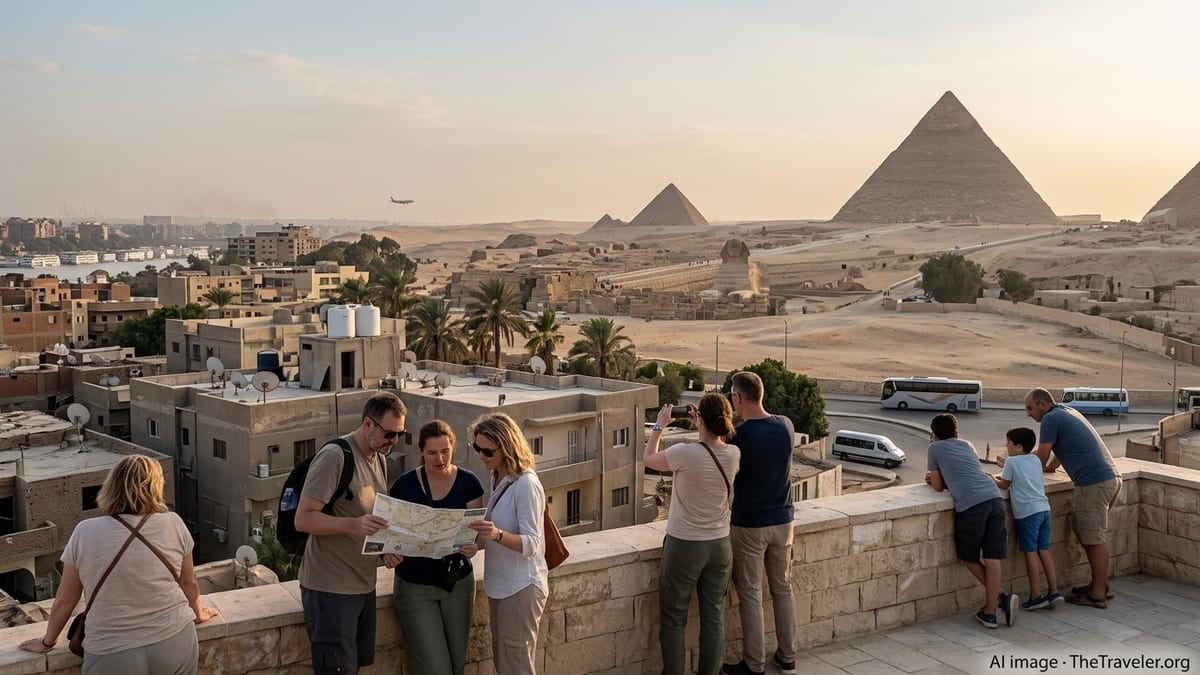
Within Egypt, the distribution of visitor flows is evolving, with Luxor, Giza and Cairo at the center of the 2025 and early 2026 growth story. Travel analytics and destination reports indicate that Giza, home to the Pyramids and the Sphinx, attracted well over 14 million visitors in 2025, making it the country’s single most visited tourism site. Hotel operators in the greater Cairo area report rising average daily rates and improving year‑round occupancy as cultural tourism blends with business and conference travel.
Luxor, often described as an open‑air museum, has also benefited from renewed international attention. Coverage of new archaeological discoveries, including additional tombs and restored temples on the West Bank, has helped extend the peak season and draw higher‑spending cultural travelers. River cruise activity along the Nile between Luxor and Aswan has rebounded, with capacity additions from both local and foreign operators indicating confidence in sustained demand through 2026.
Cairo itself is experiencing a parallel reconfiguration of its tourism offer. The long‑anticipated opening phases of the Grand Egyptian Museum on the Giza Plateau, together with urban regeneration projects, upgraded airport facilities and expanded metro links, are reshaping how visitors move between the capital, Giza and upper‑Egypt circuits. Industry observers note a gradual shift from short, single‑site excursions toward multi‑day itineraries that combine Cairo’s urban energy with heritage stops in Luxor and leisure stays on the Red Sea.
North and East African Peers Reinforce Regional Momentum
Egypt’s 2025 achievements place it alongside a cluster of African destinations that have recorded exceptional tourism gains. Morocco has emerged as one of the continent’s headline performers, with visitor numbers surpassing pre‑pandemic levels and record receipts in 2024 and 2025, supported by expanded low‑cost and long‑haul air links, sports events and promotion of secondary cities. Tunisia and Algeria, meanwhile, have seen arrivals climb back toward and, in some segments, above 2019 baselines, aided by investment in coastal infrastructure and diversified cultural offerings.
In East Africa and the Indian Ocean, Rwanda and Seychelles stand out for their focus on higher‑value, sustainability‑oriented tourism models. Rwanda’s strategy blends gorilla trekking and nature‑based tourism with conference and investment events in Kigali, while Seychelles continues to target premium beach and marine tourism, bolstered by longer‑haul European and Middle Eastern connectivity. Ethiopia, supported by Addis Ababa’s role as a regional airline hub, has been expanding its profile as a gateway for both transit visitors and cultural tourists seeking historic sites in Lalibela, Gondar and the Rift Valley.
Collectively, these markets are contributing to an African tourism map that is more interconnected and less dependent on a narrow set of source countries or single‑season demand. This diversification enhances resilience and increases the potential for multi‑country itineraries in which Egypt functions as a key anchor for history‑focused travel, paired with nearby desert, mountain or island experiences.
Strengthening Economic Links and the Global Travel Network
The tourism upswing is also deepening Egypt’s integration into global air and cruise networks. Schedule data and airline announcements through late 2025 and early 2026 show a steady increase in direct links from European, Gulf and Asian hubs into Cairo, Hurghada, Sharm el‑Sheikh and Marsa Alam. New point‑to‑point services from secondary European cities, along with capacity upgrades on established routes, have improved accessibility for mid‑market travelers and tour operators.
On the policy side, Egypt is continuing to refine its visa framework and digital travel services, building on earlier introductions of multi‑year and expanded e‑visa options. Public statements and industry reporting highlight government targets to reach 30 million annual visitors by 2028, a goal that depends on both infrastructure expansion and closer cooperation with neighboring African and Middle Eastern destinations.
Regional initiatives, including open‑skies style agreements, joint marketing within North Africa and the Red Sea, and alignment with African Union travel facilitation efforts, are gradually stitching Egypt into a broader tourism corridor. As Tunisia, Morocco, Algeria, Rwanda, Seychelles, Ethiopia and other high‑growth markets ramp up capacity and visibility, Egypt’s record 2025 performance and early 2026 momentum in Luxor, Giza and Cairo position the country as a central hub in an increasingly influential African travel network.