

More news on this day
Travel across the Middle East and Europe is facing renewed disruption as Egypt-based and Gulf carriers cancel more than a dozen flights linking Cairo with major hubs in the United Arab Emirates, Saudi Arabia, Jordan, Iraq and Germany, according to multiple airline updates and airport notices issued in recent days.
Get the latest news straight to your inbox!
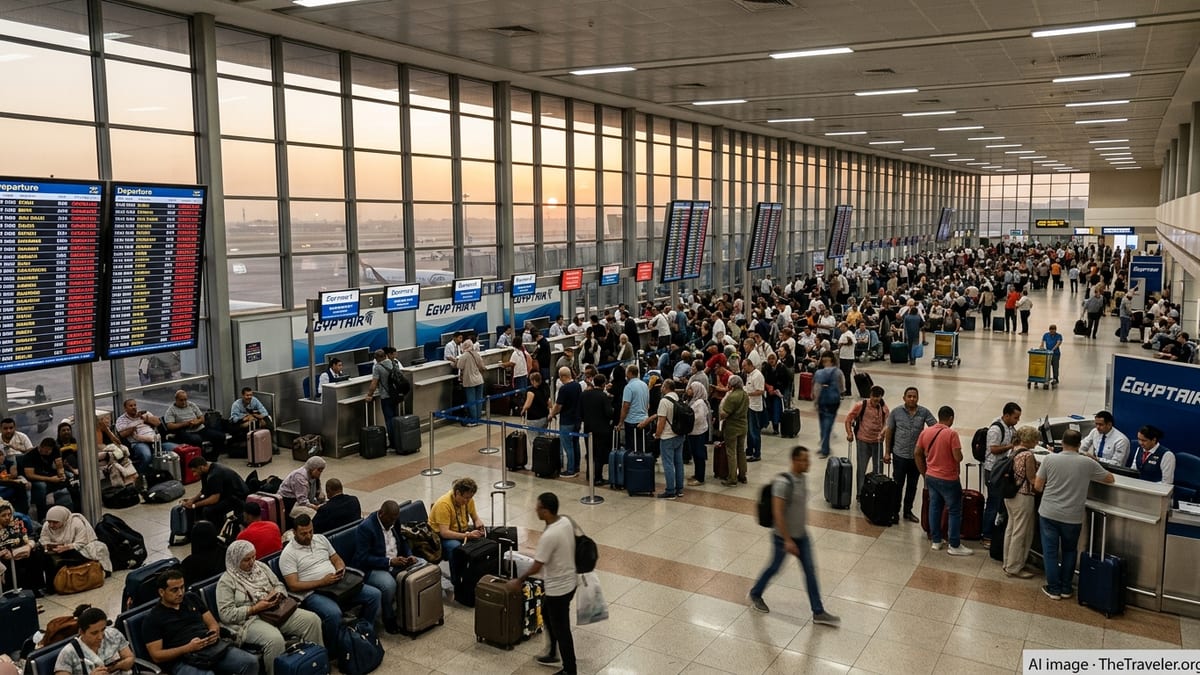
Key Routes From Cairo to Gulf Hubs Abruptly Cut
Publicly available schedules and airport advisories show Egyptair and several Gulf carriers halting or reshaping services on core routes between Cairo and Dubai, Abu Dhabi, Riyadh, Dammam, Sharjah and other regional gateways. The changes, introduced through late March, include outright cancellations, temporary suspensions and reductions in weekly frequencies on normally busy trunk routes.
Flights between Cairo and the United Arab Emirates have been among the most affected. Services to Dubai International and Abu Dhabi’s Zayed International, two of the region’s largest transfer hubs, have seen a mix of cancellations and limited resumptions, with only a portion of the usual schedule operating on some days. Capacity to Sharjah, another important low cost and regional transfer point, has also been trimmed as airlines navigate restricted airspace and shifting operational conditions.
Saudi Arabia connections are under similar pressure. Links from Egypt to Riyadh and Dammam, which typically support both business and worker traffic, have faced selective cancellations as airlines rework their networks around evolving risk assessments and congestion at alternative gateways. Passengers who rely on these flights to connect onward to Asia and Africa are reporting longer routings and more complex itineraries as they are rebooked via secondary hubs.
In several cases, carriers have published short term waivers allowing affected customers to change travel dates or reroute without additional fees, but availability remains tight on remaining services around peak travel days in late March.
European Links Including Berlin Face Knock-On Disruptions
The disruption is not limited to Gulf corridors. Flight data and timetable updates indicate that services between Egypt and Europe, including routes to Berlin, have also experienced cancellations tied to wider Middle East airspace instability and aircraft reallocation. While most European airports remain open and operating normally, the loss of certain Cairo departures has reduced options for travelers seeking to bypass Gulf hubs.
Berlin Brandenburg, which is part of Egyptair’s European network, has seen selected rotations scrubbed or rescheduled as the airline reprioritizes aircraft for shorter regional sectors and repatriation style operations. Travelers with tickets between Cairo and Berlin over the second half of March have been advised through airline channels to monitor their booking status closely, as some flights that appeared in timetables earlier in the month are no longer operating.
Other European destinations reachable from Egypt via Gulf hubs have been indirectly affected. With departures to Dubai, Abu Dhabi and Sharjah curtailed on certain days, onward connections from those hubs to cities in Germany, the United Kingdom and Scandinavia are harder to secure, even when those long haul sectors are technically operating. Industry trackers note that many passengers are being rebooked onto multi stop journeys that avoid the most constrained airspace, adding hours to total travel time.
Analysts following the region point out that the pattern of cancellations highlights how closely Europe Middle East and Asia traffic flows are intertwined, with a disruption in one cluster of airports rapidly rippling across multiple continents.
Gulf Air and Regional Carriers Adjust Networks
Gulf Air and other regional airlines have also been adjusting their operations in and around Egypt, responding both to demand shifts and operational challenges. Updates shared through airline communication channels and passenger reports describe Gulf Air modifying services that traditionally link Bahrain and Saudi Arabia with Egypt, sometimes consolidating passengers through alternative Saudi airports when direct options are limited.
In parallel, carriers based in the United Arab Emirates have been recalibrating their schedules to and from Egyptian cities. After a period of heavily reduced traffic while airspace conditions were reassessed, some UAE airlines have resumed limited operations while keeping a significant number of flights canceled or on altered timings. The result is an uneven pattern in which a flight may operate one day but disappear from the schedule the next, complicating advance planning for both leisure and business travelers.
This regional rebalancing is also influencing how airlines deploy their fleets. Aircraft that would normally operate high density rotations between Cairo and Gulf hubs are, in some cases, being reassigned to shorter intra Gulf or domestic sectors to maintain connectivity for residents and essential travel. That shift leaves fewer seats available on cross border routes, particularly in peak evening departure banks that are popular with connecting passengers.
Observers note that the current phase of disruption is layered on top of earlier schedule reductions put in place across the broader Middle East in early March, creating a cumulative effect that is still working its way through booking systems and airport operations.
Passengers Confront Cancellations, Rerouting and Limited Waivers
For travelers, the practical impact of the cancellations is being felt in the form of last minute notifications, prolonged waits for rebooking and uncertainty over future travel dates. Public posts on travel forums and social media describe Egypt bound and Egypt originating passengers receiving emails that their flights to Dubai, Abu Dhabi, Sharjah or European cities have been canceled with only a narrow set of alternative options offered.
Many carriers in the region, including Egyptair, have published temporary change policies allowing customers on affected departures to switch to later travel dates or adjust their routing without additional fare penalties. However, those waivers are often time limited and depend on finding available seats on an already reduced schedule. Travelers with complex itineraries involving multiple airlines are reporting particular difficulty obtaining coherent rebookings when one sector in a longer journey is canceled.
Some passengers are opting to reroute over alternative hubs such as Jeddah, Istanbul or European capitals where schedules are more stable, even if that requires separate tickets or overnight stops. Others are postponing trips altogether, citing the risk of being stranded in transit if further cancellations occur. Travel agents and online booking platforms are encouraging customers to verify the status of all segments, including return legs, before departing for the airport.
Consumer advocates observing the situation emphasize the importance of checking the operating carrier and flight number, not just the brand marketed on a ticket, because codeshare arrangements mean a cancellation by one airline can cascade through multiple booking channels.
Outlook for Late March and Early April Travel
Looking ahead, publicly accessible schedules suggest that airlines are planning a gradual restoration of services through late March and into April, but with significant caveats. Some Gulf carriers have already signaled that certain departures from Dammam and other regional airports will remain suspended until the beginning of April, limiting the options for Egypt bound traffic that typically connects through those points.
Egyptair’s published network still lists an extensive roster of destinations across the Gulf and Europe, including Abu Dhabi, Dubai, Sharjah, Riyadh, Dammam, Amman, Baghdad and Berlin, indicating that the current wave of cancellations is being treated as a temporary adjustment rather than a long term withdrawal. Nevertheless, aviation analysts caution that schedules may continue to change at short notice as airlines respond to any new operational or security developments.
Travel industry specialists are advising passengers booked on Egypt related itineraries over the coming weeks to build in additional flexibility. Recommended steps include choosing fares that allow changes, avoiding very tight connections, ensuring contact details are up to date with airlines, and downloading carrier mobile apps where real time notifications are typically issued first.
With the region’s air traffic still in flux, the expectation among route planners is that a more predictable pattern of flights between Egypt, the Gulf and Europe will only emerge once airlines have several weeks of stable operations, making this an unusually challenging period for travelers whose plans depend on Cairo’s role as a crossroads between continents.