

More news on this day
Air travel to and from Egypt is facing fresh disruption as more than 20 flights are reported cancelled across multiple airlines, affecting links to major cities including London, Berlin, Riyadh, Dubai, Abu Dhabi, Sharjah and Bahrain amid ongoing instability in regional airspace.
Get the latest news straight to your inbox!
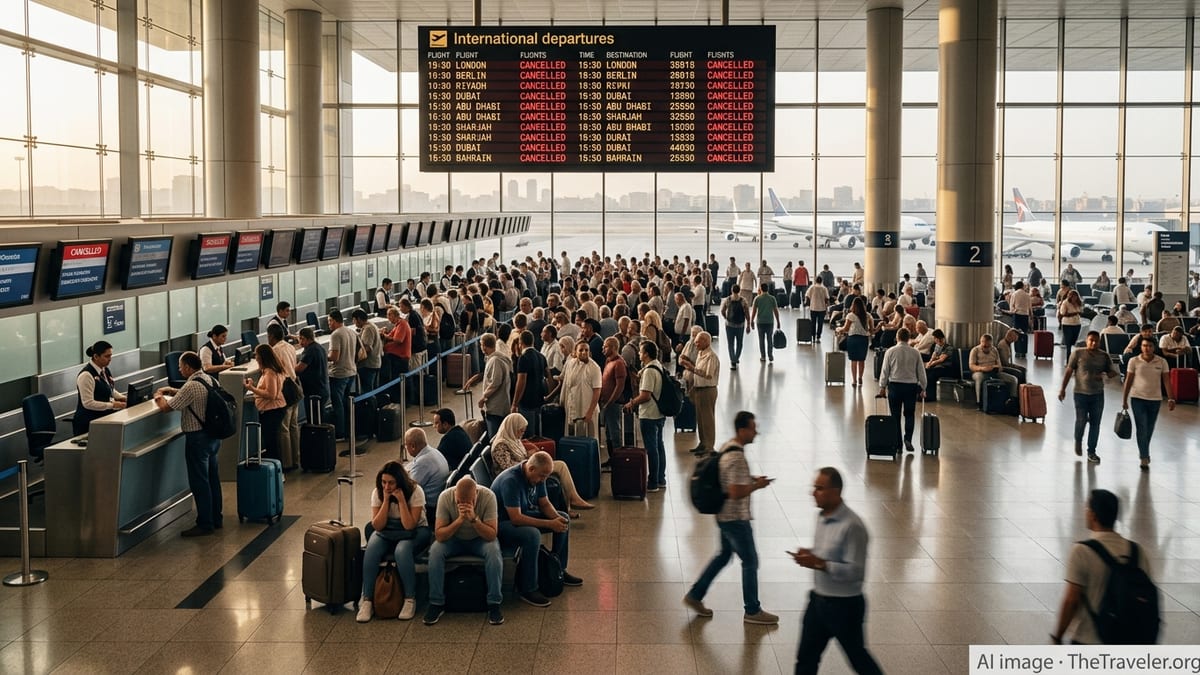
Egypt’s Airports Squeezed by Regional Airspace Turmoil
Published coverage indicates that Egypt’s air gateways, including Cairo and the rapidly growing Sphinx International Airport serving the capital, are experiencing knock-on disruption from airspace restrictions and security tensions affecting much of the Middle East. In recent days, Egypt-linked services operated by carriers such as easyJet, flydubai and Gulf Air have seen a wave of cancellations and schedule changes, with more than 20 flights scrubbed across a mix of European and Gulf routes.
The latest disruption is closely tied to a broader regional crisis that has led several neighboring states to limit or temporarily close sections of their airspace. Publicly available information on airline and airport operations shows that carriers transiting the region are being forced to reroute, consolidate or cancel flights, and Egypt’s position as a key crossroads between Europe, the Gulf and Africa means its schedules are particularly exposed to those shifts.
While core domestic and some regional connections inside Egypt continue to operate, the pattern emerging on international departures and arrivals is one of sharply reduced frequencies, late-notice cancellations and rolling timetable changes. Travelers using Egypt as both an origin and a transit point are being advised through airline updates and airport notices to check flight status repeatedly on the day of travel.
Europe Links Disrupted: London and Berlin Among Hardest Hit
Among European destinations, London and Berlin stand out as some of the most significantly affected by the latest cancellations. easyJet, which has built a notable presence on Egyptian routes including services to and from Berlin and London Luton, features prominently in reports of disrupted schedules. Flight-tracking snapshots and airline advisories indicate that several rotations between Egypt and these hubs have been withdrawn or consolidated into fewer operating services.
Connections between Egypt and the wider United Kingdom market are also seeing pressure as regional airspace bottlenecks complicate routings that traditionally overfly areas now subject to restrictions. For many travelers, that has translated into extended journey times, rebookings onto indirect itineraries, or outright cancellations where rerouting options are limited or uneconomical.
Berlin-bound traffic has likewise been reconfigured, with some Egypt–Germany services trimmed back or retimed to fit narrow operating windows through available corridors. Industry observers note that Egypt’s tourism sector, which relies heavily on budget and leisure travelers from major European capitals, is particularly sensitive to such disruptions at the tail end of the winter sun season and ahead of peak spring travel.
Gulf Connections Severely Curtailed on Flydubai, Gulf Air and Others
Gulf routes, long a backbone of Egypt’s international connectivity, are bearing the brunt of the current disruption. Flydubai and Gulf Air, two key players linking Egyptian cities with Dubai and Bahrain respectively, are among the carriers publicly flagging reduced operations and targeted cancellations. Routes connecting Egypt with Dubai, Abu Dhabi, Sharjah, Riyadh and Manama have seen multiple flights removed from schedules or converted into limited, irregular services.
Travel forums and airline customer updates describe a patchwork of operational patterns, with some flights running as special repatriation or limited-service operations while regular commercial frequencies remain suspended or sharply reduced. According to these accounts, certain Gulf carriers are prioritizing a narrow set of strategic routes, often at reduced frequency, while continuing to cancel a broad slate of departures that would usually provide dense connectivity between Egypt and the wider Gulf region.
The impact is especially acute for passengers who rely on Gulf hubs as onward gateways to Asia, North America and Australasia. With Egypt–Gulf sectors disrupted, many are facing complex rebookings, overnight stays, or long detours via alternative European or Mediterranean hubs that still have operational capacity and open airspace.
Tourists and Residents Face Rebookings, Delays and Limited Alternatives
For travelers on the ground in Egypt, the wave of cancellations has quickly translated into uncertainty at airport check-in desks and on airline apps. Reports from passengers indicate that some learned of cancellations only hours before departure, leaving limited time to secure alternative arrangements. Others have been shifted onto later flights or different routings, sometimes involving new transit points and considerably longer total travel times.
Package holidaymakers returning from Red Sea destinations and cultural tourism hotspots are among those affected, as are Egyptian residents working in Gulf states or Europe who depend on these routes for regular commuting. In many cases, publicly available airline guidance explains that rebooking is being handled in order of departure date priority, with carriers offering flexible change policies but warning that seat availability is tight.
Travel insurers and consumer advocates cited in recent coverage suggest that passengers maintain detailed records of cancellations, rebooking attempts and any additional expenses incurred, as compensation or refunds may depend on documentation and on the specific conditions under which a flight was cancelled. However, with disruptions stemming from wider regional security developments and airspace decisions, the scope of mandatory compensation may be more limited than in cases linked purely to airline operational issues.
What Travelers Should Do as the Situation Evolves
With conditions in regional airspace still fluid, industry updates stress that schedules may change at short notice and that a flight showing as operating today can still be cancelled or retimed closer to departure. Travelers planning to fly into or out of Egypt in the coming days are being urged by airlines and airports, through public advisories, to check flight status repeatedly, sign up for notifications and allow extra time at the airport in case of congestion at rebooking counters.
Travel experts contributing to recent analyses recommend that passengers transiting between Europe and the Gulf through Egypt consider, where feasible, booking through carriers that can provide alternative routings if a primary hub becomes inaccessible. They also suggest maintaining flexible plans for accommodation on either end of the journey, particularly for those with tight onward connections or fixed event dates.
Although some carriers in the wider region are beginning to restore limited operations as select airspace corridors reopen, the pattern remains uneven and subject to change. For now, Egypt’s role as a key junction between Europe, the Middle East and Africa means it will likely continue to feel the effects of any renewed airspace closures or additional security measures, keeping pressure on airlines and passengers alike as the spring travel season unfolds.