

More news on this day
British nationals planning trips to Egypt are being urged to review their plans and prepare for tighter security after the UK government sharpened its travel guidance and Egyptian authorities began enforcing stricter checks, movement controls and safety protocols in response to rapidly escalating regional tensions with Iran and its allies.
UK Travel Advice Recalibrated as Middle East Tensions Rise
The UK Foreign, Commonwealth and Development Office updated its Egypt travel advice on 1 March 2026, warning that the wider Middle East has entered a period of heightened volatility that could disrupt flights, trigger protests and increase risks to Western travellers. While the core assessment that most of Egypt’s main tourist centres remain open has not changed, officials stress that the regional security environment could deteriorate at very short notice.
The latest notice highlights that Cairo, Luxor, Aswan and major Red Sea resorts such as Sharm el Sheikh and Hurghada continue to be considered broadly safe for travel, but within a context of elevated regional risk. The advisory sits alongside a broader tightening of guidance for the eastern Mediterranean and Gulf, following US and Israeli strikes on Iran and subsequent retaliatory attacks on Western-linked targets.
British nationals are being told to regularly monitor official alerts and to treat all travel plans in and out of Egypt as subject to rapid change. The Foreign Office has also reminded travellers that some parts of the country remain subject to existing restrictions, including advice against all travel or all but essential travel to certain border areas and regions of North Sinai.
Egypt Steps Up Airport Checks, Internal Controls and Curfews
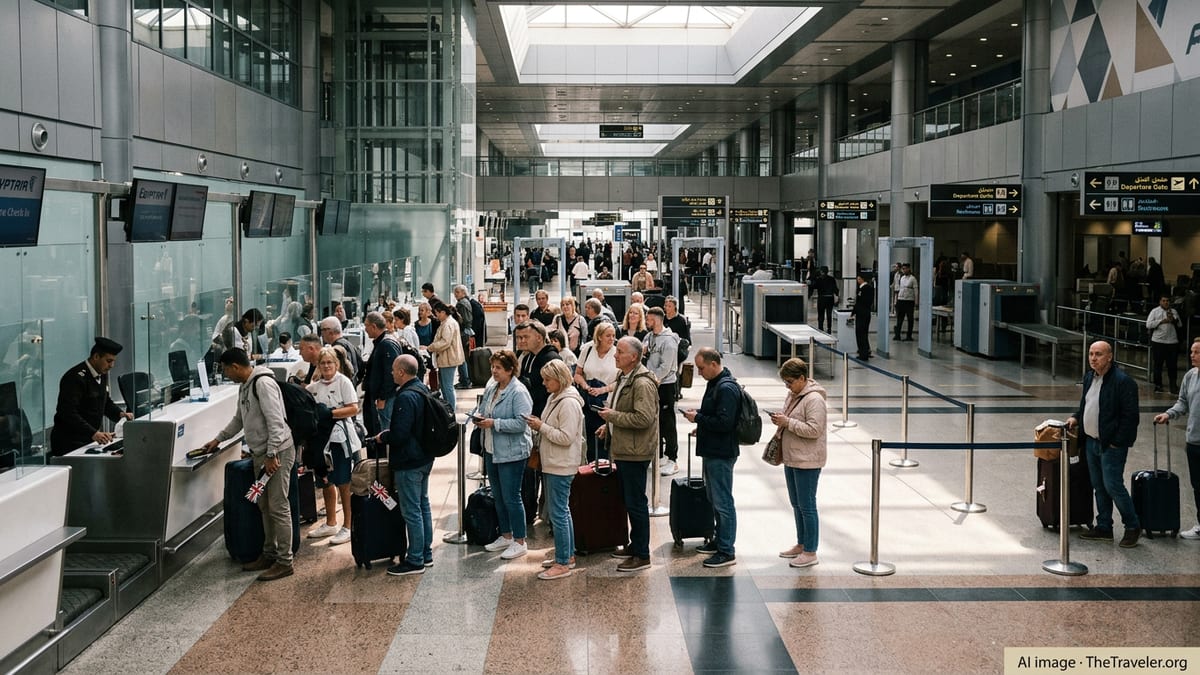
In parallel with the UK advisory shift, Egyptian authorities have quietly tightened on-the-ground procedures aimed at both deterring attacks and managing potential spillover from conflicts in neighbouring states. Security officials at Cairo International Airport and major Red Sea gateways have introduced more frequent secondary screening, manual baggage inspections and questioning for passengers on flights associated with Western carriers and regional hot spots.
Travel industry sources in Cairo report that police and military checkpoints on key highways linking Cairo with Alexandria, the North Coast and Upper Egypt have increased vehicle stops and document checks, particularly for foreign-plated coaches and private transfers used by tour groups. While tour operations continue, some overland itineraries are being re-routed away from sensitive military or energy infrastructure.
Local authorities have also signalled that ad hoc curfews or movement restrictions could be imposed in the event of large demonstrations or security incidents, particularly in central Cairo and around diplomatic districts. British visitors are being advised to carry identification at all times, follow instructions from security personnel and avoid attempting to cross or photograph checkpoints.
High Threat Environment and Insurance Implications for Britons
The UK government continues to warn of a high threat of terrorism affecting British interests worldwide, including in Egypt, and notes that groups hostile to the UK may view British nationals, hotels and airlines as potential targets. Officials stress that even where there is no specific intelligence of an imminent attack, crowded locations such as shopping malls, transport hubs and major tourist sites should be approached with heightened situational awareness.
Insurance implications are emerging as a critical concern for travellers. Many UK-based insurers directly reference Foreign Office travel advice when determining coverage. A move into areas where the UK advises against all but essential travel can invalidate standard policies, leaving travellers personally exposed to medical and repatriation costs. Agents are therefore urging British customers to ensure their itineraries stay within zones rated as permissible for non-essential travel.
Travel companies specialising in Egypt say they have seen a spike in queries from customers who are unsure whether their planned Nile cruises, archaeological tours or diving trips remain covered. Operators are responding by issuing updated maps of permitted regions, offering flexible rebooking options and recommending that clients register their presence with the British Embassy in Cairo in case evacuation or consular support is required at short notice.
Essential Safety Guidelines for British Travellers in Egypt
In response to the shifting risk picture, both British and Egyptian authorities are underscoring a set of practical safety steps for UK visitors. Travellers are being urged to keep copies of passports and visas separate from originals, to share itineraries and contact details with family members at home, and to sign up for government alert services before departure. Hotels in major cities are recommending that guests confirm evacuation routes, identify secure shelter areas and keep a small grab bag of essentials ready in their rooms.
Officials also advise avoiding large public gatherings and political demonstrations, which can form quickly in response to developments in Gaza, Israel or the Gulf. Areas around foreign embassies, military installations and government buildings are considered particularly sensitive. Visitors are being told to maintain a low profile, dress modestly, limit public discussion of regional politics and refrain from photographing security forces, checkpoints or critical infrastructure.
On the transport front, British nationals are encouraged to use reputable tour operators and pre-booked airport transfers, especially on late-night arrivals. Solo travellers are being advised to avoid overnight intercity buses where possible and to sit near other families or groups if they must use public transport. Authorities further recommend carrying some local currency in small denominations, as electronic payment systems could be disrupted by cyber incidents or power cuts linked to regional instability.
Flight Disruptions, Evacuation Planning and Industry Reaction
Beyond Egypt’s borders, airspace closures and military activity across the eastern Mediterranean and Gulf are already reshaping flight paths, with some carriers adding time and cost to avoid sensitive zones. While Egypt’s main international airports remain operational, British travellers are warned that connecting flights through hubs in countries more directly targeted in the Iran crisis are particularly vulnerable to delay or cancellation.
The Foreign Office has highlighted Egypt’s role as a strategic contingency hub, noting that it could be used for evacuation operations should neighbouring states experience a sudden deterioration in security. British nationals in the wider region are being reminded that land or sea routes through Egypt may become critical exit corridors if other options close, and that capacity on such routes could be limited.
The UK travel industry, still recovering from the pandemic and earlier regional shocks, is reacting with a mix of caution and pragmatism. Major tour operators are keeping Egypt on sale but have activated crisis-monitoring teams and are running daily risk assessments in coordination with local partners. For now, holidays are broadly proceeding, yet both officials and operators emphasise that contingency planning, flexibility and close attention to evolving guidance are essential for any British traveller heading to Egypt in the coming weeks.