

More news on this day
A sweeping new U.S. warning urging Americans to “depart now” from 14 countries across the Middle East has triggered confusion and anxiety among travelers, with Egypt emerging as a flashpoint in a region already rocked by escalating conflict involving the United States, Israel, and Iran.
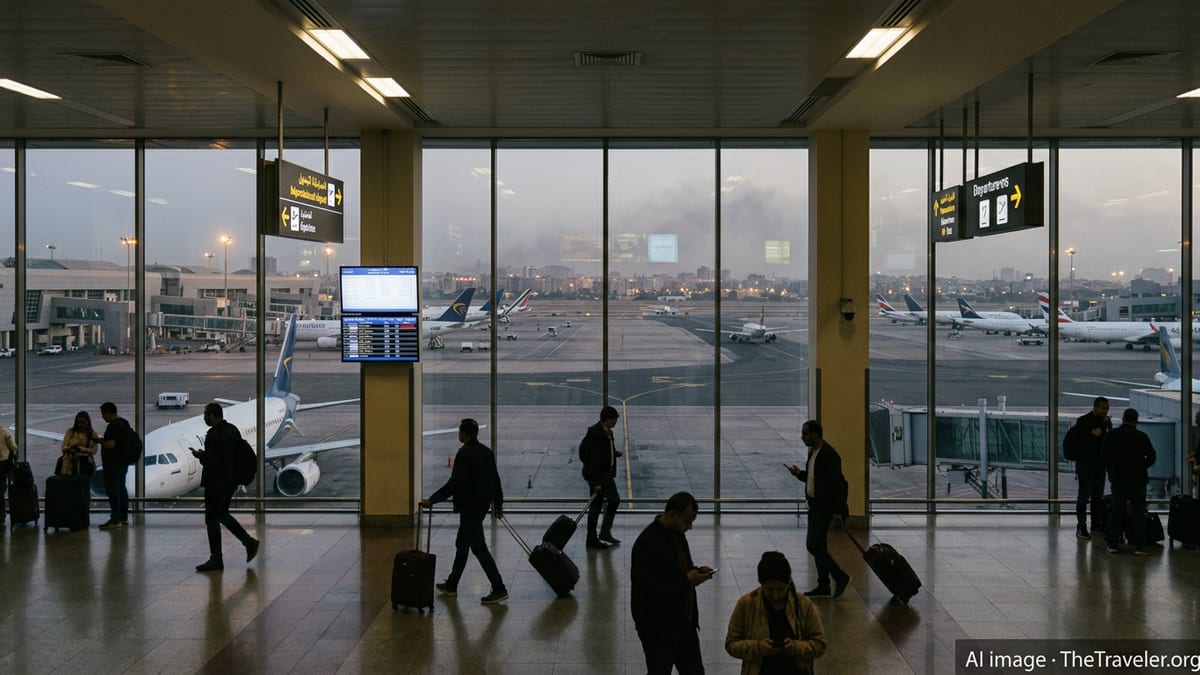
Unusual U.S. Call to Leave 14 Countries
The U.S. State Department’s latest regional messaging goes far beyond standard travel cautions, urging Americans in 14 Middle Eastern countries and territories to leave as soon as commercial options allow. The guidance, amplified by senior officials on social media and in embassy security alerts, reflects what Washington describes as “serious safety risks” tied to fast‑moving military escalation and retaliatory attacks.
Countries covered by the depart‑now guidance include Bahrain, Egypt, Iran, Iraq, Israel, the West Bank, Gaza, Jordan, Kuwait, Lebanon, Oman, Qatar, Saudi Arabia, Syria, the United Arab Emirates, and Yemen. Several of these are already under the State Department’s highest Level 4 “Do Not Travel” advisory, while many others carry Level 3 notices urging travelers to reconsider trips due to conflict, terrorism, and instability.
Officials say the call is precautionary but urgent. The conflict has already disrupted air corridors, forced airport closures, and prompted thousands of Americans to seek a way out, often with little warning as strikes and retaliatory attacks ripple across borders. U.S. authorities acknowledge that formal evacuation options are limited and stress that citizens should not wait for government‑organized flights if commercial seats remain available.
The result is one of the largest and most complex drawdowns of U.S. citizens and diplomatic personnel in the region since the Iraq war era. Charter operations, ad hoc military flights, and overland routes through remaining open border crossings are being pieced together as conditions shift by the day.
Why Egypt Is at the Center of Mixed Signals
Amid the sweeping regional warning, Egypt occupies a uniquely ambiguous position. On paper, its official State Department rating remains at Level 2, “Exercise Increased Caution,” the same overall assessment it carried before the latest Iran crisis. That places it below neighboring states now classified under Level 3 or Level 4 alerts, and U.S. officials have repeatedly underlined that their baseline view of Egypt’s internal security has not materially changed.
Yet Egypt appeared on early lists circulated by U.S. officials and media outlining the 14 countries where Americans were urged to “depart now,” placing Cairo in the same urgent category as active conflict zones. While later clarifications have stressed Egypt’s relatively lower risk, the initial inclusion set off anger among Egyptian officials and confusion among travelers who had been told for months that the country represented a comparative safe haven in a volatile neighborhood.
Cairo has pushed back publicly, insisting that the country remains secure and that tourism infrastructure is functioning normally. Domestic carriers continue to operate most routes and major airports are open, even as regional traffic patterns are disrupted by closures elsewhere. Egyptian leaders have framed the U.S. message as overly broad, arguing that it fails to distinguish adequately between front‑line conflict states and countries, like Egypt, that are primarily dealing with spillover risks.
For travelers and tour operators, the mixed signals are more than a diplomatic dispute. Bookings are being reassessed in real time, insurance policies are under review, and some visitors face a difficult choice between cutting trips short or riding out a tense and uncertain period in a country that Washington still officially labels as one of the region’s more stable destinations.
Escalating Conflict Redraws the Regional Risk Map
The warning comes as U.S. and Israeli strikes inside Iran and large‑scale Iranian retaliation have transformed the security picture across the Middle East in a matter of days. Military operations have targeted bases, ports, energy infrastructure, and in some cases civilian areas, with casualties mounting and political tensions deepening between Washington and regional powers.
Iranian drone and missile attacks on U.S. and allied facilities have been reported in Iraq, Kuwait, and elsewhere, while strikes and air defense activity have affected airspace over several Gulf states. At least some of those countries have temporarily closed airspace or heavily restricted traffic, forcing airlines to cancel or reroute flights and leaving travelers stranded at major hubs.
In this environment, the U.S. sees clustering Americans in any single regional hub as a risk. Consular staff have been thinned out or withdrawn in several countries, and embassies have curtailed routine services to focus on emergency support. Officials describe the regional risk as less a series of isolated flashpoints and more a connected theater where attacks, cyber operations, and disinformation campaigns can jump borders quickly.
The State Department has also reiterated a standing worldwide caution, advising Americans everywhere to be alert to the possibility of retaliatory plots, opportunistic attacks, and protests linked to the conflict. While the most acute dangers are concentrated in the Middle East, security officials say the global threat environment has deteriorated in tandem with developments on the ground.
Practical Impact on Travelers in Egypt and Beyond
For U.S. citizens currently in Egypt, the message from Washington is nuanced but serious. Officials are not calling the country a war zone, and flights in and out of Cairo and other major airports continue to operate. At the same time, Americans are being urged to have an exit plan, monitor embassy alerts, and consider departing sooner rather than later if they lack a compelling reason to stay.
Travel experts note that Egypt’s role as a regional air and logistics hub cuts both ways. Its relatively open airspace and functioning airports make it a critical corridor for those leaving higher‑risk countries, but this also exposes it to knock‑on effects whenever neighboring states restrict flights or when new security incidents prompt sudden schedule changes. Delays, last‑minute cancellations, and route diversions are now common across carriers serving the wider region.
Tourism businesses in Egypt report a spike in inquiries and cancellations following the U.S. depart‑now messaging, particularly from American and European travelers with near‑term departures. Some operators are offering flexible rebooking or refunds, while others warn that abrupt policy shifts and headline‑driven fear could inflict significant damage on a sector that remains vital to Egypt’s economy.
Officials in Washington, for their part, insist the goal is not to single out Egypt but to encourage Americans to act while commercial travel remains feasible. They stress that citizens should be prepared for a scenario in which flight options shrink quickly, consular staff are further reduced, and the U.S. government’s ability to assist is constrained by security conditions on the ground.
How U.S. Citizens Are Being Quietly Steered Out
Behind the public advisories, U.S. officials are using a range of quieter tools to encourage Americans to leave the region. Embassies have pushed out targeted security alerts through the Smart Traveler Enrollment Program, email lists, and messaging channels, emphasizing the need to depart while routes remain open. Consular officers are fielding round‑the‑clock calls from citizens and families seeking guidance, and in some locations are helping connect travelers with airlines or charter options.
Where commercial flights have collapsed or become too risky, U.S. agencies are coordinating limited charter and military transport, particularly from Gulf and Levant states directly affected by strikes. Overland movements through remaining open border crossings into relatively more stable countries, including Egypt and Oman, are also being facilitated in some cases, though officials caution that conditions at land borders can change with little warning.
At the same time, Washington has been careful to underline the limits of what it can provide. Officials repeatedly stress that Americans should not count on large‑scale airlifts if the situation deteriorates further. The message, both publicly and in direct communications, is that personal preparedness, flexible travel planning, and early departure are the best safeguards in a rapidly shifting crisis.
For those still weighing whether to stay or go, the latest warnings underscore how quickly the Middle East’s travel landscape has changed. Egypt may currently stand out as a relative island of stability in State Department advisories, but it is ringed by countries now marked in red, and U.S. officials are signaling that the safest move for many citizens across the region is to head home while they still can.