

More news on this day
Thousands of travelers in Egypt and the United Arab Emirates are grappling with severe disruption after widespread EgyptAir delays and cancellations at Cairo, Hurghada, and Abu Dhabi airports, as a fast-evolving regional conflict continues to upend airspace access and long-haul connections across the Middle East and beyond.
Get the latest news straight to your inbox!
Regional Conflict Triggers Widespread Flight Disruption
Publicly available airspace and security updates show that since early March 2026, the conflict involving Iran, Israel, and regional allies has led to temporary airspace restrictions across parts of the Gulf and wider Middle East, forcing airlines to reroute or suspend flights. Documents circulated to corporate travel managers and risk teams indicate that airspace over the United Arab Emirates, Bahrain, Qatar, Israel, Iran, and Iraq has faced periods of partial or full restriction, disrupting normal east–west traffic flows through the region’s major hubs.
Industry briefings highlight that while Egyptian airspace remains open, airlines operating in and out of Egypt rely heavily on nearby corridors that have been affected by military activity and risk assessments. This combination has created a ripple effect of delays, last-minute schedule changes, and prolonged ground holds at Cairo and Hurghada, as airlines attempt to re-plan routes and manage crew hours while maintaining safety margins around conflict areas.
Abu Dhabi has been particularly affected as a key connecting point between Europe, Africa, Asia, and North America. Reports from aviation risk consultancies and airline communication channels describe an initial suspension of many scheduled departures from Abu Dhabi, followed by a gradual, partial restart of selected routes with altered flight paths, longer block times, and significant knock-on delays for onward connections.
EgyptAir Operations Strained at Cairo and Hurghada
EgyptAir, Egypt’s flag carrier and the dominant airline at Cairo International Airport, has faced mounting operational pressures as it navigates the conflict-related constraints. Travel alerts distributed to multinational companies and travel management firms note that the airline has suspended some regional services and restructured certain long-haul operations, while working within tighter routing options and fluctuating overflight permissions.
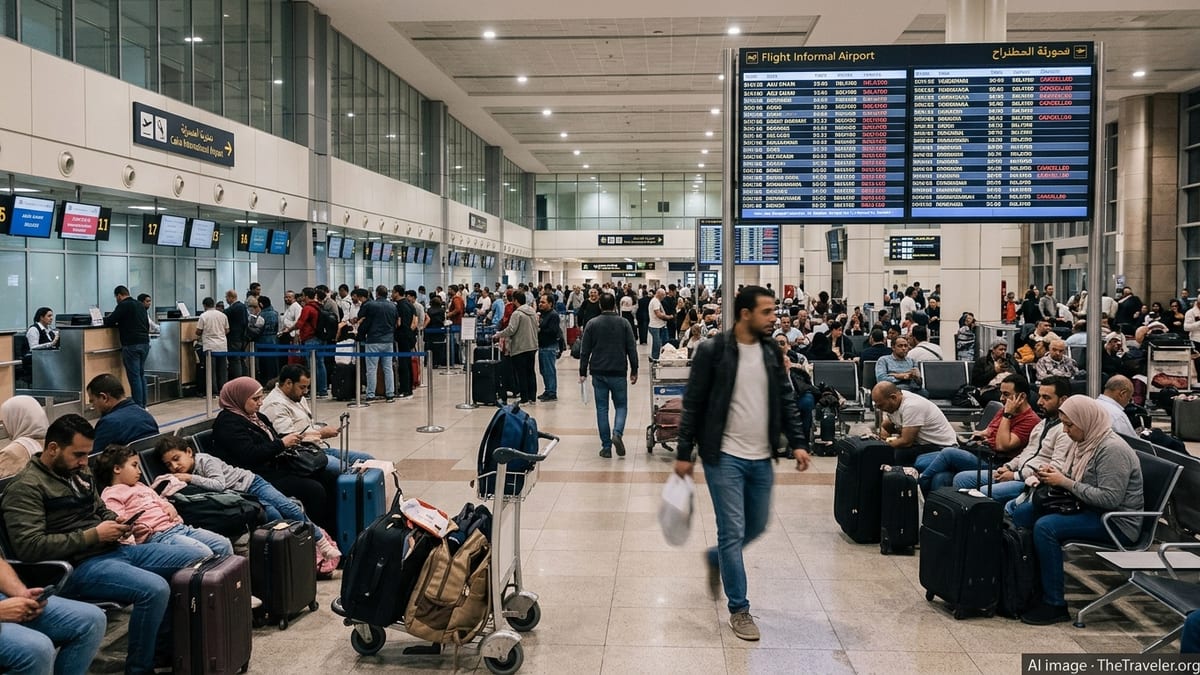
In Cairo, passengers have reported extended waits at departure gates, rolling delay notices, and occasional overnight holds as aircraft and crews are repositioned to comply with flight duty regulations. While the airport remains open and functional, published accounts from travelers and aviation forums point to crowded terminals, busy transfer desks, and dynamic departure boards showing a mix of delayed, retimed, and in some cases cancelled EgyptAir services.
Hurghada, a major Red Sea leisure destination, has also experienced disruption, particularly on routes feeding European and Gulf holiday markets. According to publicly available travel updates, EgyptAir and other carriers serving Hurghada have had to adjust schedules at short notice due to changing routings around conflict zones and the need to prioritize aircraft for core trunk routes through Cairo. This has resulted in stranded tourists facing uncertainty over return flights and limited same-day alternatives.
Abu Dhabi Hub Hit by Suspensions and Slow Recovery
Abu Dhabi’s role as a major international hub means that any airspace restriction or operational pause has far-reaching consequences for connecting passengers. Airline notices shared through travel agencies and passenger communications show that in the first days of March 2026, many scheduled commercial departures to and from Abu Dhabi were temporarily suspended while regional airspace conditions were reassessed.
As limited service resumed, information disseminated via airline schedules and traveler reports indicates that only a defined list of destinations was initially restored, with priority given to routes needed to repatriate stranded travelers and reconnect key markets. Flights between Abu Dhabi and Cairo were among those listed to operate on a restricted basis, but with ongoing delays and irregular timings, leaving many passengers facing long layovers or missed onward connections.
Travel discussion forums reflect the human impact behind these operational decisions, with passengers describing multi-day waits in Abu Dhabi, long queues at airline service desks, and uncertainty over when full schedules will return. Publicly available comments suggest that while some travelers have been rebooked on alternative dates, others have had to arrange accommodation and revised itineraries at their own expense while monitoring evolving flight status updates.
Knock-on Effects Across Routes and Travel Plans
The disruption at Cairo, Hurghada, and Abu Dhabi has had a cascading impact on routes far beyond the immediate conflict zone. With aircraft and crews out of position and flight times extended by detours around restricted airspace, normal turnaround patterns have been interrupted. Travel management advisories warn that passengers flying between Europe and Asia, Africa and North America, or the Indian subcontinent and the Americas via EgyptAir or Gulf hubs may encounter missed connections, rebookings onto later services, or unplanned overnight stays.
Published coverage in international media and corporate travel alerts also notes that other regional airlines have cut capacity or suspended operations on certain routes, limiting re-accommodation options for passengers caught up in the disruption. For travelers booked on EgyptAir itineraries that involve connections through Abu Dhabi, this has increased the risk of being stranded with fewer immediate alternatives, especially during peak travel days when remaining seats are scarce.
Insurance and risk consultants are advising corporate travelers and tour groups to build additional buffer time into itineraries that transit Egypt or the Gulf, and to be prepared for last-minute changes. Some organizations have temporarily paused non-essential travel through the most affected hubs, while leisure travelers are increasingly turning to online communities for up-to-date, ground-level reports on how airports and airlines are coping with the ongoing situation.
What Travelers Can Do if They Are Affected
For passengers already stranded or facing imminent travel through Cairo, Hurghada, or Abu Dhabi, consumer travel guidance emphasizes the importance of closely monitoring official airline channels and airport departure boards, as schedules can change multiple times in a single day. Travelers are being encouraged to check in early, keep boarding passes and booking confirmations readily accessible, and use mobile apps where available to receive real-time notifications about gate changes or retimings.
Specialist travel advisories recommend that passengers review the conditions of carriage and any disruption policies associated with their EgyptAir ticket, paying close attention to rebooking options, hotel or meal coverage in the event of extended delays, and refund eligibility where services are cancelled. Those who booked via online travel agencies or tour operators may need to coordinate with both the airline and their booking intermediary to secure new arrangements.
Looking ahead, risk-focused travel publications suggest that anyone planning trips through the region in the coming weeks should consider flexible or refundable fares where budgets permit, and avoid tight connections that rely on multiple regional legs. Travelers are also urged to keep alternative routing options in mind, such as itineraries that bypass the most affected hubs, while recognizing that capacity on these alternatives may be limited and subject to rapid change as the conflict and related airspace restrictions continue to evolve.