

More news on this day
Travelers moving through Cairo, Hurghada, and Abu Dhabi are facing mounting disruption as EgyptAir operates amid a fast-evolving regional conflict, with widespread delays, cancellations, and last-minute rerouting leaving passengers stranded across Egypt, the United Arab Emirates, and onward long-haul networks.
Get the latest news straight to your inbox!
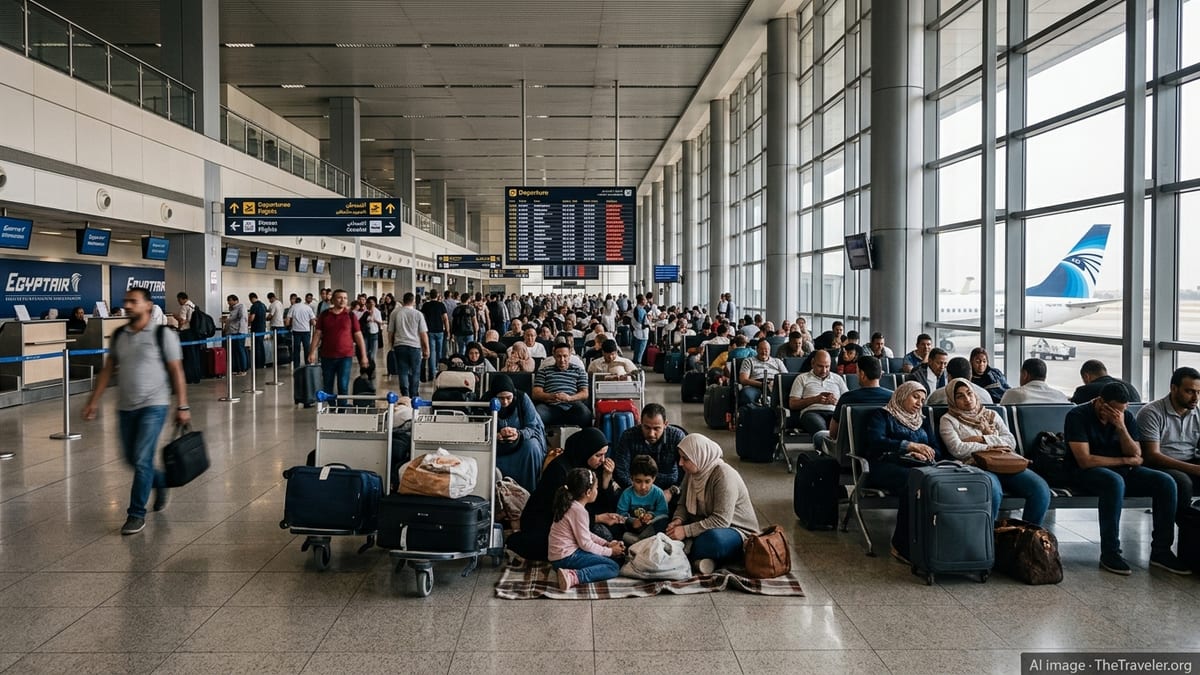
Regional Conflict Pushes EgyptAir Networks to Breaking Point
Publicly available security and aviation briefings show that the recent escalation in the Iran conflict has reshaped airspace and flight patterns across the Middle East, placing intense pressure on carriers still operating, including EgyptAir. As major Gulf hubs temporarily reduced or suspended services, Egypt’s airspace and airports have absorbed a surge in diverted and re-routed traffic, amplifying existing bottlenecks on EgyptAir’s hub-and-spoke network.
Advisories issued in early March indicate that airspace closures and war-risk restrictions around parts of the Gulf have forced airlines to redraw routes, lengthen flight times, and in some cases suspend links altogether, particularly to the United Arab Emirates, Qatar, and other high-risk destinations. EgyptAir’s schedules linking Cairo to Gulf cities such as Dubai, Abu Dhabi, Sharjah, Doha, and Kuwait have been especially vulnerable to these shifts, with entire rotations scrubbed from timetables or placed under rolling review.
One recent shipping and aviation operations bulletin noted that EgyptAir had suspended multiple routes from Cairo to key Gulf destinations until further notice, a move that effectively cut off normal connectivity for thousands of travelers who rely on the airline for transit between Africa, Europe, the Middle East, and Asia. These suspensions, layered on top of longer routings required to avoid conflict zones, have sharply reduced capacity at the very moment demand for evacuation, repatriation, and essential travel is surging.
Analysts tracking the regional impact of the conflict say the disruption now rivals the early months of the pandemic in terms of network instability, with EgyptAir contending not only with its own operational constraints but also with knock-on effects from grounded or delayed partner and feeder flights across the broader Middle East.
Cairo Airport Buckles Under Wave of Disruption
Cairo International Airport, EgyptAir’s primary hub, has emerged as a critical pressure point in this unfolding travel crisis. As neighboring Gulf airports curtailed operations, carriers have increasingly routed flights through Egyptian airspace, turning Cairo into a staging ground for diversions, emergency repositioning of aircraft, and ad hoc evacuation movements.
Travel advisories and passenger accounts indicate that the result has been prolonged queues at check-in and transfer desks, congested security lines, and departure boards filled with rolling delays and cancellations. EgyptAir’s published contingency planning documents emphasize a commitment to minimizing tarmac times and preventing excessive delays, but the current environment is testing those safeguards as aircraft and crew are frequently out of position due to late inbound operations.
Passengers transiting Cairo report missed connections on multi-leg itineraries, particularly for long-haul journeys to Europe and North America that depend on precise timing of domestic and regional feeder flights. With many Gulf routes curtailed and some neighboring carriers operating on skeleton schedules, rebooking options are limited, leaving travelers stuck airside for extended periods while they wait for a seat on the next available departure.
Although Egypt remains geographically outside the immediate combat zone, its role as an alternate corridor for flights avoiding conflict-affected skies has pushed Cairo’s infrastructure to its limits. Industry observers note that even minor schedule adjustments can cascade into widespread disruption when an already busy hub absorbs additional traffic at short notice.
Hurghada Feels the Ripple Effect on Red Sea Tourism
Hurghada International Airport, a key gateway for Red Sea resorts and package tourism, is also feeling the strain as EgyptAir and other carriers juggle aircraft availability and shifting demand. While Hurghada is far from the front lines of the conflict, disruptions to Cairo connections and Gulf feeder routes are filtering down to leisure travelers who rely on smooth domestic or regional links.
Reports from tour operators and travelers suggest that some EgyptAir flights between Hurghada and Cairo have been delayed or retimed at short notice to accommodate aircraft rotation pressures and crew duty limits. When Cairo-bound services depart late, onward connections to Europe, the Gulf, or other African destinations can easily be missed, forcing holidaymakers into unexpected overnight stays or complex rebookings.
International charter and low-cost carriers serving Hurghada have also had to adjust routings to avoid sensitive airspace, extending flight times and narrowing turnaround windows. This leaves limited slack in daily schedules; any delay on an inbound leg can quickly translate into knock-on disruption for outbound departures, including those that rely on shared ground handling resources with EgyptAir.
For the Red Sea tourism sector, the timing is particularly challenging. The late winter and early spring period traditionally brings strong European demand, and the current pattern of irregular operations is complicating transfer logistics, airport-hotel coordination, and customer service planning for local travel providers.
Abu Dhabi Disruptions Compound Strain on EgyptAir Passengers
In the United Arab Emirates, Abu Dhabi International Airport has been heavily affected by regional airspace closures and rerouting, with ripple effects for EgyptAir passengers who depend on links between Egypt and the UAE for work, family visits, and onward long-haul travel. Publicly available travel advisories describe a pattern of reduced frequencies, schedule reshuffles, and in some cases cancellations on routes touching the Emirati capital.
As Gulf carriers trimmed operations in response to missile and drone risks, EgyptAir’s own flights to Abu Dhabi have faced a combination of direct cancellations and indirect disruption via delayed arrivals, altered routings, and congested approach corridors. Travelers with itineraries connecting EgyptAir flights to services operated by partner or codeshare airlines in Abu Dhabi have been particularly vulnerable to missed onward connections when inbound legs from Cairo or Hurghada fail to arrive on time.
Passenger reports from Abu Dhabi describe long waits at transfer and ticketing counters, with limited real-time information and high demand for remaining seats on any flight still operating to Cairo or other Egyptian cities. As some regional airlines prioritize evacuation and essential travel, discretionary or leisure bookings have sometimes been pushed back, leaving tourists and business travelers scrambling to reconfigure their plans.
This dynamic has created a feedback loop in which disruption in Abu Dhabi complicates scheduling back in Cairo and Hurghada, as aircraft and crew are delayed or stranded outside Egypt, further constraining EgyptAir’s ability to restore regular operations across its regional network.
What Stranded Travelers Need to Know Right Now
For passengers caught up in the current wave of disruption, publicly available guidance from risk consultancies, embassies, and airline notices converges on several key points. First, flight status can change with little warning as airspace advisories are updated, so travelers are urged to monitor their booking directly with the operating carrier and to allow substantial extra time for airport formalities, especially at Cairo and Abu Dhabi.
Second, EgyptAir’s own customer documents explain that not all causes of delay are within the airline’s control, particularly when they relate to security restrictions, airport congestion, or regulatory decisions. In the present context, many of the longest disruptions are linked to external factors such as military activity, airspace closures, and restrictions on flying over or into certain territories, which can affect compensation and rebooking rules depending on jurisdiction.
Third, travelers whose journeys involve multiple carriers or transit points in the Gulf are particularly exposed to cascading changes. Travel advisories highlight that a cancellation or reroute on a single segment, such as an EgyptAir leg into Abu Dhabi or Dubai, can nullify onward reservations if tickets are not issued on a single booking reference or if minimum connection times are no longer met under revised schedules.
Finally, risk analysts caution that volatility in the region is likely to persist in the short term as the conflict and associated sanctions, insurance conditions, and regulatory responses evolve. While EgyptAir and other carriers continue to adjust their timetables, passengers planning trips through Cairo, Hurghada, Abu Dhabi, or other Middle Eastern hubs in the coming days should be prepared for last-minute changes, potential overnight disruption, and the need to maintain flexible, fully documented travel arrangements.