

More news on this day
As airspace closures ripple across the Middle East following a sharp military escalation, EgyptAir is keeping critical long-haul connections to Europe, Africa, and Asia in the air even as much of its regional network remains grounded.
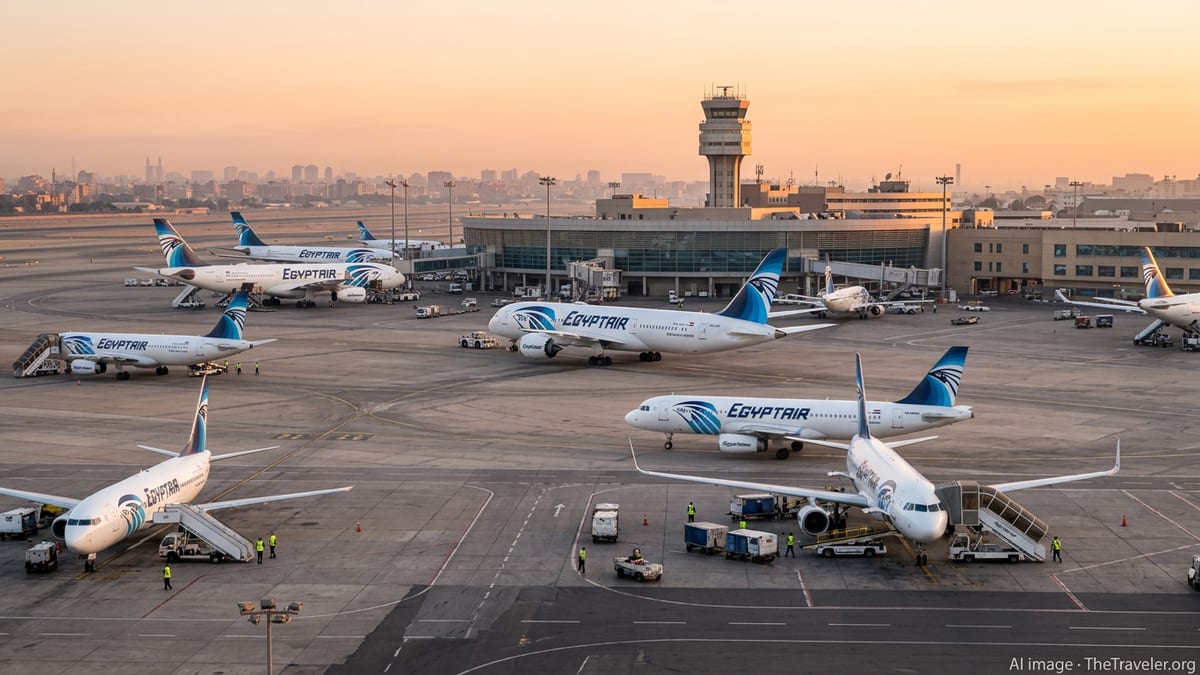
Regional Shutdowns Hit EgyptAir’s Neighborhood, Not Its Global Spine
Egypt’s national carrier has been forced to halt flights to at least 11 major Middle Eastern cities, including Dubai, Abu Dhabi, Doha, Kuwait, Amman, Beirut, Baghdad, and Erbil, after neighboring states moved to close or restrict their airspace in late February and early March. The suspensions, confirmed in successive statements by the airline and government-affiliated outlets, are open-ended and framed explicitly as safety precautions in response to the deteriorating security picture around the Gulf and the Levant.
While regional rivals such as Emirates, Etihad, Qatar Airways, Air Arabia, and Gulf Air have extended broad flight suspensions as hubs from Dubai to Doha reel from missile and drone activity, Egyptian airspace itself remains fully open. Aviation advisories note that Cairo’s skies are among the few in the region still operating normally, even as carriers are compelled to avoid multiple neighboring flight information regions.
That distinction has allowed EgyptAir to pull back sharply from volatile near‑by markets while maintaining what executives describe internally as the “global spine” of the network: trunk routes that connect Cairo with major cities across Europe, Africa, and Asia. These flights are operating with rerouted tracks where necessary but remain largely intact, preserving Egypt’s role as a bridge between continents at a moment when traditional Gulf hubs are heavily constrained.
Industry analysts say the twin realities of closed regional corridors and open domestic airspace have pushed EgyptAir into an unusual position. The carrier has lost some of its most profitable short‑haul routes to Gulf capitals, yet suddenly finds its long‑haul schedule more strategically important than at any point in recent memory.
Essential Links to Europe, Africa, and Asia Reworked but Intact
According to aviation briefings issued over recent days, EgyptAir’s priority has been to safeguard connections from Cairo to key European gateways such as London, Paris, Frankfurt, Rome, and Istanbul, along with high‑demand African destinations including Addis Ababa, Nairobi, Lagos, and Johannesburg. Services to major Asian cities, particularly in the Indian Subcontinent and Southeast Asia, are also being protected wherever viable routings can be found that bypass conflict‑affected airspace.
To keep those flights operating, dispatch teams at EgyptAir’s Integrated Operations Control Center in Cairo are replotting routes on a rolling basis. With large swathes of airspace above Iran, Iraq, Israel, Jordan, Kuwait, Qatar, and parts of the Gulf effectively off limits, many long‑haul services are being pushed further west or south, adding flight time and fuel burn but keeping aircraft and passengers clear of restricted zones.
Operational data shared by regional regulators suggests that this tactical rerouting is similar to adjustments seen during earlier crises that disrupted traffic over the Black Sea and parts of Eastern Europe. In practice, it means some EgyptAir flights to northern Europe are tracking more directly over the Mediterranean, while services bound for East and Southeast Asia are leaning more heavily on corridors over Saudi Arabia’s still‑open east–west spine and Egyptian or African coastal routes.
Travel agents in Cairo and Alexandria report that, while schedules remain volatile and day‑to‑day changes are frequent, EgyptAir’s presence on core intercontinental routes has been more stable than that of many Gulf competitors. With some Middle Eastern carriers grounding large portions of their fleets, Egyptian flights to Europe and Africa are increasingly being used as alternative legs for travelers forced to redesign their journeys around the unfolding crisis.
Cairo Emerges as a Diversion Hub for Displaced Passengers
For passengers suddenly cut off from Gulf hubs, Cairo is turning into an important staging point. Civil aviation officials in Egypt say airports nationwide activated contingency plans as the airspace closures began, focusing on passenger care and rapid schedule adjustments. With Dubai, Abu Dhabi, and Doha facing extended shutdowns or severe capacity restrictions, travelers who might once have routed east–west through the Gulf are being rebooked through Cairo on a mix of EgyptAir and partner airlines.
Ground staff report crowded terminals and long queues at transfer desks, but also note that Egypt’s airports are functioning without the runway closures and direct strike damage seen elsewhere in the region. That relative stability is enabling EgyptAir to accommodate a steady stream of diverted travelers, even as it cancels or consolidates flights to the very cities where many of those passengers began their journeys.
For tourism operators, the shift is abrupt. Egypt had spent recent seasons marketing easy one‑stop access via Gulf hubs to resort cities on the Red Sea and cultural centers like Luxor and Aswan. With those hubs now compromised, Cairo’s role as both a point of origin and a transfer node has come back into sharp focus. Several inbound operators say they are advising clients to rely on EgyptAir’s direct services from Europe and Africa rather than attempting more complex itineraries through the Gulf in the near term.
At the same time, hotel and airport authorities concede that the current inflow is not the kind of traffic they would normally seek. Many diverted passengers are simply trying to get home, staying only as long as it takes to secure a new onward flight. For Cairo, the challenge is to manage the surge without overwhelming infrastructure or eroding the travel experience that tourism officials have worked to improve.
Inside EgyptAir’s Crisis Room and Operational Playbook
EgyptAir executives say their crisis‑management structure, honed during the pandemic and previous regional flare‑ups, is now being tested at an entirely new scale. The airline’s Integrated Operations Control Center, described by officials as operating in emergency mode, is manned around the clock by flight dispatchers, safety experts, crew planners, and liaison officers from Egypt’s civil aviation authority.
From that hub, teams monitor real‑time intelligence on missile launches, air defense activity, and new regulatory notices from states across the Middle East and beyond. Flight plans for Europe, Africa, and Asia are being signed off only after cross‑checking against the latest airspace warnings. In some cases, departures are delayed on the tarmac while crews wait for updated routings that skirt emerging hotspots.
The airline is also juggling the knock‑on effects of grounded regional routes. Aircraft and crews that would normally rotate through Gulf or Levant stations are being reassigned to long‑haul sectors or short‑haul services within Egypt and to unaffected African markets. This dynamic scheduling is intended to keep as much of the remaining network as possible operating reliably, even as specific city pairs go dark for days at a time.
Internally, EgyptAir is emphasizing that safety remains the primary filter for every decision. Officials stress that potential revenue from maintaining a route will not override security assessments made in coordination with international aviation bodies. The carrier’s public statements have consistently framed the suspensions as precautionary, even as passengers and corporate clients push for clarity on when regular Middle East schedules might return.
What Travelers Should Expect in the Coming Days
For travelers holding EgyptAir tickets in the near term, the message from both the airline and travel industry experts is to stay flexible and informed. Essential connections to Europe, Africa, and Asia are still operating, but flight times, routings, and even departure dates may change with little notice as governments update their airspace restrictions.
Passenger advocates advise arriving at the airport earlier than usual, building in additional connection time, and being prepared for last‑minute rebookings. While EgyptAir has avoided the wholesale shutdowns seen at some Gulf carriers, it is still exposed to the same regional volatility that has produced thousands of cancellations and diversions across the wider network of Middle East and global airlines.
In the medium term, analysts expect Cairo’s status as a safe and open airspace corridor to keep demand for EgyptAir’s long‑haul services elevated, particularly from travelers who might once have defaulted to transiting via Dubai or Doha. Much will depend, however, on how long neighboring states keep their skies closed and whether the current conflict spills into new theaters that could complicate routing options over the Mediterranean or North Africa.
For now, EgyptAir’s resilience rests on a fragile balance: an operational bubble of relative normality inside Egypt, ringed by some of the most complex airspace shutdowns the modern aviation industry has seen. As long as that bubble holds, the carrier will remain a rare constant for travelers trying to move between Europe, Africa, and Asia in a region where the skies have suddenly become far less predictable.