

More news on this day
EgyptAir’s suspension of multiple Gulf routes amid wider Middle East airspace restrictions has triggered at least 15 flight cancellations and 13 significant delays across Cairo, Dubai, Abu Dhabi, Bahrain, Riyadh and other hubs in recent days, stranding hundreds of passengers and adding fresh turmoil to an already fragile regional aviation network.
Get the latest news straight to your inbox!
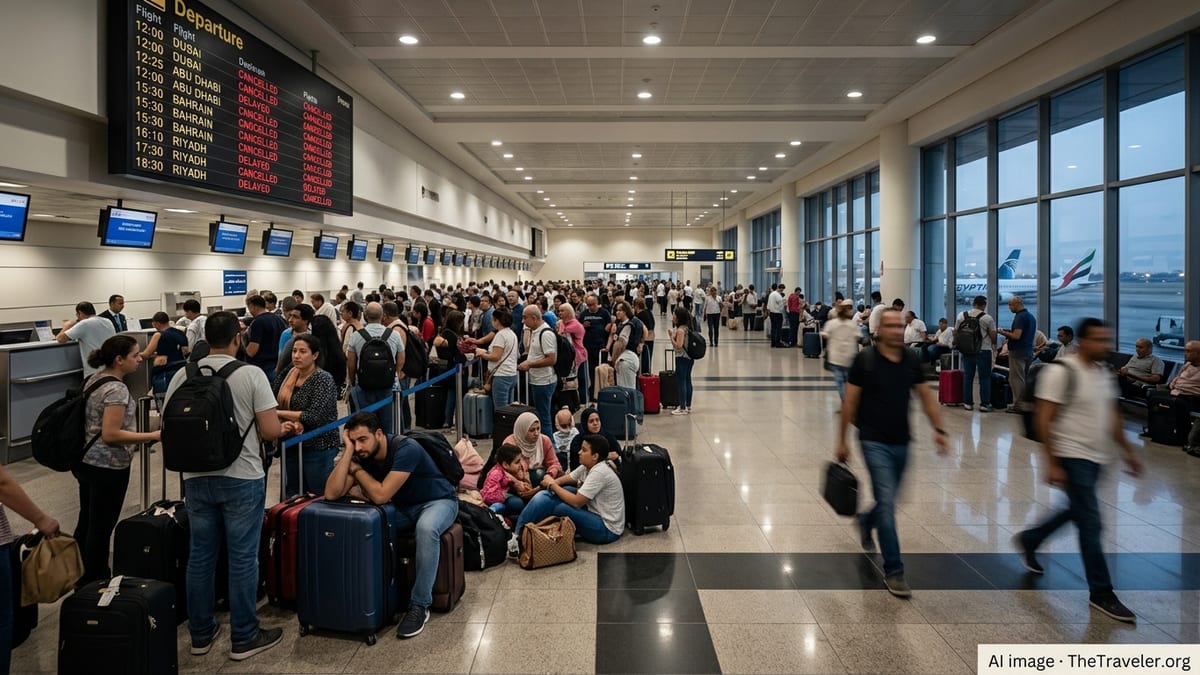
EgyptAir Pulls Back From Gulf Destinations Amid Mounting Risks
Publicly available airline and advisory notices in early March 2026 show that EgyptAir has suspended services from Cairo to several high risk destinations, including Dubai, Abu Dhabi, Sharjah, Doha, Amman, Dammam, Bahrain, Baghdad, Erbil and Kuwait until further notice. The move is framed as a response to deteriorating airspace conditions and evolving security assessments, rather than a conventional commercial schedule adjustment.
The targeted routes are among EgyptAir’s busiest regional links, funnelling traffic between North Africa and key Gulf gateways. Their suspension has immediately removed capacity on corridors that also serve as vital connections for Europe to Asia itineraries, concentrating pressure on the few remaining flights still operating in and out of Cairo.
In practice, these suspensions have translated into a cascade of cancellations and rolling delays. Industry trackers and airport departure boards across the region indicate that, on some days this month, EgyptAir alone accounted for at least 15 outright cancellations and 13 delayed departures or arrivals on routes touching Cairo, Dubai, Abu Dhabi, Bahrain and Riyadh, as the carrier repeatedly recalibrated operations in line with shifting airspace restrictions.
While those figures represent only a snapshot in a fast moving situation, they illustrate how a single airline’s network decisions can amplify wider disruption once a region’s airspace becomes fragmented. For passengers, the impact is measured in missed connections, unplanned stopovers and uncertainty about when regular schedules might resume.
Airspace Closures Ripple Across the Gulf
The EgyptAir cutbacks are unfolding against a backdrop of unprecedented airspace disruption across the Middle East. Since late February 2026, a series of military escalations and missile exchanges has prompted countries including the United Arab Emirates, Qatar, Bahrain, Kuwait, Iraq and Israel to impose tight restrictions or outright closures on portions of their airspace to civilian traffic. Aviation alerts and port advisories describe conditions as highly degraded, with routings changing day to day.
In the United Arab Emirates, Dubai International and Abu Dhabi’s Zayed International have seen normal commercial operations drastically reduced. Reports from airport operators and travel management briefings note that departures from Abu Dhabi were suspended for extended periods, while Dubai’s main hub periodically diverted inbound flights to secondary airports such as Dubai World Central when threats intensified.
Bahrain, another crucial node in the Gulf network, has been hit particularly hard. The country’s airspace has been subject to repeated closures and restrictions, leading its national carrier Gulf Air to keep regular passenger operations largely grounded and to reposition aircraft to airports in neighbouring Saudi Arabia. When Bahrain airspace shuts, regional flows between Saudi Arabia, Qatar, the UAE and beyond are forced into longer detours or halted altogether.
These closures have a compounding effect on airlines still attempting to maintain skeletal schedules. Even where a specific route remains technically open, aircraft and crews are often out of position because of previous diversions, while longer flight paths around closed zones add to fuel costs and scheduling complexity. The result is a rolling pattern of last minute cancellations and lengthy delays, with EgyptAir’s disrupted flights to and from Cairo fitting into a much wider tapestry of interrupted journeys.
Stranded Passengers Face Long Waits and Patchwork Solutions
For travellers caught in the middle of this turbulence, the numbers translate into hours or days in airport terminals. Social media accounts, passenger forums and photos from Cairo, Dubai and other hubs show crowded departure halls and improvised sleeping areas, as people wait for clarity on whether their flights will depart, divert or be scrubbed entirely.
Some passengers report being deboarded after lengthy tarmac waits when security conditions changed mid turnaround, echoing scenes across the region as airlines respond to rapidly updated airspace notices. Others describe being rerouted via secondary airports, including Dammam, Muscat or Jeddah, in an effort to bypass closed corridors and reach final destinations by piecing together multi segment alternatives.
In Cairo, the impact has been particularly acute for travellers booked on EgyptAir’s suspended Gulf routes who were relying on those flights to connect onward to Asia or Europe. With limited spare capacity on remaining services and other carriers also trimming schedules, rebooking options can be scarce, especially for those on tightly timed itineraries or non flexible tickets.
Travel advisories urge passengers not to proceed to airports in the region unless they have written confirmation that their specific flight is operating, citing crowded terminals and overstretched staff. Airlines, including EgyptAir and major Gulf carriers, have published waivers allowing date changes or refunds in many cases, but passengers often still face extended waits on customer service channels to secure new arrangements.
Why the Disruptions Matter Far Beyond the Region
The immediate impact is most visible in the Middle East’s own hubs, yet the consequences of airspace closures and route suspensions reach far beyond Cairo, Dubai or Bahrain. Gulf and Levantine airports function as critical bridges between Europe, Africa and Asia; when those bridges are compromised, global aviation feels the strain.
With swathes of airspace closed or considered unsafe, long haul carriers are replotting paths around the Gulf, Iran and Iraq, adding significant distance and time to flights that once took advantage of direct great circle routes. Analysts note that some Europe to Asia services are now bending south over the Arabian Sea or north via Turkey and the Caucasus, which increases fuel burn, narrows schedule buffers and reduces aircraft availability for other rotations.
Air cargo is equally affected. Container tracking and freight advisories show that shipments usually moving through Gulf hubs are being rerouted through alternative airports or even shifted to maritime channels where possible. For time sensitive goods, especially pharmaceuticals and high value components, longer transit times and less predictable schedules translate into higher costs and potential supply chain bottlenecks.
Against this backdrop, EgyptAir’s cancellations and delays are a microcosm of a broader reordering of regional connectivity. Each grounded flight removes capacity from a mesh of routes that underpin tourism, labour migration and trade. For travellers, the most immediate concern is simply getting home or reaching a planned destination, but for airlines and governments the challenge is how to restore reliable corridors once the security situation stabilises.
What Travellers Should Watch in the Coming Days
Conditions remain fluid as of March 20, 2026, and most observers expect further fluctuations in flight schedules across the Middle East in the short term. Industry bulletins advise that airspace restrictions may tighten or ease with little notice, depending on the regional security picture, which means that today’s operating route can become tomorrow’s cancellation with only a few hours’ warning.
Travellers holding tickets on EgyptAir, Gulf carriers or international airlines routing through Cairo, Dubai, Abu Dhabi, Bahrain, Riyadh or Doha are being urged by published advisories to monitor their booking status closely via official airline channels. The general guidance is to verify flight status on the day of travel and to be prepared for schedule changes, diversions or overnight stays if conditions deteriorate while in transit.
Flexible itineraries are proving particularly valuable in this environment. Many carriers have introduced temporary change fee waivers and fare difference relaxations for flights touching affected airports between early and late March, giving passengers more leeway to rebook to later dates or alternative gateways. However, these policies vary by airline and fare type, so careful reading of conditions is essential.
For now, EgyptAir’s 15-plus cancellations and dozens of delays underscore how exposed the region’s aviation system is to geopolitical shocks. Until airspace across the Gulf and neighbouring states stabilises and airports can safely restore regular flows, travellers planning to transit through the Middle East should expect continued uncertainty and build contingency time into any essential journeys.