

More news on this day
EgyptAir’s first Airbus A350-900 has entered service as the Egyptian flag carrier’s new long-haul flagship, coupling the airline’s hospitality traditions with a high-tech cabin aimed at raising its global profile.
Get the latest news straight to your inbox!
A Next-Generation Flagship for North Africa
Publicly available information shows that EgyptAir took delivery of its first Airbus A350-900 in February 2026, becoming the launch operator for the type in North Africa. The aircraft is the first of 16 A350-900s scheduled to join the carrier’s widebody fleet over the next several years, underpinning a broader renewal strategy focused on fuel efficiency and improved passenger comfort.
According to Airbus data, the twin-engine A350-900 is designed for long-haul missions with lower fuel burn compared with previous-generation widebodies, aided by a composite fuselage and advanced Rolls-Royce Trent XWB engines. For EgyptAir, the type is positioned to serve key intercontinental markets from Cairo and to open thinner routes where a smaller, efficient aircraft can operate profitably.
Industry coverage indicates that EgyptAir’s A350-900s are being configured with around 340 seats in a two-class layout, aligning with earlier fleet plans disclosed at the Dubai Airshow in 2023 and subsequent order updates in 2025. The airline is expected to introduce the aircraft progressively on long-haul routes where demand and range requirements make the A350-900 a compelling replacement for older models.
Cabin Layout Blends Space, Calm and Cultural Cues
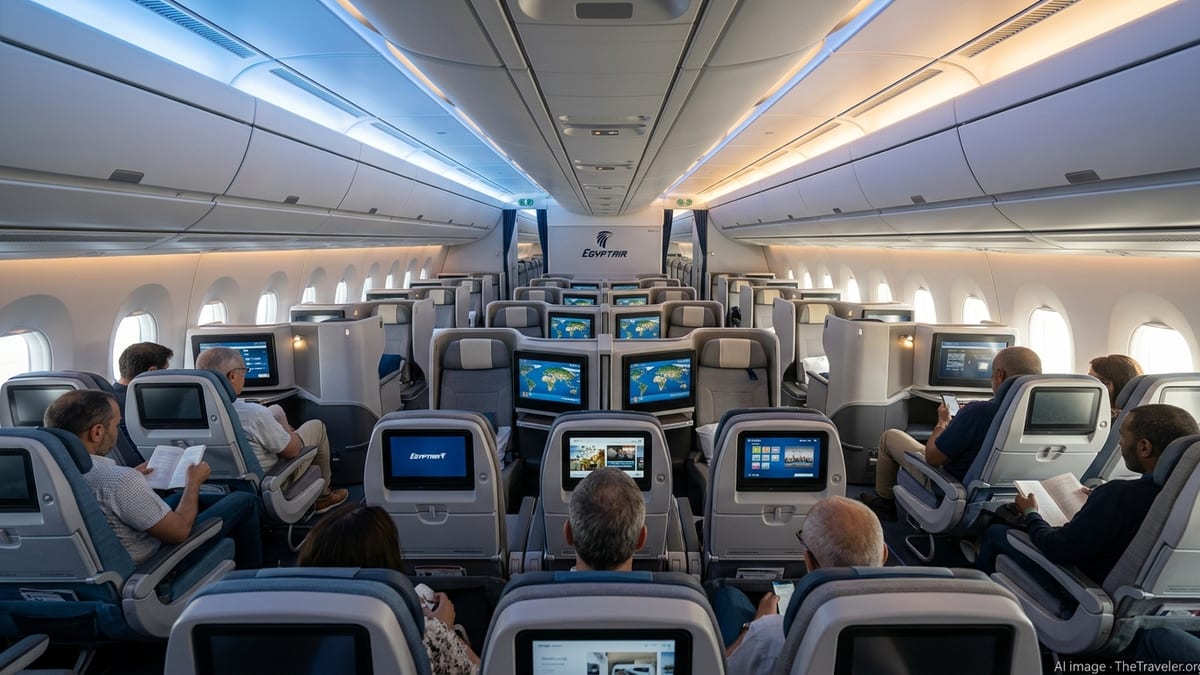
Reports on the initial delivery highlight a cabin organized into 30 business class suites and 310 economy seats, reflecting a high-capacity yet relatively spacious configuration for the A350-900. All business class seats feature direct aisle access, a key benchmark in contemporary long-haul premium cabins. The suite-style layout offers lie-flat beds, privacy partitions and sizable personal storage areas intended to appeal to both business and leisure travelers.
The wider Airspace cabin design used on EgyptAir’s A350-900 aims to create a calmer onboard environment. The fuselage cross-section allows for wider seats and aisles, while sculpted sidewalls and larger windows contribute to a more open feel. The cabin also benefits from lower noise levels, which are a hallmark of the A350 family and particularly noticeable compared with older twin-aisle types that EgyptAir has operated.
Visual touches in early imagery and descriptions point to an effort to weave Egyptian identity into the interior without overwhelming the clean, modern aesthetic. Color palettes appear to favor muted neutrals accented with blues and gold tones, referencing the airline’s branding and the country’s cultural heritage. Subtle patterns and textures in fabrics and bulkhead designs echo motifs associated with Egyptian art and architecture, offering a sense of place as travelers cross continents.
High-Tech Comfort: Air Quality, Lighting and Entertainment
The A350-900 platform introduces a series of technical upgrades aimed at passenger well-being, many of which are now present in EgyptAir’s new flagship. The aircraft’s environmental control system circulates and filters air more frequently than on older models, with humidity levels maintained at more comfortable settings for long flights. These systems, combined with a lower pressurization altitude made possible by composite construction, are designed to reduce feelings of jet lag and fatigue.
EgyptAir’s A350-900 cabins are also equipped with advanced LED mood lighting capable of gradual color and intensity changes. This allows the airline to tailor lighting sequences to boarding, meal services and rest periods, as well as to simulate sunrise and sunset transitions that align more closely with passengers’ destination time zones. Such lighting strategies have become a signature feature of next-generation widebodies and are expected to play a prominent role in EgyptAir’s onboard experience narrative.
In-seat technology is another focal point. Seatback screens in both cabins provide high-definition entertainment systems with an expanded catalog of films, television and music, reflecting EgyptAir’s intention to modernize its digital offering. Power outlets and USB charging points are available at every seat, while connectivity solutions, including onboard Wi-Fi, are planned to support messaging and limited browsing where coverage and regulatory conditions allow.
Hospitality Traditions Reimagined at 35,000 Feet
EgyptAir has long positioned itself as an ambassador of Egyptian hospitality, and the A350-900 gives the airline a fresh platform to reinterpret that identity for a global audience. Publicly available descriptions of the new flagship suggest a focus on warm service paired with greater privacy and personal control. For example, business class suites provide adjustable partitions and individualized lighting, giving passengers more autonomy over how social or secluded they wish their space to feel.
Catering on long-haul flights is expected to highlight both international dishes and Egyptian favorites, reflecting the carrier’s dual role as a connector of global cities and a national airline. The larger galleys and optimized workflow of the A350-900 are designed to help cabin crews manage multiple meal services more efficiently, potentially improving consistency in both timing and presentation on extended sectors.
The airline’s adoption of high-tech features does not eliminate traditional gestures of welcome that many travelers associate with Middle Eastern and North African carriers. Instead, the technology is framed as a way to support those elements: quieter cabins for more relaxed conversations, better lighting for a calmer service atmosphere and intuitive seat controls so crew can spend more time on hospitality and less on troubleshooting hardware.
Strategic Role in Egypt’s Tourism and Connectivity Push
EgyptAir’s A350-900 program is closely tied to broader national ambitions to strengthen Egypt’s role as both a tourism destination and a connecting hub between Africa, the Middle East, Europe and the Americas. Industry analysis notes that the aircraft’s long range and lower operating costs give EgyptAir more flexibility in scheduling nonstops to North America, Asia and key European markets, especially on routes that may not yet justify larger widebodies.
The fleet plan, which calls for 16 A350-900s to be introduced over several years, is expected to support a gradual phase-out of some older widebody types and to complement existing Boeing 787 operations. This combination of efficient twin-engine aircraft positions EgyptAir to adjust capacity more nimbly as demand evolves, while offering a more uniform standard of onboard product for long-haul travelers.
For Egypt-bound visitors, the new flagship may also influence perceptions of the journey itself. A quieter, brighter and more tech-forward experience en route to Cairo can set a different tone for trips that include cultural tourism along the Nile, Red Sea resorts or regional business travel. As more A350-900s join the fleet and appear on additional routes, the aircraft is likely to become a key symbol of how EgyptAir seeks to blend its heritage of hospitality with the expectations of modern, globally connected passengers.