

More news on this day
Egypt’s decision to raise entry visa costs and press ahead with stricter, more digitized border rules for 2026 is sending ripples through Middle East travel markets, adding new hurdles for visitors from Saudi Arabia, Bahrain, the UAE, Kuwait, Qatar, Oman, Jordan and beyond who rely on Egypt as both a destination and a key regional hub.
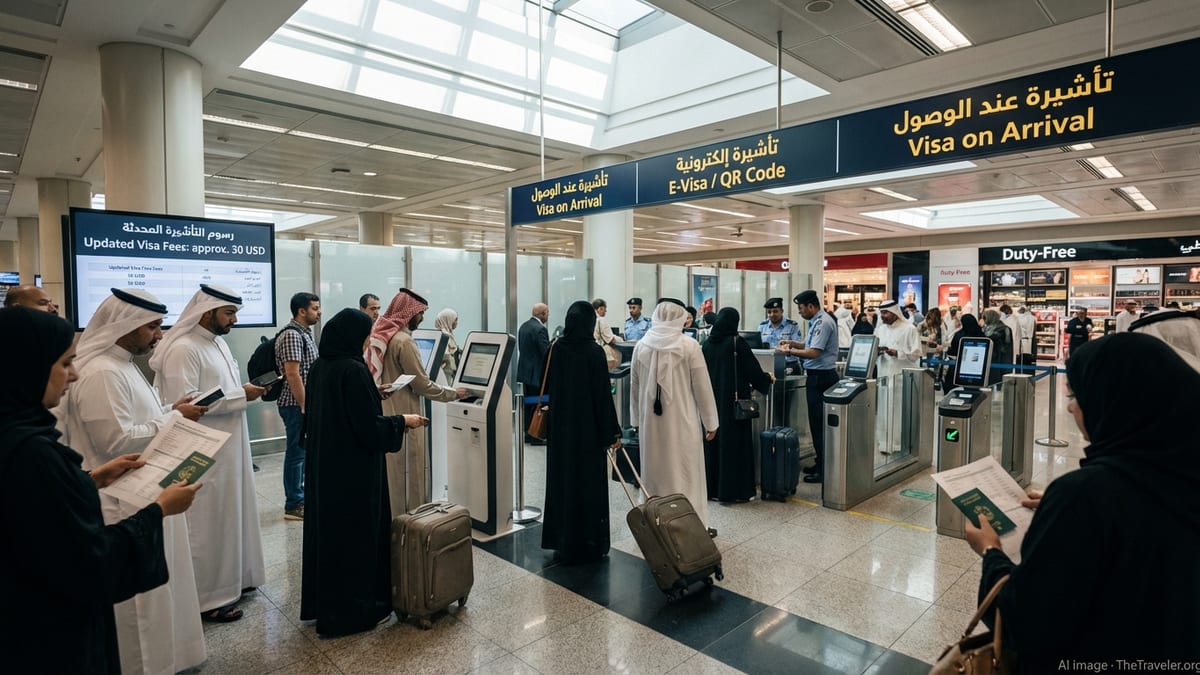
Visa Fee Hike Adds Fresh Cost Pressure For 2026 Trips
Egypt’s Chamber of Tourism Companies and Agencies has confirmed that from March 1, 2026, the standard single entry visa for many nationalities will increase from 25 to 30 US dollars, with multiple entry visas remaining at 60 dollars. While the change looks modest on paper, tour operators across the Gulf and wider Middle East say the new pricing will filter quickly into package costs for Red Sea resorts, Nile cruises and Cairo city breaks popular with travelers from Saudi Arabia, Bahrain, the UAE, Kuwait, Oman, Qatar and Jordan.
The higher headline fee comes after months of speculation about a larger increase, which the Ministry of Tourism had previously denied. Industry sources describe the final decision as a compromise that still signals a tougher stance on the cost of entry, even as Egypt courts record tourism numbers. Operators fear that for price sensitive families and group tours, particularly from emerging markets and secondary Gulf cities, the rise will be one more reason to consider alternatives such as Türkiye or domestic tourism within Gulf Cooperation Council states.
For independent travelers and frequent regional visitors, the change coincides with broader cost inflation in airfare, hotels and ground services heading into 2026. Some agents report early signs of itinerary trimming, with shorter stays in Egypt or fewer internal flights to Luxor and Aswan as travelers attempt to offset higher up front entry costs and protect overall budgets.
Digital Borders, Stricter Compliance And Longer Queues
In parallel with the visa fee adjustment, Egyptian authorities are accelerating a structural overhaul of border procedures. From early 2026, paper arrival and departure cards are scheduled to be replaced by fully digital systems integrated with airline passenger data, while visa on arrival purchases at airports will be tied to QR coded receipts and automated gates. Officials frame the reforms as a way to cut queues and improve data security, but carriers serving the Gulf warn that any technical missteps could translate into new bottlenecks during peak holiday periods.
Prime Minister Mostafa Madbouly has tasked ministries with preparing all major ports of entry to handle both e visa travelers and so called urgent issuance visitors ahead of the tourism surge forecast around the Grand Egyptian Museum’s long delayed opening. For tour groups originating in Saudi Arabia, the UAE, Qatar and other Gulf states, this will require closer coordination on advance passenger information, as well as clearer pre departure briefings about documentation, health checks and proof of accommodation requirements.
Travel management firms say that in the short term, stricter compliance and occasional system outages tend to mean longer queues and a higher risk of denied boarding or refused entry for passengers whose paperwork is incomplete or inconsistent. They note that although Gulf Cooperation Council citizens currently enjoy visa exemptions for Egypt in many cases, mixed nationality families and corporate delegations frequently include colleagues or relatives who must still navigate the full visa process under tighter scrutiny.
Regional Travelers Caught Between Easing And Tightening Rules
Egypt’s tougher stance lands at a time when the wider Middle East is sending mixed signals on travel access. Within the Gulf, the long discussed Unified Tourist Visa, due to launch in late 2025 or early 2026, is expected to simplify movement across Bahrain, Kuwait, Oman, Qatar, Saudi Arabia and the United Arab Emirates on a single permit. Officials there present the project as a Schengen style breakthrough that will encourage multi stop itineraries and longer stays across the bloc.
Yet the same governments are also introducing more conditional entry regimes and seasonal restrictions. Saudi Arabia has already experimented with temporary suspensions and caps on certain short term visas, citing congestion during peak pilgrimage periods and pressure on local infrastructure. Egypt, for its part, is tightening eligibility and compliance around pilgrimage routes and package tours ahead of the 2026 Hajj season, moving away from older, more discretionary systems.
Jordan, Oman and Qatar are similarly recalibrating policies, pairing selective visa waivers for strategic markets with more active monitoring of overstays and unlicensed work by visitors. The result is a more fragmented landscape in which some travelers find it easier than ever to enter on streamlined digital permits while others, often from neighboring states or African and Asian markets, confront higher fees, more documentation and shorter permitted stays.
Tourism Industry Braces For Itinerary Rethinks
Across the Middle East, airlines, cruise lines and tour operators that link Gulf capitals with Cairo, Hurghada, Sharm el Sheikh and Luxor are now reassessing capacity and pricing for 2026. Many had banked on Egypt’s post pandemic rebound to anchor regional circuits that combine Gulf city stays with Nile cruises or Red Sea diving packages. With new visa costs and more complex entry rules, planners are modeling scenarios in which some travelers drop Egypt from multi country itineraries altogether.
Trade sources say there is particular concern about group travel from Saudi Arabia and Kuwait, where extended families often book sizeable blocks of seats and rooms around school holidays and religious festivals. Even small increases to per person entry costs quickly multiply across such bookings, while tougher screening for last minute visa on arrival purchases raises the risk that one family member could be held up at the border, disrupting the entire group’s plans.
Agents also point to uncertainty over how strictly Egyptian authorities will enforce new pre registration and biometric requirements, especially at land borders and secondary airports where staffing and technology upgrades may lag. Until operating patterns settle, some Middle East based companies are steering first time visitors toward all inclusive packages with escorted airport handling, trading flexibility for predictability and a lower risk of paperwork mistakes.
Travelers Urged To Plan Earlier And Budget More
For individual travelers from Saudi Arabia, Bahrain, the UAE, Kuwait, Qatar, Oman, Jordan and neighboring states, the message from industry professionals is to treat Egypt’s 2026 season as one that demands earlier planning and a slightly higher budget. Even where visa exemptions still apply, passengers are being advised to check the latest rules for mixed nationality groups, children, dual citizens and residents of Gulf states who travel on non Gulf passports.
Specialists recommend that travelers arriving via Egypt as part of a broader Middle East journey allow extra connection time, particularly if switching between international and domestic flights in Cairo. With digital systems and fee structures in flux, border formalities may be less predictable than in previous years, and missed onward flights could prove costly during crowded holiday peaks.
Despite the added friction, analysts note that Egypt’s pull as a regional heavyweight in culture, religion and leisure tourism remains strong, and demand from Gulf markets is unlikely to disappear. Rather, they expect a gradual sorting of travelers into those prepared to navigate higher fees and tighter rules in exchange for iconic experiences, and those who redirect to destinations that currently promise smoother, cheaper entry in an increasingly competitive Middle East tourism landscape.