

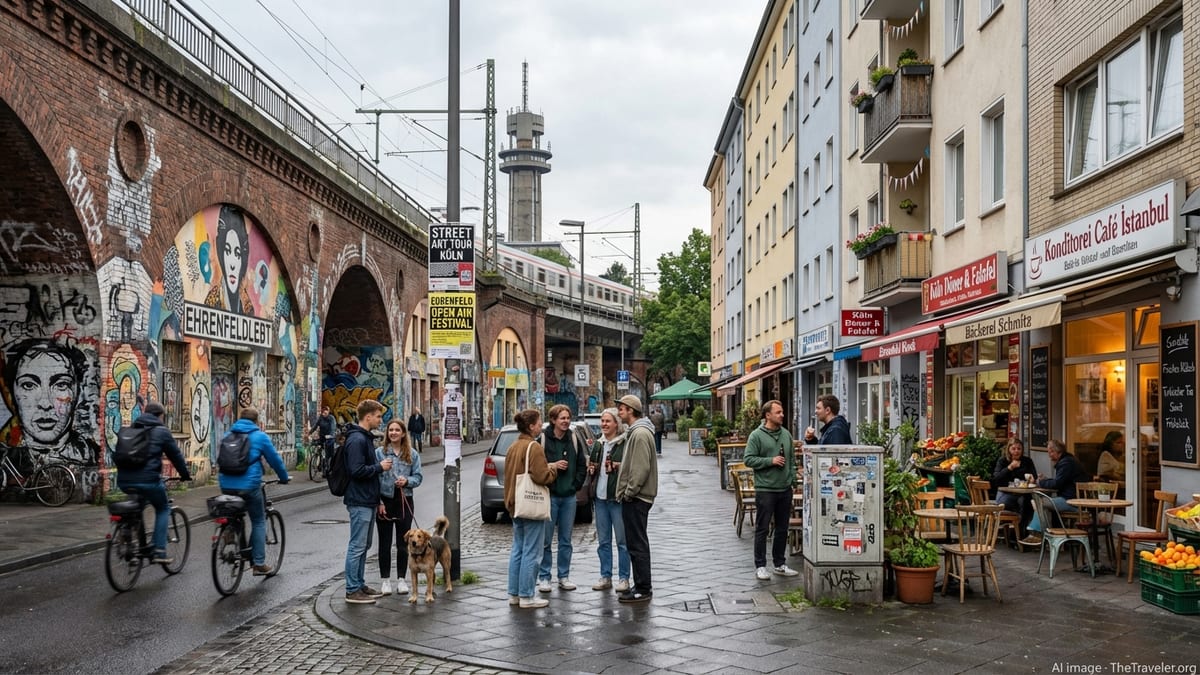
Ehrenfeld is one of those neighborhoods that does not just invite you to visit, it pulls you into its rhythm. Once a working class and industrial district in Cologne’s west, it has evolved into a dense collage of street art, cafés, Turkish bakeries, indie boutiques and live music venues.
Murals climb former factory walls, coffee roasters fill once utilitarian spaces with warm light, and the clink of beer bottles from late-night kiosks mixes with the hum of passing trains. For travelers looking beyond Cologne’s cathedral and museums, Ehrenfeld offers an intimate look at the city’s contemporary, multicultural soul.
From Factory Floors to Creative Playground
Ehrenfeld’s story starts with industry. In the late 19th and early 20th centuries, the area grew around rail lines and factories that produced everything from paint and paper to pipes and household goods. The iconic Helios Tower, once a factory chimney, still punctuates the skyline and serves as a reminder of the neighborhood’s working past, even as the industries it served have largely disappeared. Walking its streets today, you glimpse this history in red-brick facades, railway arches and repurposed warehouses that now house bars, studios and clubs.
Over recent decades, as heavy industry moved out, artists, migrants, students and young families moved in. Rents were relatively affordable compared with central Cologne, and the large industrial buildings offered space for studios, rehearsal rooms and cultural projects. The result was an organic transformation rather than a top-down redevelopment. Live Music Hall, Club Bahnhof Ehrenfeld under the railway arches, and Bumann & Sohn in a former workshop are all examples of venues that blend industrial architecture with contemporary culture, preserving a rough-around-the-edges charm rather than sanding it away.
This shift also brought new tensions familiar to many European cities. The same creative magnetism that made Ehrenfeld appealing has attracted more investment and higher rents. New apartment blocks have replaced some older buildings, and debates about gentrification, displacement and cultural identity are part of the local conversation. Travelers who look closely will notice flyers for neighborhood initiatives, cultural associations and grassroots festivals that aim to keep the district inclusive and community-driven, even as it becomes more popular.
For visitors, the historical layering is part of the appeal. You can sip an espresso where machine parts were once milled, listen to an indie band under steel beams that supported factory cranes, or follow the path of the old freight lines as you trace a route of murals and graffiti. Ehrenfeld is not a frozen postcard; it is a living laboratory of how cities recycle themselves.
Street Art as Open-Air Museum
Nowhere is Ehrenfeld’s transformation more visible than in its street art. The neighborhood has become one of Cologne’s most important urban art districts, with walls that change almost as quickly as the seasons. Around Ehrenfeld station, massive murals turn what might have been a drab transport hub into an outdoor gallery. Under and along the railway arches, you will find large-scale works by local and international artists, from politically charged pieces to surreal creatures and pop-culture references. The once plain stone of the arches now carries scenes like a woman bathing in a giant coffee cup beside a camera-toting pigeon, a playful image that mirrors the neighborhood’s blend of everyday life and creative fantasy.
Venture out from the station to streets such as Hüttenstrasse, Heliosstrasse, Lichtstrasse and Gerhard-Wilczek-Platz, and the density of murals increases. Some pieces honor local history, like tributes to the Edelweiss Pirates, a youth resistance group that opposed the Nazi regime. These works remind passersby that public art in Ehrenfeld is not just decoration; it can be remembrance, protest and storytelling. Other walls showcase animals in stark monochrome, sweeping religious symbolism, or colorful abstractions that lean into pure visual impact rather than narrative.
Körnerstrasse is another hotspot where street art takes on a more intimate scale. Here, you will see not only big murals but also paste-ups, stickers, tiny figurines tucked into wall niches and handwritten notes taped to lampposts. It feels like a neighborhood-wide sketchbook, with contributions from established artists and anonymous locals alike. Travelers often find that the joy of Ehrenfeld’s street art is less about ticking off famous pieces and more about wandering with eyes wide open, spotting details in unexpected corners.
Guided street art walks are now a staple of Ehrenfeld’s cultural offer. Some tours are run by local guides who are themselves part of the art scene, explaining the unspoken codes, techniques and rivalries that shape the work on the walls. You might learn the difference between a legal mural and a guerrilla piece done overnight, or how certain symbols and tags indicate crews, alliances or playful feuds. For anyone curious about how urban art functions as a parallel visual language, these walks offer insight that turns a casual stroll into a deeper reading of the neighborhood.
Café Culture and Everyday Rituals
If the murals provide the color, Ehrenfeld’s cafés provide the pace. The district’s coffee culture is less about polished perfection and more about places that feel lived in. On and around Venloer Strasse, Körnerstrasse and side streets that fan out from the station, you will find cafés with mismatched furniture, plants spilling from windowsills, blackboards listing daily cakes and small record collections in the corner. Some double as galleries or stages for readings and acoustic sets, making a morning cappuccino feel like an easy entry into local creative life.
Breakfast is a ritual here, and many cafés serve it all day. It is common to see shared tables layered with bread baskets, spreads, cheeses and fruit, surrounded by a mix of young families, freelancers with laptops and groups of friends easing into the day. In the warmer months, terraces and pavement seating blur the line between inside and outside. Conversations drift across tables, dogs lie under chairs and the constant background hum is a reminder that Ehrenfeld’s cafés are as much community living rooms as commercial businesses.
The neighborhood’s café landscape reflects its multicultural mix. Turkish and Middle Eastern spots serve strong tea, simit and sweet pastries; Italian cafés pull intense espresso alongside cornetti; vegan bakeries experiment with plant-based versions of traditional German cakes. You can move from a third-wave coffee bar that sources beans from micro-roasters to a cozy, old-school café that seems unchanged since the 1980s, all within a few blocks. This blend of the contemporary and the familiar is part of what makes Ehrenfeld feel accessible even to first-time visitors.
For travelers, these spaces are excellent vantage points for people-watching and absorbing the neighborhood’s rhythm. Choose a table by a window on Venloer Strasse and watch cyclists weave through traffic, neighbors greet each other with quick handshakes, delivery riders balance stacks of pizza boxes, and students rush for trains. Even a short coffee break becomes an informal lesson in how Ehrenfeld lives, works and socializes on an ordinary weekday.
Multicultural Markets, Food and Nightlife
Ehrenfeld’s cultural diversity is perhaps most immediately apparent in its food. Along Venloer Strasse and the surrounding grid, Turkish bakeries, Vietnamese snack bars, Italian pizzerias, Indian curry houses and Middle Eastern falafel stands sit side by side with German pubs and contemporary bistros. The smell of freshly baked flatbread can mingle with that of roasting coffee or wood-fired pizza as you turn a single corner. This mix is not curated; it is what happens when different communities put down roots and open the kinds of places they themselves want to visit.
Street food and casual dining are central to the neighborhood’s appeal. In the evenings, locals line up for kebabs and falafel that have earned a citywide reputation, while food trucks and pop-up concepts appear in courtyards and in front of clubs. The district’s street food scene mirrors the energy of its street art: evolving, slightly improvised and very public. If you arrive during one of the neighborhood’s market days or small festivals, stalls selling handmade jewelry, zines and vintage clothes might sit alongside stands offering regional cheeses or homemade kimchi, turning ordinary plazas into social hubs.
As night falls, Ehrenfeld’s mood shifts but does not slow down. The area around Ehrenfeldgürtel and the side streets leading back toward the station come alive with bars, clubs and live music venues. Club Bahnhof Ehrenfeld hosts everything from hip hop and electronic nights to readings and cultural events under the railway arches. Nearby Live Music Hall draws larger international acts, while more intimate bars and cellars offer jazz jams, indie bands and open mics. The atmosphere is generally relaxed and unpretentious; you are just as likely to see people in sneakers and hoodies as in carefully curated outfits.
For those who prefer a quieter evening, traditional Kölsch pubs and neighborhood bars provide a softer soundtrack. Here, the local beer is served in slim glasses, and the conversation flows as easily as the drinks. It is a good setting to encounter another side of Ehrenfeld’s identity, one that ties back to Cologne’s broader pub culture and its reputation for conviviality. Whether you choose a crowded club or a corner stool in a dimly lit bar, the common thread is a sense that locals and visitors share the same spaces rather than occupying parallel worlds.
Strolling the Streets: Venloer, Körnerstrasse and Beyond
While individual venues make headlines, Ehrenfeld is best understood on foot. Start at Ehrenfeld station and let Venloer Strasse lead you deeper into the district. This is the neighborhood’s main artery, lined with supermarkets, phone shops, delis, small fashion labels and casual eateries. It is busy, occasionally chaotic and thoroughly everyday. Yet even here, visual surprises appear: a mural on the side of a residential block, a carefully curated shop window, or a tiny gallery tucked between a bakery and a hairdresser.
A short detour brings you to Körnerstrasse, one of Ehrenfeld’s most characterful streets. Bunting often stretches from balcony to balcony, and the variety of facades, from pastel townhouses to more weathered buildings, gives it a slightly cinematic air. Cafés spill onto the pavement, galleries and design stores showcase the work of local makers, and small delicatessens sell everything from organic produce to fine cheeses. As you walk, keep your eyes peeled for the miniature artworks that hide in plain sight, from sculpted figurines on window ledges to clusters of stickers on electricity boxes.
Continuing into Neuehrenfeld, around Subbelrather Strasse and the quieter residential streets, you encounter a slightly different face of the neighborhood. Late 19th century apartment blocks stand alongside early 20th century housing and post-war buildings, with small workshops and family-run businesses at street level. This part of Ehrenfeld feels more local and less curated, but the same mix of cultures and generations is evident in bakeries, corner pubs and specialty shops. It is a good area to wander without an agenda, simply watching how daily life unfolds away from the more obviously hip corners.
Green spaces punctuate the urban fabric. Parks such as Leo-Amann-Park offer places to pause, picnic or join an impromptu ping-pong game. On warm days, they fill with students, families and groups of friends, many with take-out from nearby cafés or kiosks. These small pockets of greenery underline one of Ehrenfeld’s strengths: it may be dense and urban, but there is almost always somewhere nearby to catch your breath.
Festivals, Tours and Local Initiatives
Ehrenfeld’s cultural calendar is as layered as its streetscapes. Throughout the year, various festivals and markets animate its courtyards, railway arches and club spaces. Events that spotlight local designers, vinyl dealers, food producers and upcycling projects reflect the district’s interest in sustainability and independent creativity. Others focus on music scenes ranging from electronic and hip hop to world music and indie rock, drawing audiences from across Cologne and beyond.
Street art and culture tours have become an important bridge between residents, artists and visitors. Organized walks lead groups through key mural zones, explain the history behind certain images and introduce smaller interventions that might otherwise go unnoticed. Some tours end in a neighborhood café or literature bar, where participants can discuss what they have seen and, in some cases, even design their own tags or small pieces under guidance. These experiences help contextualize the art in its social and political environment rather than reducing it to a backdrop for photos.
Local initiatives also play a role in shaping the neighborhood’s future. Community organizations form around everything from protecting historic buildings to supporting refugee integration, organizing open-air concerts in courtyards or setting up creative Sunday markets that feel more like neighborhood gatherings than commercial fairs. The buzzword is often participation: residents are encouraged to contribute ideas, volunteer time or simply show up and be present, reinforcing Ehrenfeld’s sense of itself as a shared project rather than a finished product.
Travelers who plan ahead can time their visits to coincide with such events, but even unplanned trips are likely to encounter some form of cultural activity, whether a small record fair in a bar back room or an outdoor screening in a courtyard. Paying attention to posters on lamp posts and flyers in café windows is often the best way to discover what is happening during your stay, and is itself a minor pleasure of walking through Ehrenfeld’s streets.
The Takeaway
Ehrenfeld does not present culture as something to be consumed in a single museum visit or photo stop. Instead, it offers a patchwork of experiences that gradually reveal a neighborhood in motion. The street art is striking, but its real impact lies in how it coexists with laundry-laden balconies, school playgrounds and supermarket parking lots. The cafés are inviting, but they feel integral to local routines rather than staged for visitors. Nightlife spills out from arches and courtyards that once served freight trains and factory workers, mapping a new layer of stories onto old brick and steel.
For travelers, Ehrenfeld is an opportunity to feel Cologne at street level. It is where you can see how the city negotiates questions of heritage and change, diversity and cohesion, creativity and affordability. Whether you join a street art tour, linger over breakfast on Körnerstrasse, browse a Sunday market in a club’s beer garden or simply follow the murals from one corner to the next, you become part of a neighborhood that remains open to reinvention. Leave enough time to wander, and Ehrenfeld will explain itself not through monuments, but through the countless small moments that make up its daily life.
FAQ
Q1: Where exactly is Ehrenfeld in Cologne, and how do I get there?
Ehrenfeld lies to the west of Cologne’s historic center, around Ehrenfeld station and the stretch of Venloer Strasse that runs through the district. From Cologne’s main station, you can reach it in just a few minutes by suburban train or tram, or in around 15 to 20 minutes by bike.
Q2: Is Ehrenfeld safe for visitors, especially at night?
Ehrenfeld is a lived-in, urban neighborhood with a busy nightlife, and most visitors experience it as safe when they follow normal city awareness. The main streets and bar areas are usually lively well into the night, but as in any big city, it is wise to stay in well-lit areas, keep an eye on belongings and use licensed taxis or public transport after very late hours.
Q3: What is the best way to explore Ehrenfeld’s street art?
The simplest approach is to walk from Ehrenfeld station along Venloer Strasse and into nearby streets such as Heliosstrasse, Hüttenstrasse and Körnerstrasse, keeping an eye out for murals and smaller interventions. If you want context about the artists, techniques and history, consider joining a guided street art tour, which will help you understand the stories behind the most significant works.
Q4: Are there particular streets I should not miss in Ehrenfeld?
Venloer Strasse is the district’s busy spine, full of everyday shops and eateries, and is an essential starting point. Körnerstrasse is especially beloved for its cafés, galleries, bunting-draped facades and dense concentration of small artworks. Exploring side streets toward Neuehrenfeld and the areas around Helios Tower and Subbelrather Strasse will give you a broader sense of the neighborhood’s character.
Q5: What kind of food can I find in Ehrenfeld?
Ehrenfeld reflects Cologne’s multicultural mix in its food scene. You will find Turkish bakeries and kebab shops, Italian pizzerias, Vietnamese and Indian restaurants, vegan cafés, classic German pubs and contemporary bistros. Street food options range from falafel wraps and curries to wood-fired pizza and seasonal market stalls, so it is easy to eat well on almost any budget.
Q6: How does Ehrenfeld’s nightlife compare to the city center?
Ehrenfeld’s nightlife is generally more alternative and intimate than the mainstream bars around Cologne’s old town. The area offers a mix of clubs under railway arches, live music halls, small bars, Kölsch pubs and late-opening kiosks where locals gather. It attracts a younger, creative crowd but remains relaxed and unpretentious, making it a favorite for both residents and visitors.
Q7: Are there family-friendly things to do in Ehrenfeld?
Yes. By day, Ehrenfeld’s streets are filled with families heading to cafés, playgrounds and parks such as Leo-Amann-Park. Children often enjoy spotting colorful murals and small artworks on a casual walking tour, and many cafés offer kid-friendly menus or relaxed spaces where families feel welcome. The atmosphere during daylight hours is very much that of an everyday neighborhood.
Q8: When is the best time of year to visit Ehrenfeld?
Ehrenfeld is worth visiting year-round, but spring through early autumn tends to be the most enjoyable because you can make full use of outdoor seating, parks and open-air events. In warmer months, street life intensifies, terraces fill up and markets or small festivals are more frequent, allowing you to experience the neighborhood’s social and cultural life at full strength.
Q9: How much time should I plan for a visit to Ehrenfeld?
If you only want a taste of the neighborhood, a half day is enough for a walk from the station through key streets, with stops at a café and a few murals. To explore more deeply, including markets, a guided tour, a relaxed meal and perhaps an evening concert or club night, plan on a full day and evening, which allows the area’s slower rhythms to emerge.
Q10: Is Ehrenfeld a good base for staying in Cologne?
For travelers who value local atmosphere over postcard views, Ehrenfeld can be an excellent base. It offers good public transport connections to the city center, plenty of cafés and eateries, and a lively yet neighborhood-scale nightlife. If you enjoy street art, independent shops and multicultural street life, staying in Ehrenfeld will put you in the middle of the scenes you came to experience.