

More news on this day
New rounds of flight cancellations by El Al Israel Airlines and Gulf Air are intensifying travel disruption for passengers moving between Thailand and key Middle Eastern hubs, with connections to Tel Aviv’s Ben Gurion Airport, Bahrain International Airport, Tehran’s Imam Khomeini Airport and other onward destinations heavily affected in recent weeks.
Get the latest news straight to your inbox!
Middle East Conflict Ripples Across Thai Skies
Escalating military tensions in the Middle East since late February 2026 have triggered significant airspace closures and rerouting across the Gulf region, creating knock-on disruption for flights serving Thailand. Publicly available aviation data and local Thai media coverage indicate that partial or temporary airspace shutdowns in Bahrain, Qatar, Iraq and surrounding states have forced airlines to cancel or detour services, particularly those linking Southeast Asia to Tel Aviv and major Gulf hubs.
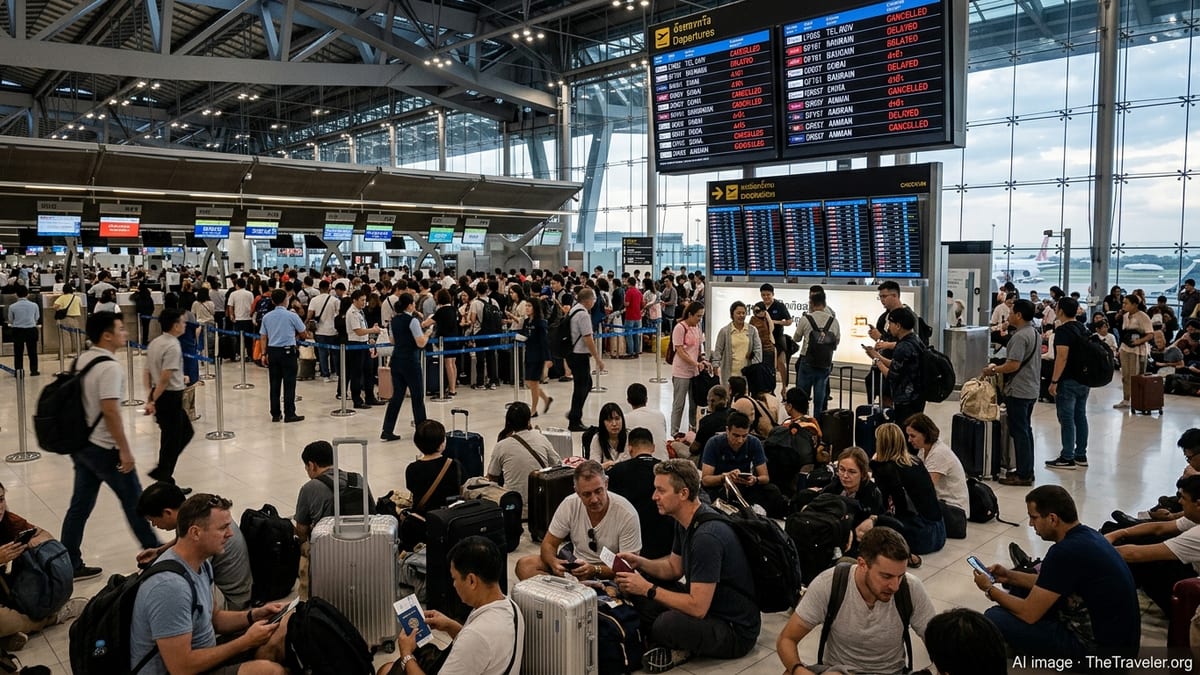
Reports from Bangkok’s Suvarnabhumi Airport describe a sharp spike in cancellations and delays as Middle Eastern and Gulf carriers adjust schedules or suspend services on short notice. El Al, which normally operates direct routes between Bangkok, Phuket and Ben Gurion, has faced repeated schedule upheaval whenever regional airspace is deemed unsafe, affecting both regular services and special repatriation flights. Gulf Air, Bahrain’s flag carrier, has also scaled back operations and offered flexible rebooking as Bahrain’s airspace has intermittently restricted routine traffic.
These developments have complicated travel between Thailand and onward destinations such as Israel, Bahrain and Iran, where many passengers rely on one or two-stop itineraries via Bangkok or Phuket. When key legs between Thailand and Middle Eastern hubs are canceled, connections to Ben Gurion, Bahrain International and Imam Khomeini are often broken, leaving travelers temporarily isolated in Thai resort cities and transit hotels.
Air travel analysts note that regional corridors which only recently began to recover from earlier geopolitical shocks are once again under pressure. Schedules that were already reduced because of the protracted Israel–Hamas conflict are now being reshaped around new security concerns involving Iran and Gulf states, with Thailand caught in the middle as a popular leisure and transit point.
Bangkok and Phuket See Dozens of Flights Scrubbed
Thailand’s two main international gateways, Bangkok Suvarnabhumi and Phuket International, have seen repeated waves of cancellations tied to the latest Middle East crisis. Local travel and aviation outlets in Thailand recently reported more than 30 flights canceled at Suvarnabhumi in a single short period, along with at least a dozen services disrupted at Phuket, as airlines either diverted around closed airspace or grounded aircraft until new routings could be confirmed.
Within these broader figures, publicly available airport boards and airline-status tools show El Al services among those affected on the Thailand–Tel Aviv axis. In earlier episodes of regional tension, El Al flights between Bangkok or Phuket and Ben Gurion have been forced to turn back or delay departure after midair assessments of the security environment, and the latest unrest has produced similar uncertainty around departures and arrivals. Each adjustment cascades through onward itineraries for passengers connecting to Europe or North America via Tel Aviv.
Gulf Air operations have also been disrupted on routes that commonly link Thailand to Bahrain and beyond. Industry and passenger reports indicate at least one Gulf Air service involving Thailand among a broader tally of cancellations across its network after Bahrain’s airspace was affected. Travelers holding tickets from Bangkok or Phuket via Bahrain to Europe, the Middle East or South Asia have experienced short-notice changes, with some flights canceled outright and others still listed but subject to review up to the day of departure.
The overall pattern has left airport concourses in Bangkok and Phuket busier than usual with travelers seeking new options. While Thai authorities emphasize that Thailand itself remains fully open and functional, the reality on the ground for many passengers is extended layovers, hotel nights added at their own expense, and a scramble to rebook onto alternative routes that avoid the most volatile airspace.
Passengers Face Isolation and Complex Rebooking Choices
For individual travelers, the operational decisions by El Al and Gulf Air translate into sudden isolation from planned onward journeys. Leisure visitors who expected a straightforward return from Phuket to Tel Aviv or from Bangkok to Bahrain have found themselves stuck in Thailand with limited clarity on when direct or one-stop connections will fully resume. Some accounts from passenger-rights forums describe Gulf Air cancellations on Bahrain routes that forced travelers to abandon carefully planned multi-leg itineraries and start over with new tickets on different carriers.
In practice, a canceled sector from Thailand to a Middle Eastern hub can sever access to multiple onward destinations, including Ben Gurion in Israel, Bahrain International, Tehran’s Imam Khomeini and various European and North American cities served by those hubs. Rebooking often requires rerouting via alternative gateways such as Dubai, Abu Dhabi, Doha, Istanbul or Singapore, each of which may also be adjusting schedules in response to the same conflict.
Publicly available guidance from airlines and travel advisers suggests that many carriers, including Gulf Air, have introduced temporary waivers allowing free date changes or cancellations for tickets covering travel during the height of the disruption. These policies, however, are typically time limited and vary by fare type and booking channel, leaving some passengers unsure whether to wait for an airline-driven cancellation or proactively change their plans.
Travel insurance adds another layer of complexity. Some policies may cover additional accommodation and transport costs arising from conflict-related disruption, while others specifically exclude war or political instability. Passengers stranded in Bangkok or Phuket are being encouraged by consumer advocates to retain boarding passes, cancellation notices and receipts for extra expenses in case they are eligible to file later claims with airlines or insurers.
Impact on Thailand’s Tourism Corridor and Regional Connectivity
The timing of the latest cancellations is especially sensitive for Thailand, which continues to rely heavily on long haul visitors from Europe, the Middle East and beyond. Routes operated by El Al and Gulf Air do not account for the majority of arrivals, but they serve as important links for niche markets, including Israeli holidaymakers, Gulf-based expatriates and business travelers using Bahrain as a connection point.
Thai tourism and aviation commentators have noted that while most inbound visitors from the Middle East still reach Thailand via large Gulf hubs such as Dubai and Doha, disruptions to even a handful of carriers can undermine confidence in regional connectivity. Travelers planning complex itineraries through Bangkok or Phuket may be more hesitant to book when headlines focus on canceled flights, stranded passengers and blocked airspace over conflict zones.
The knock-on effect reaches beyond Thailand. When El Al and Gulf Air remove or reduce services involving Bangkok or Phuket, it limits options for travelers seeking to combine Southeast Asia stays with visits to Israel, Bahrain or Iran. This potentially dampens demand for multi-destination trips that have become increasingly popular among younger and more adventurous travelers, particularly those routing overland or by air between the Mediterranean and Asia.
Airline schedulers now face the delicate task of maintaining a minimum level of service to keep markets active while reducing exposure to volatile corridors. Publicly available statements from carriers emphasize safety and regulatory compliance as primary drivers of flight planning in the current climate, with resumption of normal frequencies contingent on a sustained easing of tensions across the Gulf and eastern Mediterranean.
What Travelers From Bangkok and Phuket Should Do Now
For passengers currently in Thailand or with imminent departures, travel experts recommend a cautious and proactive approach. Those holding El Al tickets from Bangkok or Phuket to Tel Aviv, or Gulf Air tickets routing via Bahrain, are advised in publicly available guidance to monitor booking portals and airline status pages frequently and to sign up for direct notifications about schedule changes.
When flights are still operating but subject to possible rerouting, accepting schedule changes early can sometimes secure scarce seats on alternative connections before they sell out. In cases where El Al or Gulf Air cancels a flight outright, passengers are generally being offered a choice of rebooking on future dates or applying for refunds, in line with each airline’s published policies for disruption linked to the current conflict.
Travel planners also suggest building more generous transit windows and considering routings that avoid the most contested airspace entirely, even if this means extra stops or higher fares. For example, some travelers are opting to connect through airports farther from the Gulf region, such as hubs in East Asia or Europe, to reduce the risk that their itineraries will be affected by last minute closures over the Gulf or Levant.
As the geopolitical situation remains fluid, industry observers expect schedules for El Al, Gulf Air and other affected carriers to continue changing with little warning. For now, Thailand’s skies remain busy, but the latest wave of cancellations underscores how closely Bangkok and Phuket’s international connectivity is tied to events far beyond the country’s borders.