

More news on this day
Hundreds of travelers were left stranded in Israel today as El Al Israel Airlines grounded more than twenty flights out of Tel Aviv’s Ben Gurion Airport, disrupting key routes to Thailand, the United Kingdom, Italy, the United States and several other destinations amid an already fragile post-crisis flight schedule.
Get the latest news straight to your inbox!
Grounded Schedule Deepens Disruption at Ben Gurion
Publicly available flight boards and local media reports indicate that El Al pulled a substantial portion of its departures from Tel Aviv today, with more than twenty services removed from schedules at short notice. The cancellations primarily affected long-haul and high-demand leisure and VFR routes, intensifying pressure on an air travel network that has been operating with reduced capacity since recent security escalations around Israel.
Services between Tel Aviv and major European hubs in the United Kingdom and Italy were among the hardest hit, alongside at least one rotation to Thailand and several departures to major US gateways. Travelers arriving at Ben Gurion early in the morning reported finding departure screens flipping from “scheduled” to “canceled” across a cluster of El Al flights, as remaining departures quickly filled with rebooked passengers.
The reductions come on top of broader constraints on outbound traffic from Israel in recent weeks following missile and drone attacks that damaged aircraft and airport infrastructure. Previous reporting has described caps on passenger numbers per flight and a focus on repatriation services, conditions that have made every canceled departure significantly more disruptive for travelers trying to leave or return to the country.
Operational details released so far point to a combination of fleet availability, security-driven spacing of departures, and crew scheduling challenges. Together, these factors left El Al with limited flexibility to maintain its full timetable once additional safety margins were applied to today’s operations.
Stranded Passengers Face Long Queues and Limited Options
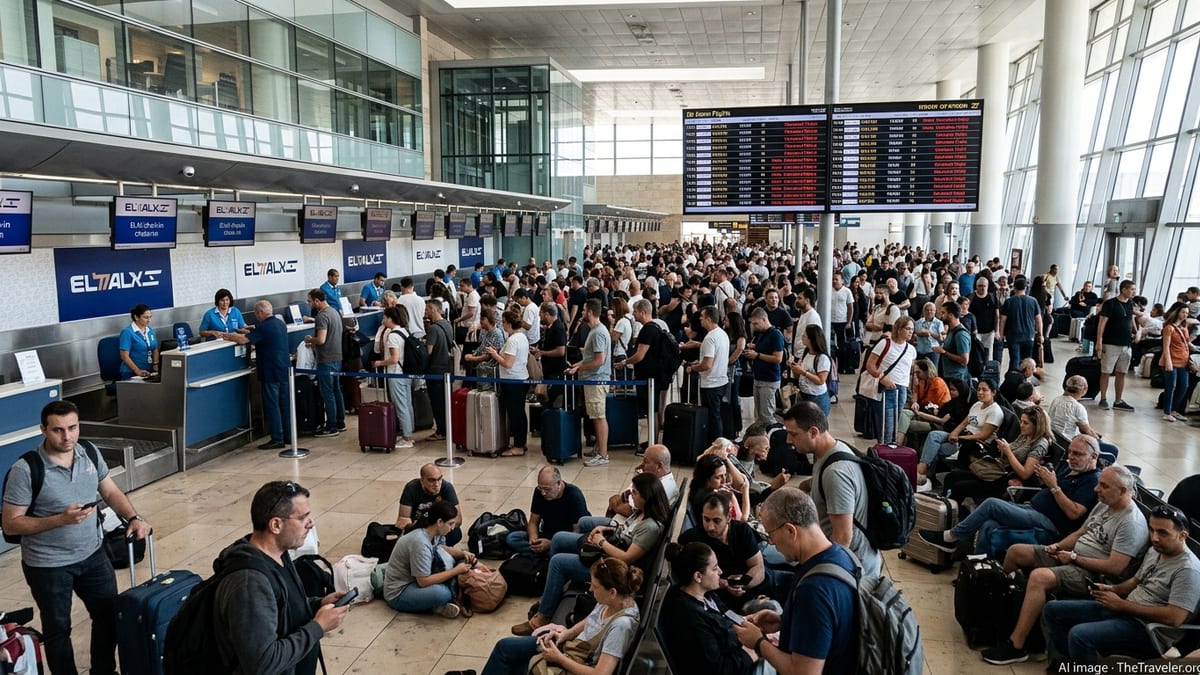
Scenes at Ben Gurion’s main terminal today reflected a familiar pattern from previous periods of disruption in Israel: dense queues at airline counters, families clustered around luggage trolleys, and travelers attempting to rebook journeys on mobile apps that were often showing no availability for days. Social media posts from the terminal described lines stretching through the departure hall as passengers sought clarity on when, or if, they would be able to fly.
For many stranded travelers, alternative options are sharply constrained. Numerous international carriers have only partially restored or continue to limit their Tel Aviv services after successive rounds of regional tension, leaving El Al as the primary operator on several key routes. With today’s cancellations, rebooking often meant accepting indirect routings via secondary hubs, overnight connections, or departure dates pushed well into next week.
Travel industry observers note that the knock-on effect goes beyond the passengers actually booked on today’s grounded flights. Once seats on remaining El Al services fill with rebooked travelers, little inventory remains for those who already held tickets in coming days or for new bookings. That dynamic has fueled a pattern of rolling capacity shortages every time a new round of cancellations hits the schedule.
Reports from travel agents in multiple markets suggest that some passengers bound for Europe and North America are now being advised to consider reaching nearby regional airports first, such as in Cyprus or Greece, and then connecting onward on carriers that are not currently operating direct Israel services. Such multi-step itineraries typically add cost and complexity, but for some travelers they have become the only immediate way out.
Key Routes to Thailand, the UK, Italy and the US Affected
Today’s cancellations struck at several of El Al’s most visible international corridors. Flights linking Tel Aviv with Bangkok, a major long-haul leisure route and a key connection point for travel across Southeast Asia, were among those impacted, leaving holidaymakers and returning workers facing days of uncertainty over new departure dates.
In Europe, published departure lists showed gaps on services to London and Italian gateways, including popular city pairs used by both tourists and the sizable Israeli diaspora communities. Travelers connecting through these hubs for further onward journeys to North America and other parts of Europe faced the added complication of missed interline connections and separately ticketed segments.
On transatlantic routes, outbound services to major US cities, including New York, have already been operating under tight passenger caps and reduced frequencies. When one or more of these flights is pulled from the timetable, the pool of available transatlantic seats shrinks sharply. Recent coverage of so-called “recovery” or “rescue” services shows that demand on these routes has remained extremely high, as dual nationals and foreign citizens seek to leave Israel while conditions remain volatile.
Observers note that the pattern of cancellations continues a broader trend in which Middle East security developments translate quickly into constrained long-haul connectivity. Even when Ben Gurion remains technically open, airspace restrictions, insurance considerations and security assessments can result in rapidly shifting schedules that leave travelers with little warning.
Airline Under Pressure to Balance Safety, Capacity and Demand
El Al has been at the center of Israel’s air connectivity throughout the recent crisis period, maintaining operations when many foreign carriers sharply curtailed or suspended flights. Publicly available information from aviation authorities and previous reporting on capacity limits suggests that the airline is operating within a complex framework of security requirements, government guidelines and operational constraints.
Industry analysts point out that the carrier has had to juggle multiple priorities: ensuring aircraft and crew safety, complying with evolving airspace and airport protocols, and responding to intense public pressure to keep a reliable link between Israel and major global cities. Earlier reports on special “recovery” flights and capped-capacity services demonstrate how the airline has been used as a strategic tool for repatriating citizens while also trying to preserve commercial viability.
The sudden grounding of more than twenty flights in a single day underscores how fragile that balance remains. If a single runway closure, additional security inspection layer or aircraft rotation delay ripples through the schedule, the result can be widespread cancellations rather than minor timing adjustments. This is especially true when spare aircraft and standby crews are already stretched thin by an elevated level of contingency planning.
Aviation commentators caution that, as long as regional tensions continue and foreign carriers remain hesitant to fully restore Israel operations, disruptions similar to today’s are likely to recur. They note that in this environment, even a modest change in guidelines on passenger caps or night operations can trigger a wholesale recalibration of the timetable for days at a time.
What Travelers Should Expect in the Coming Days
For passengers affected by today’s grounding or holding upcoming El Al tickets, publicly available advisories from airlines and regulators in comparable disruption events point to a few likely patterns. Rebooking priority is typically given to travelers who were scheduled to fly on canceled services, often on the next available flight in the same cabin when seats open. However, where capacity is heavily constrained, it may take several days before all disrupted passengers can be accommodated.
Travel agents and frequent-flyer communities generally advise that passengers monitor their bookings closely through official airline channels, as timetables may continue to shift with limited notice. Given the high demand for limited seats, some travelers are encouraged to consider flexible routings via nearby countries or alternative dates, particularly if their travel is not time critical and they can avoid the most crowded departure windows.
Insurance coverage and refund rules vary by policy and fare type, but prior disruption waves in Israel and elsewhere suggest that many passengers will turn to their insurers or credit card providers if rebooking options become impractical. Consumer advocates typically recommend that travelers keep detailed documentation of cancellations, delays and additional expenses, in case claims are later disputed.
With no firm indication yet of when El Al’s grounded flights will be fully restored to the timetable, the near-term outlook for smooth departures from Tel Aviv remains uncertain. For now, travelers passing through Ben Gurion are likely to face a mix of tightly packed flights, longer processing times and the constant possibility that schedules may change even after they have cleared security.