

More news on this day
An El Al flight from Los Angeles to Tel Aviv faced a significant security scare this week after staff at Los Angeles International Airport discovered “Free Palestine” stickers on 140 checked suitcases, triggering an explosives sweep, delaying departure and deepening passenger anxiety amid already heightened tensions on Israel-bound routes.
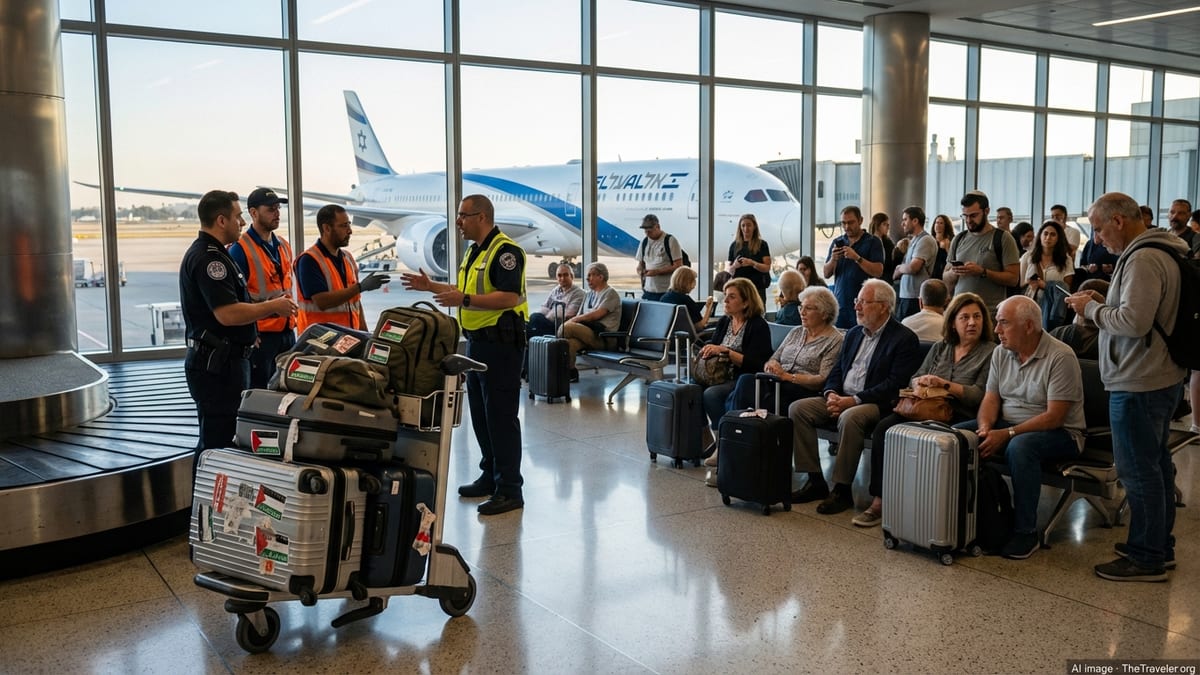
Stickers on 140 Bags Trigger Security Alarm at LAX
The incident occurred on Monday, February 16, on El Al flight LY6, a Boeing 787-9 Dreamliner operating the carrier’s nonstop route from Los Angeles International Airport to Tel Aviv. The flight, scheduled to depart at 2 p.m. local time, had already completed boarding when ground personnel noticed that a large number of checked bags bound for the aircraft carried identical “Free Palestine” stickers.
What at first appeared to passengers as a routine delay quickly escalated into a full security response. Airline staff initially informed travelers of a short hold due to a baggage issue, but as time passed and the aircraft remained at the gate, cabin crew and the captain began offering more detailed explanations, acknowledging that 140 pieces of luggage had been flagged for additional checks because of the stickers.
Inside the cabin, frustration grew as passengers compared notes and tried to piece together what was happening in the cargo hold below. For many, the discovery that such a large volume of luggage had been altered after check-in raised immediate questions about how close unknown individuals had come to their personal belongings and to a flight bound for Israel.
According to accounts shared with regional and aviation media, the flight ultimately left the gate nearly two hours behind schedule, with the security operation still unfolding on the tarmac and in restricted baggage areas at LAX.
El Al Opts to Depart Without Affected Luggage
Once the stickers were discovered, El Al invoked its strict security protocols, which require that any irregularity involving checked baggage be treated as a potential threat until proven otherwise. Security teams halted loading operations, segregated the marked suitcases and began painstaking hand inspections of each bag, checking for explosives or other prohibited items.
As the process stretched on, operational managers faced a difficult choice: continue to hold the fully boarded aircraft at the gate until all 140 suitcases had been cleared, or depart without the affected luggage in order to limit knock-on delays to the airline’s schedule and reduce time on the ground in a tense security environment. After consultations with security officials, the airline chose to dispatch LY6 without the luggage, while screening continued on the ground.
Passengers were informed mid-operation that the flight would depart without the flagged bags, which would instead be sent to Israel on a later service once cleared. Some travelers protested the decision, citing critical personal items and important family events. One passenger, quoted by regional media, complained that a suitcase containing a dress for a daughter’s upcoming wedding had been left behind, to which a senior crew member reportedly replied that it was better to arrive safely without the bag than to risk an alternative outcome.
Upon arrival at Ben Gurion Airport near Tel Aviv, travelers were handed notices explaining that their luggage had been retained in Los Angeles for security reasons and was scheduled to arrive on a subsequent flight once inspections were complete. The airline later confirmed that the bags were examined and cleared before being forwarded to Israel.
Suspected Ground-Side Tampering Raises Serious Questions
While no explosives or hazardous materials were ultimately reported in connection with the incident, the scale and nature of the sticker placements have alarmed both passengers and security professionals. With 140 bags affected, aviation analysts and travelers alike say it appears unlikely that individuals without special access could have applied the stickers solely in public check-in areas without attracting attention.
Security commentators have suggested that the operation bears the hallmarks of an insider act carried out by one or more airport workers with access to secure baggage handling zones. The uniform appearance of the stickers and the concentration on luggage destined for a single Israel-bound flight have sharpened concerns that political messaging was deliberately introduced into a sensitive part of the airport’s security chain.
Passengers who spoke to Israeli and international outlets questioned how an individual was able to place stickers on so many bags, asking whether the same access might have been used for more dangerous forms of tampering. Their comments underscore a key distinction drawn by aviation security experts: the slogan printed on the stickers is less important than the fact that unauthorized materials were attached to screened baggage out of passengers’ sight.
For LAX, one of the busiest international gateways in the United States, the episode is likely to prompt a close review of staff vetting, camera coverage in baggage halls and the procedures that govern who can handle tagged and screened luggage once passengers have left the check-in counters.
El Al and Shin Bet’s Stringent Security Regime
El Al has long been known for maintaining one of the most rigorous airline security regimes in the world, developed in coordination with Israel’s domestic security agency, Shin Bet. On routes from high profile international gateways like Los Angeles, the airline deploys its own security personnel in addition to airport and federal authorities, conducting pre-flight interviews, behavioral screening and extra baggage checks for many passengers.
That framework was immediately visible in the response to the LAX incident. Once the irregular stickers were detected, El Al security officers took custody of the affected suitcases, removed them from the normal baggage flow and oversaw the expanded search process. Their decision to treat the presence of political stickers as a potential security breach, rather than a mere act of vandalism, reflects the airline’s risk calculus on flights that have historically been considered high-value targets.
The incident also illustrates the extent to which El Al’s procedures can affect airport operations in foreign countries. While host airports retain overall responsibility for aviation security, El Al’s standards frequently exceed local requirements, leading to additional checks and, at times, diplomatic friction. In most cases, however, authorities have been willing to accommodate the heightened protocols due to Israel’s unique security concerns and the history of past attacks on its aviation assets.
For travelers, this often translates into longer check-in times, more intensive questioning and, as in this case, unexpected delays. Yet many regular passengers on Israel-bound flights say they accept the inconvenience as a necessary trade-off for safety in a volatile geopolitical climate.
Passengers Caught Between Safety and Disruption
Inside the cabin of LY6, the tension between stringent security and passenger convenience played out in real time. Initial announcements about a minor baggage issue gave way to more candid explanations as the delay passed the one hour mark and travelers demanded clarity. Accounts from onboard describe a mix of anxiety, anger and resignation as people absorbed the news that their belongings might not be traveling with them.
Some passengers remained focused on the immediate personal impact: missed connections at the end of their journey, delayed access to medication or formal wear needed for important events soon after arrival. Others voiced broader worries about how such an incident could have happened in the first place, pressing crew for information on whether an arrest had been made or whether any airport employees were under investigation.
Cabin crew, caught between operational constraints and customer frustrations, tried to reassure passengers that security procedures were being rigorously followed and that all baggage would eventually be reunited with its owners. However, the lack of instant answers about who was responsible or whether additional threats had been discovered contributed to an uneasy atmosphere throughout the delay and even during the overnight flight to Israel.
The episode highlights the difficult communications challenges airlines face during fast-moving security events. Providing too little information risks eroding passenger trust, yet offering detailed speculation while an investigation is still under way can create confusion or compromise security operations. In this case, most of the specific details emerged only after the aircraft had landed and travelers and media began sharing their experiences.
Rising Tensions Around Israel-Linked Travel
The LAX sticker incident comes against the backdrop of sharply heightened tensions surrounding Israel and travel to and from the country since the escalation of the Gaza conflict in October 2023. Airlines serving Tel Aviv have repeatedly adjusted schedules, rerouted flights and updated security procedures in response to shifting risk assessments and political pressures.
In parallel, airports and carriers linked to Israel have reported a surge in politically motivated acts of vandalism and protest. In one widely reported case last year, activists sprayed accusatory graffiti on El Al offices in Europe, part of a wave of demonstrations targeting Israeli or Israel-affiliated institutions. Although such acts are often framed as symbolic expression, they can take on a more serious character when they intersect with aviation security.
Analysts point out that any interference with luggage, aircraft, airside equipment or boarding areas, even if intended purely as a statement, is treated as a potential threat until fully investigated. In the LAX case, the “Free Palestine” slogan itself was less significant to security teams than the implication that someone with access to a secure zone used that access to target baggage on a specific flight.
For many passengers on LY6, the stickers were a visual reminder that geopolitical disputes can intrude directly into the experience of travel, transforming what was meant to be a routine return from a sports weekend into a tense and uncertain journey home.
Implications for Airport Security and Worker Screening
As investigators and security planners dissect the circumstances surrounding the LAX delay, particular attention is likely to focus on how many opportunities staff had to intervene before the flight neared departure. With 140 suitcases affected, the operation would have required both time and relative privacy, suggesting that existing oversight mechanisms in the baggage system were either insufficient or temporarily circumvented.
Industry experts say the most probable scenario involves a ground worker or contract employee with legitimate access to checked baggage areas but motivated by political views or a desire to create disruption. If that assessment is borne out by the investigation, the case will join a small but concerning list of insider incidents that have prompted calls for tighter worker vetting, more frequent background checks and expanded use of surveillance technology in restricted zones.
Airports worldwide have been working for years to harden the so-called soft underbelly of aviation infrastructure by limiting the number of staff who can reach sensitive areas and monitoring those who do more closely. Yet the sheer scale of major hubs like LAX, where thousands of employees from multiple organizations share access to overlapping spaces, makes complete control extremely difficult. The El Al case underscores how even a nonviolent act inside this ecosystem can ripple outward into international headlines and operational headaches.
U.S. authorities have not yet publicly detailed any disciplinary actions or criminal charges connected to the LAX episode, and it remains unclear whether they have identified a specific suspect. Nonetheless, the incident is already being studied by security professionals as a real-world stress test of current systems for protecting checked baggage and identifying irregular activity before it can affect a flight.
El Al Balances Reassurance and Resolve
Publicly, El Al has emphasized that its handling of the LAX incident demonstrates the effectiveness of its security protocols. By detecting the irregularities before departure, pulling the affected bags aside and choosing to prioritize passenger safety over on-time performance and convenience, the airline has framed the episode as evidence that its multi-layered defenses work as intended.
At the same time, the carrier and Israeli officials are signaling that they view the mass sticker campaign with gravity, describing it as an attack on the integrity of an Israel-bound flight, even in the absence of physical harm. Statements from El Al and pro-Israel organizations have linked the act to a broader pattern of harassment and intimidation directed at Israelis and Jews traveling abroad since the latest round of conflict began.
For El Al’s customer base, the message is twofold: the airline remains determined to operate its international network in close coordination with Israeli security agencies, and it is prepared to accept delays, missed connections and the cost of handling stranded baggage in order to preserve safety. That stance resonates with many frequent fliers who say they value the carrier precisely because of its uncompromising approach.
Yet the challenge ahead will be maintaining that high bar while also minimizing the disruption such incidents cause to passengers, particularly in an era when social media quickly broadcasts every delay and misstep to a global audience. How El Al and airports like LAX adapt their procedures in the wake of this incident will shape traveler confidence on Israel-bound routes for months to come.