

More news on this day
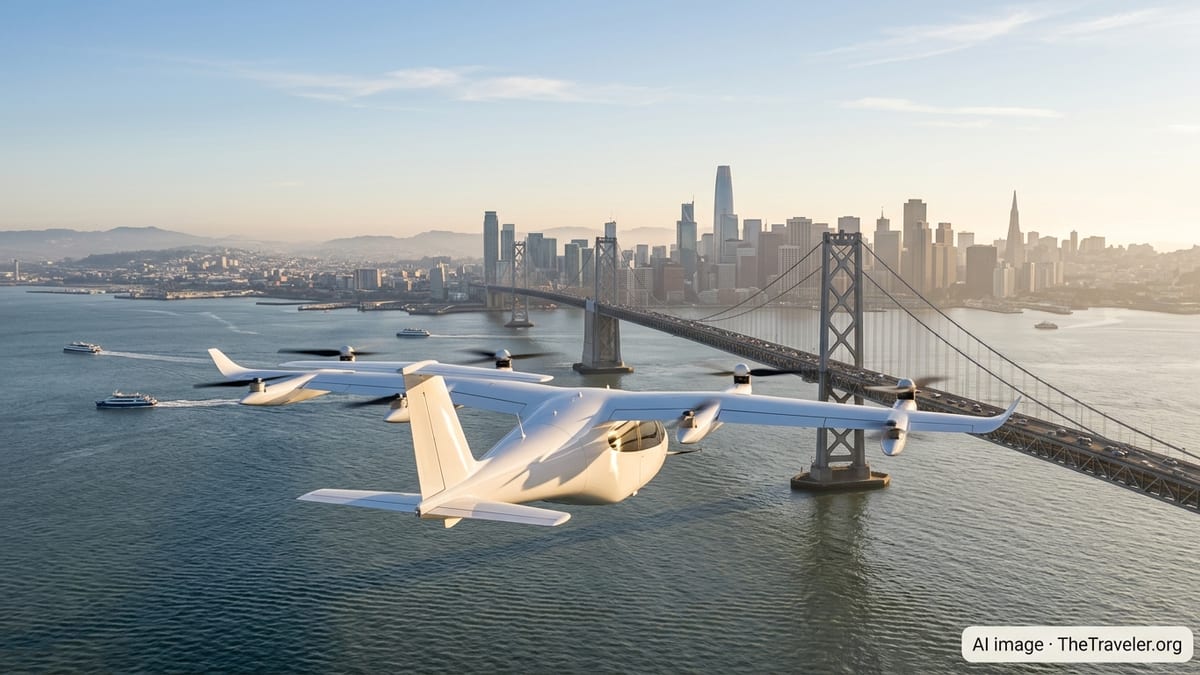
An electric air taxi skimming past the Golden Gate Bridge was once the stuff of concept art, but a series of real-world demonstration flights over San Francisco Bay this month signals that zero-emission aircraft could soon become part of the region’s daily commute.
Get the latest news straight to your inbox!
From Distant Concept to Bay Area Test Flights
Electric vertical takeoff and landing aircraft, known as eVTOLs, have been in development for years, but San Francisco is now emerging as one of the first major U.S. metros where the technology is being flown in front of the public. In mid-March, Joby Aviation carried out a piloted demonstration flight across San Francisco Bay, looping around the Golden Gate Bridge before returning to Oakland, in what observers described as a watershed moment for urban air mobility in the region.
Publicly available information from the company indicates that the aircraft used in the Bay flight is part of Joby’s broader test program, which also includes operations at its facilities in Marina on the Monterey Bay and at Edwards Air Force Base in Southern California. The San Francisco showcase marked a deliberate shift from remote test sites to a dense urban corridor, offering a preview of how these aircraft could coexist with airline traffic and established flight paths.
Industry coverage notes that the demonstration was the first stop on Joby’s nationwide “Electric Skies” tour, designed to familiarize communities and regulators with the sound profile and operating characteristics of electric air taxis. The flights over the Bay highlighted the aircraft’s ability to take off vertically, transition to wing-borne forward flight, and integrate into conventional airport operations before returning to a compact landing footprint.
For Bay Area residents watching from shorelines and office towers, the sight of a quiet, battery-powered aircraft tracing familiar commuter routes offered a tangible glimpse of a transport mode that has largely existed in renderings and regulatory filings until now.
New Routes for the Daily Commute
Developers and planners see the San Francisco Bay Area’s geography as a natural fit for electric air taxis. The region’s narrow bridges, crowded freeways, and water barriers create chokepoints that can turn relatively short point-to-point trips into hour-long slogs. Academic studies of urban air mobility applied to the Bay Area suggest that aerial routes linking existing job centers and residential hubs could cut travel times by 20 minutes or more on some commutes, particularly during peak congestion.
Archer Aviation, another California-based eVTOL developer, has already sketched out a network concept centered on the Bay. According to industry reports, Archer’s plans envision a waterfront vertiport at Oyster Point in South San Francisco, sometimes referred to as a “Sea Portal,” that would connect by air to key nodes such as Napa, San Jose, Oakland, and Livermore. The idea is to layer an aerial mesh on top of existing road, rail, and ferry services, with short hop flights replacing lengthy cross-bay drives.
In parallel, Joby has signaled that it expects to begin commercial operations in 2026, supported by a recently announced air taxi program coordinated with federal transportation agencies. Company materials indicate that routes in the United States will focus on dense urban markets where trip-time savings are most pronounced, and analysts frequently cite the San Francisco region as a leading candidate given its concentration of tech employers and early adopters.
For commuters, that could eventually mean swapping a 60-minute, stop-and-go drive from the Peninsula to downtown San Francisco for a 10 to 15 minute aerial hop between purpose-built vertiports, or a direct connection between regional airports and city centers that bypasses freeway bottlenecks entirely.
Building a Vertiport Network Above an Existing City
Turning demonstration flights into daily service will depend heavily on ground infrastructure. Electric air taxis need vertiports equipped with charging systems, passenger facilities, and ways to plug safely into the national airspace system. In the Bay Area, early concepts are clustering around existing transportation assets, such as waterfront developments, business parks near highways, and underused spaces adjacent to commercial airports.
Reports on Archer’s Bay Area strategy describe a phased rollout in which the Oyster Point waterfront hub would be followed by a small network of vertiports at regional airports and business centers around Napa, Oakland, San Jose, and Livermore. These sites could initially support a limited number of flights per hour, gradually scaling as demand and regulatory approvals grow.
Policy documents and industry roadmaps from federal aviation authorities and NASA outline how advanced air mobility operations might be layered into existing flight corridors while preserving safety and minimizing noise. In practice, that means Bay Area vertiports would be designed with approach and departure paths that avoid densely populated neighborhoods where possible, and incorporate noise-abatement procedures informed by community feedback and flight testing data.
Developers are also looking at how to integrate vertiports into mixed-use projects so they feel like an extension of the urban fabric rather than isolated aviation facilities. In South San Francisco, proposals pair rooftop or waterfront landing pads with office, life-science, and hospitality spaces, positioning air taxis as one option in a broader mobility toolkit that still includes trains, buses, ferries, and micromobility.
Regulation, Safety and Public Acceptance
Even as the technology advances, the path to routine air taxi commutes runs through a complex regulatory landscape. Electric air taxis must complete rigorous certification with the Federal Aviation Administration, demonstrate safe operations in controlled test programs, and obtain approvals for specific routes and vertiport locations. Publicly available FAA concept-of-operations documents describe a gradual introduction of highly automated aircraft into low-altitude urban airspace, with human pilots likely remaining on board during the early years of service.
Noise and privacy remain two of the most commonly cited concerns in community discussions. Manufacturers emphasize that eVTOL aircraft are significantly quieter than helicopters, particularly in cruise, but independent measurements in real-world urban environments are still limited. Demonstration flights like those over San Francisco Bay are partly intended to provide data and give residents direct exposure to the sound profile, allowing planners to refine operating envelopes and flight paths.
Safety perceptions will also be shaped by the broader context of automation in transportation. Bay Area residents have become accustomed to autonomous cars and robotaxis operating on city streets, and incidents involving ground-based systems often influence public attitudes toward new aerial technologies. Industry analysts suggest that clear communication about certification milestones, redundancy in critical systems, and transparent incident reporting will be essential in building trust.
Local governments around the Bay are beginning to engage with advanced air mobility through planning workshops and technical forums, looking at zoning rules, emergency response coordination, and environmental review processes. While timelines for large-scale deployment remain fluid, the groundwork being laid now is expected to determine how seamlessly air taxis can be folded into day-to-day city life once aircraft are fully certified.
What Early Travelers Can Expect
When commercial electric air taxi services finally launch in the Bay Area, early offerings are likely to feel more like premium airport shuttles than mass-transit replacements. Industry projections point to piloted aircraft carrying three or four passengers, with ticket prices initially closer to business-class rail or ride-hail services than to standard bus fares, before potentially declining as fleets grow.
Travelers can expect app-based booking, security procedures comparable to commuter flights, and short walking connections between vertiports and nearby transit or rideshare pickup zones. Operators are positioning their aircraft as tools for predictable, time-saving trips during the most congested parts of the day, such as morning and evening peaks or before major events.
Over time, as additional vertiports come online around the Bay and more aircraft enter service, planners envision a shift from point-to-point routes serving airports and central business districts to a more distributed network that includes smaller job clusters and residential communities. In that scenario, an electric air taxi from South San Francisco to Napa, or from downtown Oakland to a Peninsula tech campus, could become a realistic option for a growing share of regional travelers.
For now, the image of a sleek, battery-powered aircraft gliding quietly over the Golden Gate Bridge serves as a symbol of how dramatically Bay Area commutes may change over the next decade. The timing will depend on regulatory approvals, infrastructure investment, and public acceptance, but the technology’s arrival in San Francisco’s skies suggests that the era of electric air commuting is moving from theory to visible, audible reality.