

More news on this day
Iran’s decision to grant preferential passage through the embattled Strait of Hormuz to a small group of Asian partners is rapidly redrawing the map of energy security, pricing, and even future travel for millions of citizens across Eurasia.
Get the latest news straight to your inbox!
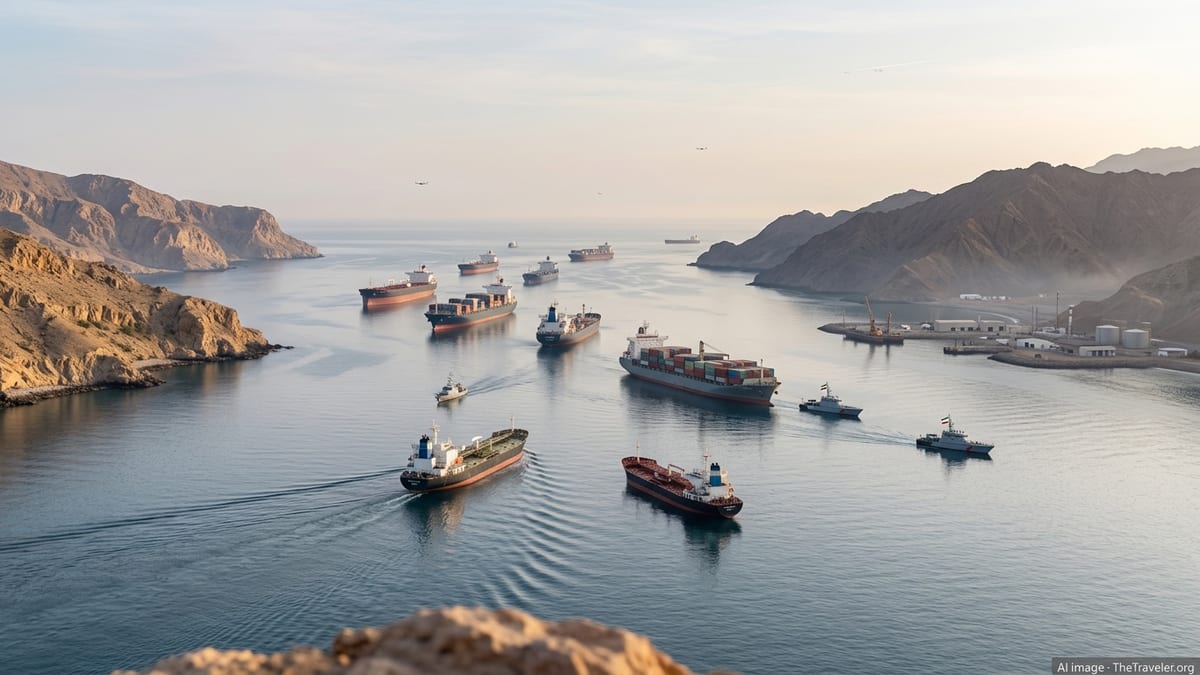
From Near Blockade to Curated “Guest List” in the Strait
In late February 2026, the Strait of Hormuz shifted from a universal shipping artery to a tightly managed chokepoint. Publicly available information shows that Iranian forces imposed a permission-based transit regime, telling many commercial vessels that passage was not allowed, while vetting others that entered Iranian waters. Analysts describe it as the functional equivalent of a toll gate across one of the world’s most important oil corridors.
Traffic through the strait has plunged since the start of the conflict, with data cited in recent coverage indicating that only a fraction of the usual tankers and container ships are still moving between the Persian Gulf and the Gulf of Oman. The squeeze immediately rippled into global energy markets, driving oil prices sharply higher and raising fears of prolonged shortages for economies that rely heavily on Gulf crude.
Against that backdrop, Tehran has begun carving out exceptions. According to a growing body of maritime reporting, Iran has quietly approved passage for a cluster of countries whose ships are deemed “non-hostile.” Within this group, a core of six states now stands out for especially favored treatment: China, Russia, India, Iraq, Pakistan, and Thailand.
These six, sometimes described in regional commentary as an emerging “elite” tier of partners, are seeing their oil and cargo flows resume even as many Western-linked vessels remain sidelined or rerouted. The result is an unprecedented split regime in which geography has not changed, but access has.
How Preferential Access Cushions Citizens at Home
For governments in Beijing, Moscow, New Delhi, Baghdad, Islamabad, and Bangkok, guaranteed or fast-tracked access through Hormuz offers a crucial buffer against the most severe economic shocks of the crisis. When most other importers face delayed shipments and elevated freight insurance costs, these six can still move significant volumes of crude and liquefied gas along their traditional sea lanes.
Economists following the region note that uninterrupted or restored energy flows help moderate the domestic impact of price spikes. Fuel and electricity subsidies are politically sensitive across much of Asia; any abrupt jump in import costs can cascade into higher transport fares, food prices, and industrial input costs. For countries with large, price-conscious populations, being on Iran’s preferred transit list becomes a form of macroeconomic risk insurance.
This tiered access also affects inflation expectations. If refineries in China, India, Pakistan, and Thailand can secure baseline supply from Gulf producers, central banks face less pressure from energy-driven price surges. While consumers still feel global volatility at the pump, the combination of negotiated access, long-term contracts, and alternate suppliers such as Russia can help cap the worst spikes that might otherwise result from a near-blockade.
The social dimension is less visible but no less significant. Stable fuel supplies underpin everything from commuter travel and domestic tourism to the price of imported food staples. In practical terms, the Elite 6 arrangement gives these governments more levers to shield their citizens from shortages and rationing that might be felt more acutely in states still effectively shut out of the Hormuz corridor.
Lower Freight Costs and the Long Tail on Global Prices
Beyond immediate energy security, privileged passage through Hormuz shapes shipping economics across the wider Indian Ocean. For tankers and container vessels serving the six favored countries, the new regime often means higher operational costs due to tolls, escorts, and compliance with Iranian routing rules. Yet those costs may still be lower than the alternatives facing excluded states, which are forced to take longer routes, rely on more expensive spot cargoes, or compete intensely for limited shipping capacity.
Shorter distances and predictable schedules translate into relatively lower freight rates on key Asia–Gulf routes for the Elite 6. Shipping planners point out that when a subset of countries can move cargo through the most direct corridor, they avoid the compounded expenses associated with rerouting via the Red Sea, the Cape of Good Hope, or complex multimodal land corridors.
Those savings can filter through to end users over time. Cheaper maritime logistics help temper the cost of imported crude, petrochemicals, plastics, fertilizers, and manufactured goods. For large emerging markets such as India, China, and Thailand, where import-heavy supply chains underpin consumer markets, even modest cost advantages at sea can support efforts to keep inflation in check.
There is also a competitive angle. Manufacturers and exporters based in the Elite 6 may enjoy a relative edge in energy and shipping costs compared with peers in countries still facing effective exclusion from Hormuz. That advantage could subtly influence where multinationals locate factories, distribution hubs, or sourcing agreements once the immediate crisis gives way to a longer-term adjustment period.
A New Geography for Trade and Future Travel
The selective reopening of Hormuz intersects with a parallel web of overland and hybrid corridors that connect the Gulf, Iran, Central Asia, Russia, and South Asia. Projects such as the International North–South Transport Corridor, linking Indian ports to Russia via Iran and the Caspian region, are already framed as faster and more cost-effective than the traditional Suez Canal route for certain cargoes.
Similarly, Iran’s development of the Chabahar port and the Chabahar–Zahedan railway aims to create a deepwater outlet to the Indian Ocean that does not require transiting the narrowest part of the strait. For India and Russia in particular, these schemes promise diversified access even when the shipping lanes through Hormuz are tightly controlled. Preferential sea passage now adds another layer of resilience atop these emerging land–sea networks.
For travelers, the implications may unfold more slowly but could be far-reaching. As trade corridors stabilize around a set of “trusted” routes and partners, airlines, tour operators, and rail companies often follow freight. Gulf and South Asian hubs that maintain reliable fuel supplies and competitive operating costs are better positioned to retain or expand long-haul connections, even in periods of geopolitical tension.
This is especially relevant for Thailand, whose inclusion among the preferred transit states underscores its position as a tourism and logistics crossroads between the Indian Ocean and the Pacific. Stable energy imports support the aviation sector that underpins its visitor economy, from regional low-cost carriers to long-haul flights connecting Europe, the Middle East, and East Asia through Thai airports.
Opening New Worlds for Travelers, Quietly
While the crisis in Hormuz is fundamentally about oil and security, its long-term consequences will likely be felt in how and where people travel. If China, Russia, India, Iraq, Pakistan, and Thailand continue to enjoy a more predictable flow of fuel and trade, their airports and coastal cities may become relative safe harbors in an otherwise volatile transport landscape.
Travel industry analysts already pay close attention to energy markets when projecting ticket prices and route viability. With a protected pipeline of Gulf crude still reaching refineries in the Elite 6, carriers based in those markets may have more room to manage costs and sustain routes that might become uneconomical elsewhere. That could preserve connectivity for travelers looking to move between Europe, the Middle East, and Asia on multi-stop itineraries.
Over time, these structural advantages could reinforce a shift of global travel gravity toward Asian and Middle Eastern hubs that sit on or near secure energy corridors. Ports in Iran and the Gulf, logistics centers in India and Pakistan, and aviation hubs in Thailand and China may benefit from a perception of relative reliability, even if tensions around the Strait of Hormuz remain unresolved.
For now, the arrangement is narrowly framed as an energy lifeline. Yet by insulating key partners from the worst of the blockade’s effects, Iran’s selective opening of Hormuz is also helping to sketch the outlines of a new travel and trade geography, in which being on the right side of a chokepoint offers not just oil, but opportunity.