

Emergency care performance is a critical relocation factor for families and professionals considering Portugal. While the country’s National Health Service provides broad access to urgent and life-threatening care, pressures on hospital emergency departments, variations in response times and differences between public and private facilities shape the actual experience on the ground. Understanding how Portugal’s emergency system is organised, how hospitals perform under strain, and what coverage is required for foreign residents is essential for decision-grade relocation planning.
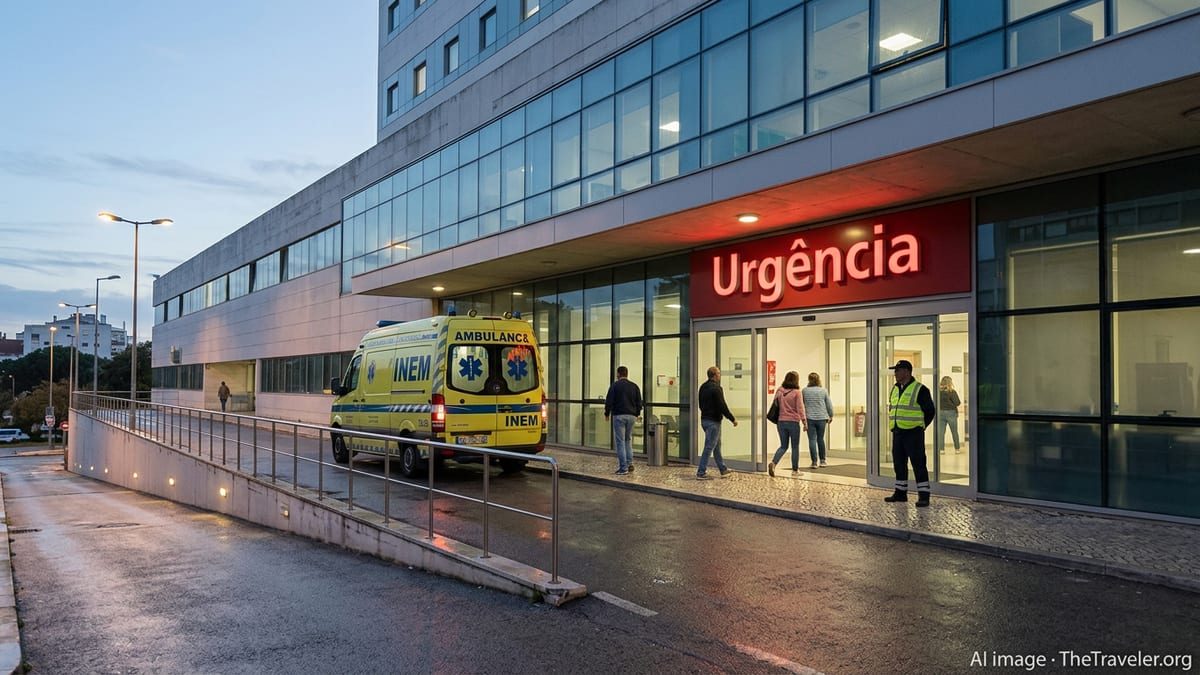
Structure of Emergency Care in Portugal
Portugal’s emergency care is anchored in the public National Health Service (Serviço Nacional de Saúde, SNS), supported by the National Institute of Medical Emergency (INEM) for pre-hospital response and complemented by a dense network of private hospitals and clinics with emergency departments. The system is designed so that life-threatening emergencies can be handled at any public hospital with an emergency unit, with 112 as the single European emergency number. INEM coordinates ambulance dispatch, pre-hospital stabilisation and routing of patients to appropriate hospitals.
Public emergency departments are classified by capability, from basic urgent care units in smaller hospitals to polyvalent emergency departments in major urban centres equipped for complex surgical and intensive care cases. Private hospital groups in Lisbon, Porto, the Algarve and other regional hubs increasingly operate 24/7 emergency rooms, often used by insured expatriates for shorter waits and more predictable service environments. However, definitive trauma and high-complexity emergencies are still largely concentrated in the higher-level public hospitals.
Portugal has one of Western Europe’s denser emergency hospital networks relative to population, with close to 90 hospital units offering emergency services nationally, according to recent public health reporting. This extensive network improves geographical access, particularly along the coastal urban corridor where most of the population and expatriate communities are concentrated. In rural interior regions, coverage is more dependent on coordinated use of local health centres, INEM ambulances and referral hospitals in district capitals.
In operational terms, emergency care pathways are increasingly regulated by a “call before you go” logic. The SNS 24 health line, staffed by nurses using clinical protocols, is intended to steer non-life-threatening cases toward primary or urgent care rather than hospital emergency departments. This structure aims to preserve emergency capacity for time-critical conditions, although real-world adherence and capacity limits continue to challenge that goal.
Quality Indicators and International Benchmarks
Judged by core health outcome indicators, Portugal performs relatively strongly compared with many OECD peers, with low rates of deaths from conditions considered preventable or treatable with timely care. Recent OECD reporting notes that Portugal’s preventable and treatable mortality is below the OECD average, suggesting that the system, including emergency and hospital care, generally succeeds in avoiding many avoidable deaths when patients reach appropriate services in time.
Access and financial protection indicators also position Portugal reasonably well by international standards. OECD data show that publicly mandated schemes cover roughly 60 percent of total health spending, a lower share than some northern European systems but sufficient to keep the share of the population reporting unmet care needs for cost, distance or waiting times at low single-digit levels in EU surveys. For emergency care specifically, the legal guarantee of access for life-threatening situations, regardless of status, significantly reduces the risk of catastrophic exclusion from urgent treatment for residents and visitors.
At the same time, structural stress points are evident. Hospital bed density in Portugal is around three and a half beds per 1,000 population, lower than the OECD average of about 4.3. With hospital emergency departments also shouldering a high volume of non-emergency cases, crowding and delays are recurrent, particularly during winter and influenza seasons. Economic and workforce pressures in the public system have led to periodic staff shortages, strikes and temporary closures or reconfiguration of smaller emergency units, all of which can affect local response capacity.
For relocation planning, the key implication is that Portugal offers generally good emergency outcomes at the system level, but individual experiences can vary widely depending on location, time of day, hospital choice and whether a household has private insurance that enables flexible use of higher-end private emergency facilities.
Emergency Department Utilisation, Triage and Waiting Times
Portugal stands out internationally for its extremely high use of hospital emergency departments. Recent analyses comparing OECD countries indicate that annual emergency visits per 100 inhabitants in Portugal are roughly double the OECD benchmark, with some studies citing over 70 contacts per 100 inhabitants when late 2024 data are included. This pattern reflects both trust in hospital emergency services and structural gaps in timely primary care access, particularly for patients who lack a regular family doctor.
Such heavy utilisation drives systematic overcrowding. Emergency departments apply structured triage scales, with categories ranging from immediate life-threatening (often coded as red) through urgent (orange and yellow) to non-urgent (green or blue). High-priority cases are typically seen rapidly, often within minutes for red codes and up to around 30 minutes for the highest non-resuscitation priority categories as per typical triage targets. However, low-priority patients can face waits of several hours, particularly during peak times, and may be redirected to primary care or observation areas if no emergency intervention is indicated.
Recent evaluations of mainland Portugal’s emergency services highlight that the majority of admissions fall into non-critical triage categories, confirming that emergency departments function de facto as extended-hours access points for general medical issues. This role contributes to longer average waits and can lead to cancelled elective surgeries or reallocation of staff when crowding becomes severe. For relocating households accustomed to systems with robust urgent care clinic networks, the normality of long emergency room stays for non-critical issues in Portugal can be surprising.
From a risk-management standpoint, the evidence indicates that life-threatening emergencies are generally prioritised effectively, but non-urgent needs may not be efficiently or comfortably addressed in public emergency departments. Many expatriates mitigate this by combining SNS access for major emergencies with private insurance and a clear plan for which hospitals to use for intermediate or urgent, but not life-threatening, problems.
Pre-hospital Response: INEM and Ambulance Coverage
Pre-hospital emergency response is coordinated nationally by INEM, which oversees medical regulation centres that receive calls forwarded from 112, dispatch ambulances and medical vehicles, and provide real-time clinical decision-making support. INEM’s fleet includes basic life support ambulances, medicalised ambulances with on-board physicians, and rapid intervention vehicles, supplemented by helicopters for critical cases and by hundreds of municipal fire brigades that provide additional ambulance capacity under INEM coordination.
Coverage is strongest in metropolitan Lisbon, Porto and along the coastal strip, with multiple INEM stations and fire brigades accessible within relatively short distances. In these urban and peri-urban areas, response times for high-priority calls are generally competitive with western European norms, although detailed national average figures are not routinely published in a comparable way. In less populated inland regions, travel distances and reliance on local fire brigades can lead to longer response intervals, especially in adverse weather or at night.
The operational model relies heavily on telephone triage and protocol-driven resource allocation. Call handlers in emergency regulation centres are tasked with classifying cases rapidly and assigning the appropriate level of response. For suspected cardiac arrest, major trauma or stroke, priority dispatch aims to deliver advanced life support assets as quickly as possible, often in conjunction with local firefighters who can reach scenes rapidly. This layered approach improves the probability that at least basic life support arrives within clinically meaningful timeframes, even if a medicalised unit takes longer to reach the patient.
For relocating professionals, the key consideration is that Portugal has a mature, integrated pre-hospital emergency system, but response performance is not uniform. Households choosing rural or semi-rural locations should factor in potential longer ambulance arrival times and may wish to understand which INEM bases and hospitals serve their area, as well as whether local volunteer fire brigades are primary responders.
Coverage, Entitlements and Cost Exposure for Foreign Residents
Emergency medical care in life-threatening situations is provided in Portugal irrespective of nationality or legal status, and hospitals are not permitted to refuse essential urgent treatment. However, the way costs are handled differs by residency status and insurance arrangements, which is highly relevant for relocation risk planning. Residents registered with the SNS and contributing to the social security system typically face only modest co-payments for emergency department visits, often in the range of approximately 20 to 30 euros for non-exempt patients, with exemptions available for low-income, chronic disease and other protected groups.
Foreign residents with legal status can usually register with the SNS, obtain a user number and access emergency care under the same financial terms as Portuguese citizens, once administrative procedures are completed. During the initial months, or for non-resident family members, emergency treatment may be billed at higher rates and payment may be requested at the point of care. Non-EU residents are generally expected to hold private or travel health insurance as a condition of visa issuance, and these policies often reimburse emergency hospital and ambulance costs retrospectively.
EU and European Economic Area citizens visiting or temporarily staying in Portugal can use the European Health Insurance Card to access necessary emergency and medically required care at public facilities under the same cost-sharing rules as Portuguese residents. The card does not make care free in all cases, but it significantly reduces exposure to large upfront bills and simplifies reimbursement when returning to the home country. For third-country nationals, equivalent arrangements depend on bilateral agreements or private insurance terms.
From a relocation perspective, the key risk is not lack of access to life-saving care, but rather the financial and administrative uncertainty around non-resident status, the potential for out-of-pocket payments before SNS registration is secured, and the variability of what different private insurers classify as emergency versus urgent care. Careful review of insurance policy wording, including ambulance and emergency department coverage, is therefore recommended for any move to Portugal.
Public vs Private Emergency Hospitals: Performance and Trade-offs
Public SNS hospitals form the backbone of complex emergency care in Portugal, including trauma, major cardiac events and intensive care. They tend to have the broadest range of specialties, access to national reference centres and close integration with regional pre-hospital protocols. Quality of clinical care for serious conditions is generally strong, as reflected in low treatable mortality rates. However, these facilities are also where crowding, long waits, boarding in corridors and overburdened staff are most visible, especially in large urban emergency departments.
Private hospitals, operated by major healthcare groups in principal cities and some secondary centres, usually offer more controlled environments, shorter waits for triaged non-critical cases and more predictable amenities. Many expatriates and internationally mobile professionals report using private emergency rooms for moderate but urgent issues such as fractures, high fever in children or acute infections, particularly during off-hours. These hospitals typically require proof of private insurance or guarantee of payment and may charge significantly higher list prices than SNS facilities, though negotiated insurer tariffs often lower the actual cost borne by patients.
Clinical capacity for the most complex emergencies in private hospitals can be more variable. While some flagship private hospitals operate intensive care units and manage a wide spectrum of emergencies, others stabilise patients and then transfer them to SNS hospitals for definitive care. For that reason, pre-hospital services may still preferentially route critical cases to designated public reference centres, and international professionals should not assume that the nearest private hospital is always the destination in a major incident.
When evaluating location choices within Portugal, relocating households should map both public and private emergency options, assess which facilities have paediatric emergency departments, and check which hospitals are within their insurer’s network. This preparation can materially influence the experience of urgent but non-life-threatening episodes, which are statistically more common than major trauma or cardiac events.
The Takeaway
Portugal provides broad and legally protected access to emergency medical care, underpinned by a universal public system, a structured national pre-hospital network and an increasingly significant private hospital sector. System-level indicators suggest that when patients reach appropriate services in time, outcomes for treatable emergency conditions are generally favourable by OECD standards. This is a material advantage for families and professionals considering medium or long-term relocation.
However, chronic pressure on emergency departments, high utilisation for non-critical issues, below-average hospital bed density and periodic workforce constraints translate into frequent crowding and long waits for lower-priority emergencies in public hospitals. Experiences are highly variable by region, time of day and hospital, with major urban centres combining sophisticated clinical capabilities with some of the most congested emergency rooms.
For relocation decision-making, emergency care quality in Portugal can be considered adequate to strong in clinical terms but operationally stressed. Families who pair SNS access with well-designed private insurance, clear knowledge of local emergency pathways and realistic expectations about waiting times will be best positioned to benefit from the system’s strengths while mitigating its weaknesses. Those planning to live in rural or semi-rural areas should pay particular attention to ambulance coverage and referral hospital configuration when assessing overall risk.
FAQ
Q1. Is emergency medical care in Portugal free for residents?
For registered SNS users, life-threatening emergency care is provided regardless of ability to pay, but non-urgent emergency department visits usually carry modest co-payments, often in the range of about 20 to 30 euros for those without exemptions.
Q2. How long do patients typically wait in Portuguese emergency rooms?
High-priority cases such as suspected stroke, heart attack or major trauma are usually seen rapidly, often within minutes. Lower-priority cases can experience waits of several hours, especially in large public hospitals during peak times or winter seasons.
Q3. Are ambulance response times reliable across Portugal?
In major cities and along the coastal corridor, INEM-coordinated ambulance coverage is generally robust and response times are competitive with western European norms. In rural and interior regions, longer distances and dependence on local fire brigades can lead to slower responses.
Q4. Can foreigners use public emergency services before obtaining residence status?
Yes. Public hospitals must treat life-threatening emergencies regardless of status. However, non-residents and those not yet registered with the SNS may face higher charges and be asked to pay at the point of care, to be reclaimed later from private or travel insurance where applicable.
Q5. Do EU citizens have special rights to emergency care in Portugal?
EU and EEA citizens with a valid European Health Insurance Card can access necessary emergency and medically required treatment in public facilities under the same cost-sharing conditions as Portuguese residents, though standard co-payments may still apply.
Q6. How does the quality of public and private emergency hospitals compare?
Public hospitals generally provide the most comprehensive emergency capabilities, including trauma and intensive care, but are often crowded. Private hospitals typically offer shorter waits and more comfortable environments for moderate emergencies, although the most complex cases may still be transferred to public centres.
Q7. Is it necessary to have private health insurance for emergency care in Portugal?
It is not legally required for residents, since the SNS provides emergency access. However, many expatriates choose private insurance to reduce financial exposure, access private emergency departments and shorten waits for non-critical emergencies.
Q8. What number should be called in a medical emergency in Portugal?
The number to call is 112, the European emergency number. For non-immediate but urgent health concerns, residents are encouraged to contact the SNS 24 health line, which can advise on whether hospital emergency care is necessary.
Q9. Are paediatric emergency services widely available?
Major public hospitals in urban centres and many private hospitals operate dedicated paediatric emergency departments, while smaller hospitals and health centres may manage children within general emergency units or refer to regional paediatric centres.
Q10. How should relocating families assess local emergency care when choosing where to live?
Families should identify nearby public and private hospitals with emergency departments, understand which facilities are designated for major emergencies, confirm their insurance network coverage and consider likely ambulance response routes and travel times from their prospective home.