

More news on this day
Emirates is rapidly restoring and expanding Airbus A380 operations across the United Arab Emirates, the United States, Germany, Japan and Australia, signaling renewed confidence in long-haul demand and positioning Dubai as a central hub for high-capacity global travel.
Get the latest news straight to your inbox!
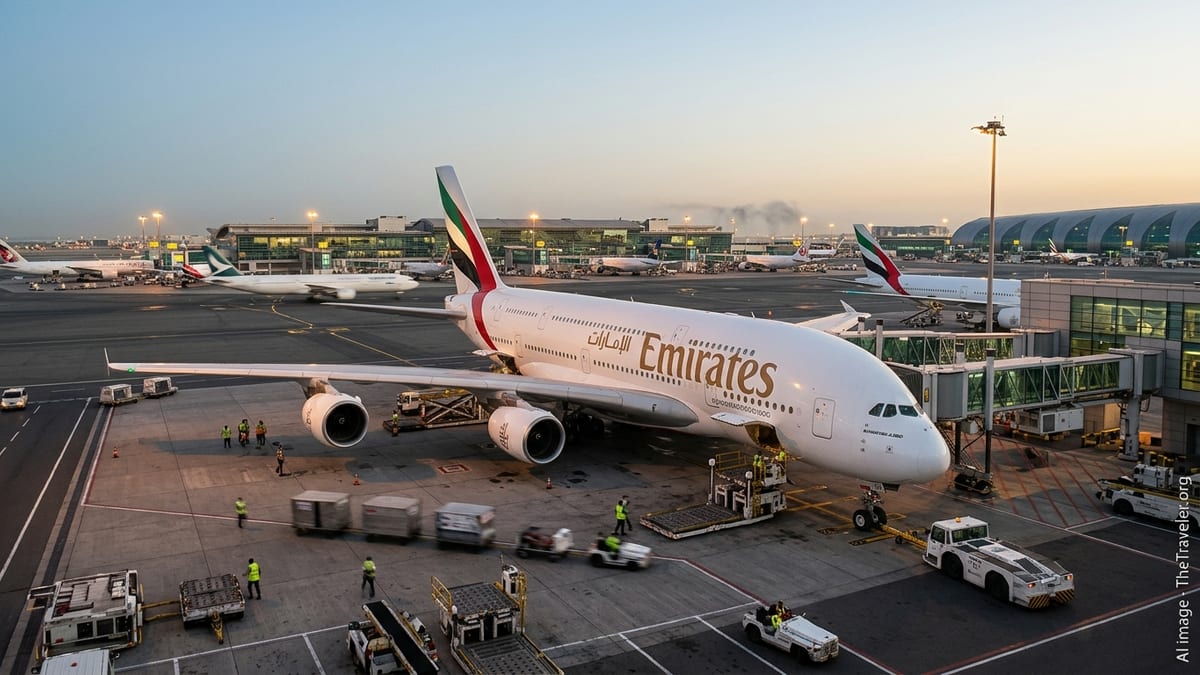
A380 Strategy Underpins Emirates Network Growth
Publicly available fleet data shows Emirates remains the world’s largest Airbus A380 operator, with more than 110 aircraft in service and an active retrofit program extending the type’s life well into the 2030s. The airline has framed the double-deck jet as a cornerstone of its growth strategy, using the aircraft to add capacity on dense trunk routes while complementing newer Airbus A350 and Boeing 777 aircraft.
Recent annual reporting and industry analysis indicate that the A380 carried a substantial share of Emirates’ total passengers in the 2024 to 2025 financial year, underscoring the type’s ongoing commercial relevance. The carrier has focused A380 deployments on markets where slot constraints, strong premium demand and growing leisure traffic justify the superjumbo’s 500-plus seat capacity.
Network updates published over the past year highlight a phased restoration of pre-pandemic A380 services alongside new or upgauged routes in Europe, North America, Asia and Oceania. The strategy pairs A380 capacity with Dubai’s expanding hub infrastructure, designed to channel connecting traffic between the Americas, Europe, Africa and the Asia-Pacific region.
Maintenance and cabin-upgrade contracts announced with major aerospace suppliers further support plans to keep the A380 flying at scale. These agreements focus on modernizing interiors, including premium economy cabins, and ensuring long-term support for critical systems as the aircraft continues to anchor the airline’s widebody fleet.
United Arab Emirates and United States Strengthen Long-Haul Links
Emirates’ home base in the United Arab Emirates remains the core of its A380 network, with Dubai serving as the primary hub for superjumbo operations. As the airline rebuilds and reshapes its schedule, high-density A380 flights are concentrated on routes where demand to and from the UAE, as well as connecting flows, remain strongest.
In the United States, schedule updates and booking data over the last two seasons point to the gradual return of A380s on major East Coast and gateway routes. Reports indicate that airports such as New York John F. Kennedy and Washington Dulles have seen expanded or restored A380 services as Emirates matches capacity to robust transatlantic and transpacific demand funneled through Dubai.
Industry coverage shows that as travel patterns normalize, Emirates has been fine-tuning its US A380 schedule, adjusting aircraft types between seasons while retaining the double-deck jet on key city pairs. The focus has been on markets with strong premium and connecting traffic, where the A380’s large first and business class cabins and upgraded premium economy seating can be fully utilized.
The restored A380 services between the UAE and the US contribute to a broader trend of rising long-haul traffic across the Atlantic and to South Asia, Southeast Asia and Australia. With Dubai as an intermediate hub, passengers from multiple US cities can reach destinations across Emirates’ network on itineraries that feature the airline’s flagship aircraft on at least one long sector.
Germany and Japan See Capacity Boosts on Flagship Routes
In Europe, Germany has re-emerged as a focal point of the Emirates A380 strategy. Aviation industry reports show that Munich, in particular, has gained attention as the airline reintroduced a high-density 615-seat A380 configuration on the Dubai route, targeting strong business and leisure flows in both directions. The move significantly lifts capacity while allowing Emirates to showcase its latest onboard products.
The deployment of one of the highest-capacity A380 layouts to Munich reflects confidence in sustained demand from southern Germany and neighboring regions. Observers note that this configuration is designed for routes where high passenger volumes can offset the costs of operating the world’s largest passenger aircraft, reinforcing Munich’s role in Emirates’ European network.
Across the wider German market, schedule adjustments over recent seasons indicate that Emirates continues to balance A380 and 777 operations depending on seasonal peaks, airport constraints and corporate demand. The return of the A380 on selected German routes is viewed by analysts as a sign of the country’s enduring importance for both point-to-point and connecting traffic via Dubai.
In Japan, publicly available schedules and industry commentary highlight the steady buildup of capacity between Dubai and major Japanese gateways. While a mix of widebody types serves the market, the reintroduction and strengthening of A380 services on certain rotations has been framed as a response to revived corporate travel, tourism and growing interest in multi-stop itineraries linking Japan with Europe and the Middle East.
Australia Welcomes the Superjumbo Back to Key Cities
Australia has been one of the standout beneficiaries of Emirates’ A380 restoration, with multiple cities seeing the return or upgrade of the aircraft on long-haul routes to Dubai. Airline publications and regional aviation reports describe how Perth and Brisbane have regained A380 services, following earlier restorations to Sydney and Melbourne, lifting capacity on some of the country’s longest and busiest international corridors.
Openly available materials from Emirates highlight that cabin-refitted A380s, including four-class configurations with premium economy, are being prioritized for Australian routes. This reflects strong demand from both leisure and corporate travelers, as well as from passengers connecting onwards to Europe, the Middle East and Africa. The aircraft’s spacious cabins and high seat count are particularly well suited to peak holiday periods and major events.
Adelaide has also featured in the carrier’s broader network announcements, with the city returning to Emirates’ map via other widebody types and positioned to benefit from additional connectivity through Dubai. While not all Australian gateways see A380 service year-round, the pattern of seasonal and permanent deployments suggests that the superjumbo is central to the airline’s long-term strategy in the Australia to Europe and Australia to Middle East markets.
The revival of A380 services across Australia coincides with a broader rebound in long-haul travel demand and the country’s reopening as a tourism and study destination. The presence of the aircraft at major Australian airports has again become a visual symbol of renewed international connectivity and the enduring appeal of ultra-long-haul travel via global hubs.
Premium Economy and Retrofit Program Enhance Passenger Appeal
Beyond pure capacity, a central feature of Emirates’ A380 resurgence is the expansive retrofit program underway across much of the fleet. Official reporting and specialist aviation coverage describe a multi-year cabin modernization effort that equips A380s with upgraded business and economy cabins and a rapidly growing premium economy section intended to capture demand between traditional cabin classes.
By late 2025 and into 2026, Emirates materials and independent analyses indicate that dozens of A380s and Boeing 777s had already completed full interior refreshes. The airline has outlined plans for premium economy to be available on a growing number of routes, with many of those services operated by A380s linking Dubai to high-demand cities in the United States, Germany, Japan and Australia.
For travelers, the restored and refurbished A380 network translates into a more consistent onboard experience across long-haul sectors, particularly on itineraries that stitch together multiple continents through Dubai. The combination of larger cabins, refreshed interiors and additional seating options is positioned to strengthen Emirates’ competitive profile as long-haul markets continue to recover.
Industry observers suggest that, taken together, the fleet investments, route upgrades and targeted A380 redeployments indicate that the aircraft will remain a signature feature of the Emirates brand for many years. As services build back across the United Arab Emirates, the United States, Germany, Japan and Australia, the superjumbo’s return to the skies is reshaping long-haul travel patterns and reinforcing Dubai’s role as a leading global aviation hub.