

More news on this day
Rome Fiumicino Airport has taken a major step forward in inclusive aviation, as Emirates and Aeroporti di Roma (ADR) roll out new accessibility-focused initiatives designed to make air travel smoother and less stressful for neurodivergent passengers and travelers with reduced mobility.
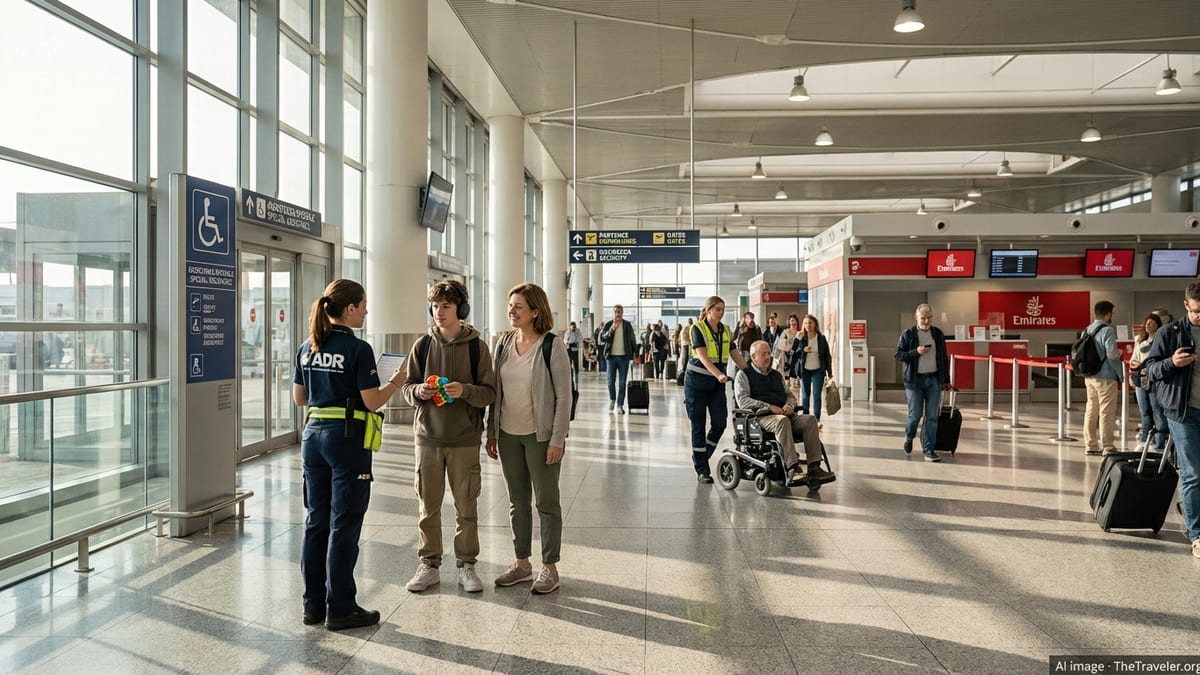
Travel Rehearsal Brings Airport Experience to Life
A new initiative called Travel Rehearsal debuted this week at Rome Fiumicino, giving autistic travelers and people with sensory sensitivities the chance to experience a full airport journey in a controlled, low-pressure setting. Co-organized by Emirates and ADR in partnership with local autism association ANGSA Lazio APS, the program recreated every key step of a real trip, from arrival at the terminal to boarding the aircraft.
The Rome session, held on 21 February, involved 12 young participants and 16 caregivers who were guided through check in, security screening, gate procedures and boarding. The aim was to help participants become familiar with the environment, noises and formalities that can often trigger anxiety, so that future journeys feel more predictable and manageable.
For Emirates, the Travel Rehearsal is part of a broader focus on hidden disabilities and sensory needs, extending work first launched at its Dubai hub to selected airports across its network. At Fiumicino, ADR’s staff and facilities provided the operational backbone, ensuring the simulation mirrored real passenger flows while remaining flexible and supportive for each individual.
By allowing families to practice the journey in advance, organizers hope to chip away at the reality that many autistic travelers simply choose not to fly. Industry estimates cited by the partners suggest that a large majority of people on the autism spectrum avoid air travel because of unfamiliar environments and fear of overwhelming situations.
Rome Fiumicino Emerges as a Testbed for Inclusive Design
The Travel Rehearsal is the latest in a series of projects positioning Rome Fiumicino as a European testbed for more inclusive airport design. ADR has made accessibility and personalized assistance a core pillar of its development strategy, pairing staff training with technology-driven support.
In early February, ADR Assistance, the group’s dedicated unit for passengers with reduced mobility, strengthened its coordination with Italy’s rail infrastructure manager Rete Ferroviaria Italiana at the Fiumicino Airport railway station. The new setup creates a clearer handover point between rail and air services, reducing waiting times and ensuring that travelers who need help are supported continuously from the train platform to the terminal and back again.
A dedicated interchange area and joint monitoring of requests mean that wheelchair users and other passengers requiring assistance are less likely to experience gaps in service when moving between transport modes. For an airport that functions as a major rail-air hub for central Italy, this is a critical piece of the accessibility puzzle.
These changes build on earlier investments in inclusive mobility across the airport campus, including electric shuttle fleets linking terminals and car parks, and a growing number of clearly signed assistance points that make it easier for passengers to request help at short notice.
Digital Tools Expand Support for Disabled and Visually Impaired Travelers
ADR is also turning to digital tools to support independent travel, particularly for blind and low-vision passengers. A partnership with accessibility platform Be My Eyes is being integrated into the airport’s assistance ecosystem, allowing travelers to connect via live video and AI-powered tools with trained agents who can guide them through wayfinding, information screens and service locations.
The technology, accessible through the Be My Eyes mobile app, is designed to complement on-the-ground assistance rather than replace it. Passengers can, for example, receive help locating check in desks, reading flight updates or confirming the right boarding gate without having to rely solely on physical signage or public announcements.
For ADR, these tools are part of a wider shift toward hyper-personalized travel, where passengers with different needs can tailor the level and type of support they receive. Combined with initiatives like Travel Rehearsal, they signal a move away from a one-size-fits-all model towards a more nuanced understanding of disability, including hidden conditions and sensory differences.
The airport operator has framed accessibility not as a niche service but as a mainstream quality marker for a global hub. With Fiumicino consistently ranked among Europe’s leading airports, its technology pilots and partnerships are being closely watched by peers across the region.
A Global Model for Inclusive Travel Partnerships
For Emirates, the Rome Travel Rehearsal is a key European chapter in a global accessibility roadmap that began at its home base in Dubai. The airline has been rolling out programs that help passengers with sensory sensitivities and cognitive disabilities familiarize themselves with flying, from pre-visit airport tours to dedicated guidance materials and adapted in-terminal processes.
By teaming up with ADR, Emirates is able to extend that approach beyond its own hub and into an important gateway for Europe-bound traffic. Fiumicino is one of the busiest airports on the continent and a key destination for travelers from the Gulf, making it a strategic location to trial support models that could later be replicated elsewhere in the network.
The collaboration also underscores a broader change in how airlines and airports approach accessibility. Rather than each actor working in isolation, initiatives like Travel Rehearsal demand close coordination between terminal operators, ground handlers, check in teams, security staff and airline crews. Only by aligning procedures and communication can airports deliver the consistent, low-stress journey that neurodivergent passengers in particular require.
Industry observers note that such partnerships are becoming a competitive differentiator as travelers and advocacy groups scrutinize how aviation players respond to accessibility expectations. Rome’s new simulation program, coupled with its enhanced assistance links and digital tools, positions both ADR and Emirates as early movers in a space that is likely to see rapid evolution in the coming years.
Raising the Bar for Future Airport Experiences
The series of upgrades at Fiumicino comes as airports worldwide reassess their customer experience strategies in the wake of growing demand and changing traveler demographics. An aging population, better recognition of neurodiversity and stronger legal frameworks around disability rights are all pushing operators to rethink how terminals are designed and staffed.
Rome’s recent steps suggest that future airport experiences will be measured not only by speed and retail variety but also by how confidently a wide range of passengers can navigate them. Simulated journeys like Travel Rehearsal, cross-modal assistance agreements and AI-supported guidance platforms are early examples of what a more inclusive standard could look like in practice.
While many of the new tools and procedures are still in pilot phase, ADR and Emirates are signaling that accessible travel is moving from a specialist concern to a central part of mainstream airport planning. For travelers who have long felt excluded by the stress and unpredictability of flying, Rome Fiumicino’s evolving model offers a tangible glimpse of a more welcoming future in the air.