

More news on this day
As a widening conflict shutters large swathes of Middle Eastern airspace and leaves hundreds of thousands of passengers stranded, Dubai’s powerhouse carriers Emirates and Flydubai are working to stitch global travel back together from one of the world’s most important hubs.
Get the latest news straight to your inbox!
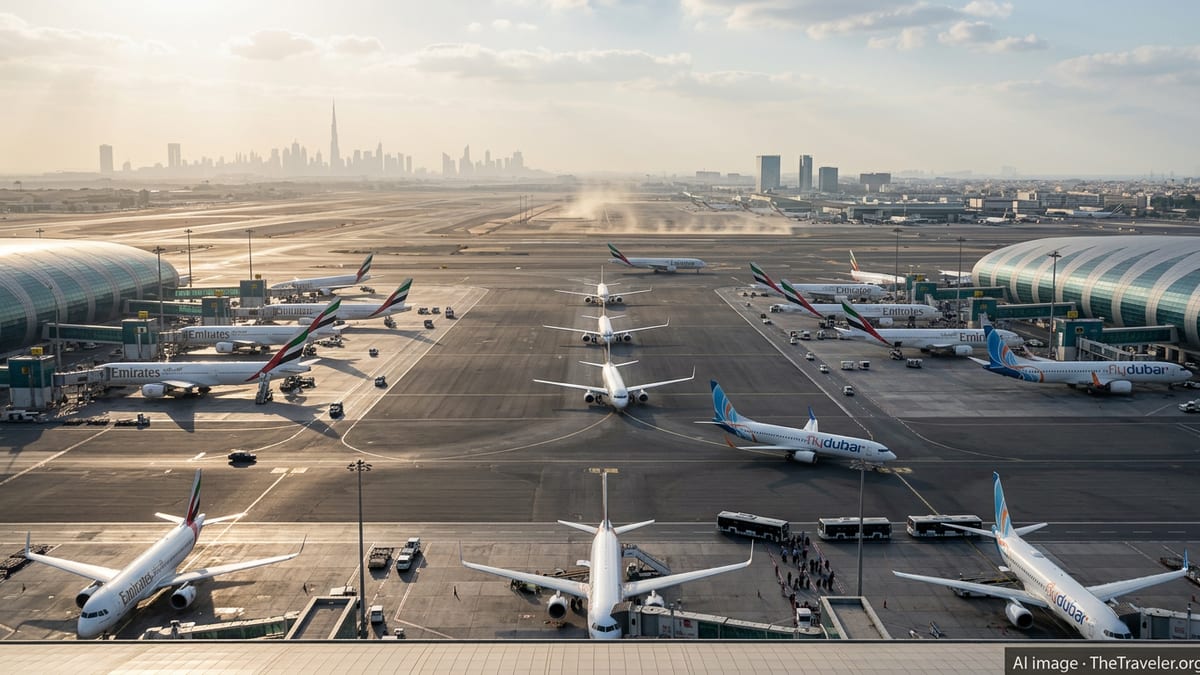
Hub of a Region in Turmoil
Dubai International Airport has once again become a focal point of global aviation disruption as military tensions involving Iran, Israel and the United States have triggered rolling airspace closures across the Gulf. In recent days, airspace managed or affected by Iran, Iraq, Qatar, Bahrain, Kuwait, Saudi Arabia and the United Arab Emirates has been periodically shut or heavily restricted, bringing scheduled operations to a standstill at airports that normally link Europe, Africa and the Americas with Asia and Australasia.
Reports from industry trackers indicate that Dubai, Abu Dhabi and Doha saw more than a thousand flights cancelled or diverted in the immediate aftermath of the latest strikes, with Dubai’s two airports experiencing some of the heaviest disruption. Aviation analytics show that Emirates, Flydubai and their Gulf peers typically move tens of thousands of passengers through these hubs every day, underscoring how quickly conflict in the region spills over into global travel patterns.
The crisis comes on the heels of earlier disruptions over the past two years, from temporary airspace shutdowns in June 2025 to severe flooding and weather-related cancellations in the United Arab Emirates. Those episodes forced airlines based in Dubai to hone their contingency planning and build playbooks for rapid recovery, experience that is now being deployed as they navigate the latest wave of instability.
Emirates Scales Back, Then Ramps Up
Emirates, Dubai’s flagship carrier and one of the world’s largest long-haul airlines, has taken the most visible measures as the conflict has intensified. Publicly available operational updates show that the airline initially suspended all scheduled departures to and from Dubai for several days as airspace closures rippled across the region, prioritising customer safety and compliance with regulatory directives.
As selected corridors have reopened, the carrier has shifted into recovery mode. Industry coverage indicates that Emirates has begun operating a mix of exceptional services aimed at clearing backlogs of stranded passengers, while preparing to restore its extensive global network. In some cases, aircraft that would normally operate nonstop over the Gulf and Iran are instead being routed north over Turkey and the Caucasus or south via the Arabian Sea, lengthening flight times but keeping city pairs connected.
Emirates is also drawing on lessons from previous spikes in regional tension, when it temporarily suspended routes to high-risk destinations such as Tel Aviv and adjusted frequencies to cities in Iraq and Lebanon. Analysts note that the airline’s widebody fleet and deep slot portfolio at Dubai International give it flexibility to add capacity quickly once airspace stabilises, allowing it to re-accommodate disrupted travelers more efficiently than many competitors.
Flydubai Focuses on Regional Connectivity
While Emirates concentrates on long-haul intercontinental flows, Flydubai has become a critical lifeline for short and medium-haul connectivity around the Middle East, Central Asia, East Africa and the Indian subcontinent. The low-cost carrier, which operates primarily narrowbody Boeing jets from Dubai International, has faced its own share of cancellations and diversions as conflict-adjacent airspace has closed without much notice.
Flight information published in recent days shows that Flydubai has partially resumed operations from key terminals, albeit with capacity still constrained and schedules subject to change at short notice. The airline has focused its restored flying on high-demand regional routes where alternative options for travelers are limited, including to South Asian cities and labor corridors that depend heavily on Gulf connectivity.
During previous periods of heightened tension, Flydubai suspended service to destinations in Iran, Iraq and Lebanon while maintaining a skeleton network elsewhere. Current patterns appear similar, with the carrier trimming exposure to the most volatile areas even as it works to keep essential regional links open. For travelers, that has translated into a patchwork of operational routes that still provide options to reach Dubai for onward long-haul connections with Emirates when conditions allow.
Rerouting, Longer Flights and Rising Costs
The wider reconfiguration of airspace across the Middle East has forced both Emirates and Flydubai to embrace significant rerouting, adding time and cost to many journeys. Publicly available flight-tracking data shows that services which previously followed relatively direct great-circle paths over conflict-affected countries are now bending far north or south to avoid closed skies, sometimes adding an hour or more to block times.
This shift has operational and financial implications. Longer routes translate into higher fuel burn, tighter aircraft utilisation and increased crew duty times, all of which can strain airline schedules and margins. Industry observers point out that if the current conflict and associated airspace restrictions persist, ticket prices on certain city pairs could rise as carriers seek to recoup elevated operating costs.
For now, the priority at Dubai’s airlines appears to be restoring reliability rather than profitability. Schedules are being rebuilt cautiously, with spare aircraft and crew kept in reserve where possible to absorb last-minute changes. Travellers are being advised by airline communications and travel advisories to monitor their bookings closely, sign up for notifications and be prepared for rebooking onto alternative routings or dates.
Dubai’s Role in Global Travel Resilience
The latest crisis underscores Dubai’s centrality to modern air travel and the ripple effects when its skies fall quiet. Before the current conflict, regional traffic data highlighted how airports in the United Arab Emirates had become key drivers of aviation resilience, even as demand in the wider Middle East softened due to political and economic uncertainty. Dubai International consistently ranked among the busiest international hubs worldwide, with Dubai World Central expanding rapidly as a secondary airport.
Analysts note that this hub-and-spoke strength cuts both ways: disruption at Dubai can radiate across continents, but a rapid restart there can also accelerate the broader recovery of global networks. With both Emirates and Flydubai now gradually rebuilding schedules, attention is turning to how quickly they can clear the backlog of disrupted passengers and re-establish predictable connections between Europe, Africa, Asia and Australasia.
Travel industry experts suggest that the experience accumulated during earlier airspace closures and weather events has left Dubai’s aviation ecosystem better prepared than in past crises. Ground handlers, airport authorities and airlines have invested in contingency planning, data-driven dispatch tools and cross-border coordination, all of which are being tested once again as they work to keep people and trade moving through one of the world’s most strategically important crossroads.