

More news on this day
Emirates and Flydubai are set to operate a combined 417 departures from Dubai International Airport this weekend, with 210 flights scheduled for Friday, March 27, and 207 for Saturday, March 28, signaling a period of relative stability in outbound operations after weeks of disruption across the United Arab Emirates’ airspace.
Get the latest news straight to your inbox!
Stable But Reduced Schedules Out of DXB
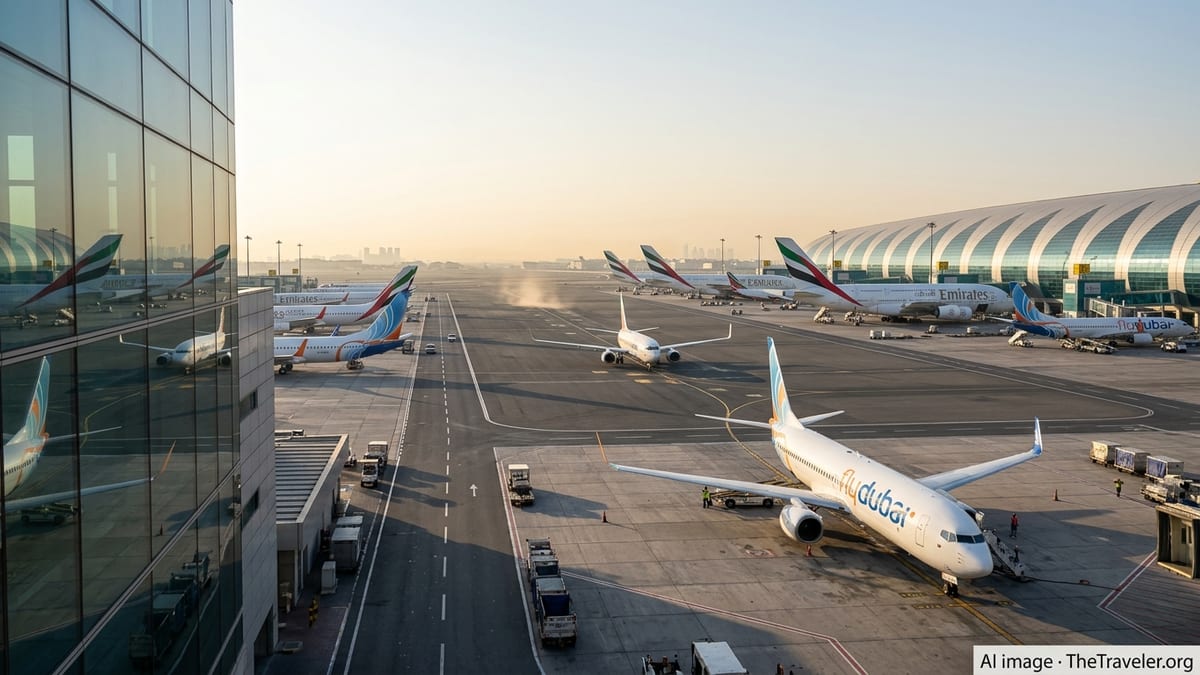
Publicly available schedule data for March 27 and 28 indicates that Emirates and Flydubai are maintaining a stable pattern of outbound flights from Dubai International Airport, even as the wider regional situation remains fragile. The two carriers are expected to operate 210 departures on Friday and 207 on Saturday, covering a mix of long-haul, medium-haul, and regional routes.
The current volumes remain below the airlines’ pre-crisis levels, but the weekend pattern suggests that the worst of the immediate disruption has eased. Industry trackers and airline schedule summaries show that most departures now follow a predictable wave structure across early morning, mid-day, and late-night banks, offering more certainty for travelers who have managed to secure confirmed bookings.
Timetable information also points to a continued focus on core markets, with capacity prioritized on high-demand routes to Europe, South Asia, and key Middle Eastern gateways. Secondary and purely seasonal routes appear to be returning more slowly, underscoring that this weekend’s stability is part of a phased recovery rather than a full restoration of normal operations.
Despite the improvement, aviation data services continue to flag a higher-than-usual risk of short-notice changes, meaning that the apparent stability in headline flight counts does not fully capture the operational complexity airlines are managing behind the scenes.
Recovery Continues After Early-March Shutdown
The steady flow of flights this Friday and Saturday comes less than a month after Dubai International Airport experienced one of its most disruptive periods in recent memory. Airspace closures and security concerns at the end of February and into early March led to a near-total halt of scheduled commercial flights, with Emirates and Flydubai among the carriers forced to suspend most services.
By early March, reports indicated that Dubai International had reopened on a limited basis, with carefully controlled movements and a gradual return of passenger services. Emirates, in particular, shifted from operating only repatriation and essential flights to rebuilding its network in stages, first restoring a fraction of its destinations and then scaling up as conditions allowed.
Analysis of airline communications, aviation databases, and airport updates over the past three weeks shows a clear trajectory from emergency shutdown to constrained recovery. Emirates moved from suspension to a limited network and then toward a majority of its usual routes, while Flydubai progressively increased its regional footprint from a handful of services to a broader schedule across the Gulf, Middle East, and selected near-Europe points.
The 210 and 207 ex-Dubai departures this Friday and Saturday therefore represent more than just raw numbers; they are the latest markers in a carefully managed ramp-up designed to restore connectivity while respecting ongoing operational and security constraints in the region.
Passenger Experience: More Predictable, Still Dynamic
For travelers transiting Dubai this weekend, the stabilization of Emirates and Flydubai schedules translates into a more predictable, though still cautious, experience. Flight-status tools and booking engines show a majority of the Friday and Saturday services as operating as planned, with fewer last-minute cancellations than earlier in March.
Even so, the recovery phase is characterized by tight controls at Dubai International. Information shared by passengers and aviation watchers in recent days describes an airport that is busier than during the shutdown but still short of its typical peak-season crowds. Access to terminal check-in areas has often been restricted to passengers holding confirmed, same-day flights, a measure that helps keep congestion manageable while flight programs are rebuilt.
Rebooking patterns highlight how airlines are using the relatively stable weekend schedule to clear backlogs. Many travelers affected by earlier cancellations have been shifted onto these March 27 and 28 departures, contributing to higher load factors on select routes. Travel agents and online forums continue to advise customers to reconfirm itineraries and monitor any schedule adjustments in the 24 hours before departure.
Operational data suggests that connection windows, particularly for long-haul itineraries with regional feeders, remain tighter than usual. Passengers connecting between Emirates and Flydubai at Terminal 3 are generally benefiting from synchronized schedules, but with fewer back-up options in the event of delays compared with a fully restored timetable.
Network Focus: Core Hubs and High-Demand Corridors
The breakdown of this weekend’s 417 outbound flights shows that both Emirates and Flydubai are concentrating on their most commercially and strategically important corridors. Long-haul services on Emirates aircraft continue to anchor the schedule, linking Dubai with North America, Europe, Africa, and Asia on a slimmed-down but broadly representative version of the carrier’s usual global network.
On the regional side, Flydubai’s operations complement Emirates by providing dense coverage across the Gulf Cooperation Council, the wider Middle East, parts of East Africa, and select destinations in Central and Eastern Europe. Industry analysts note that this co-ordinated approach allows the two airlines to maintain Dubai’s role as a transfer hub even without fully restoring every pre-crisis route or frequency.
Weekend timetables underline a particular emphasis on South Asian gateways, key European capitals, and major regional business centers. These markets not only generate strong point-to-point demand but also underpin connecting traffic through Dubai to onward destinations, which remains essential to the economics of both carriers’ networks.
Less central destinations, especially purely leisure or seasonal points, appear later in the recovery curve. Flight-search data and schedule filings show fewer frequencies or, in some cases, continued pauses on these routes, reflecting a prioritization of capacity where it is likely to be most immediately needed.
What Travelers Should Expect Over the Coming Days
Looking beyond this Friday and Saturday, aviation observers expect Emirates and Flydubai to continue gradually increasing their schedules from Dubai, provided regional conditions do not deteriorate. Recent statements and operational summaries from the carriers have pointed to an ambition to restore most of their pre-disruption networks, though without committing to a fixed date for full normality.
For passengers, the near-term picture is one of cautious optimism. The fact that 210 and 207 departures are scheduled out of DXB on consecutive days suggests that airlines are confident enough in airspace stability and airport capacity to plan more than a day or two ahead. At the same time, the experience of early March means that both travelers and carriers are acutely aware of how quickly circumstances can change.
Travel industry guidance for those flying this weekend remains consistent: book only flights that appear as operating in up-to-date schedules, keep contact details current with the airline, and check for changes repeatedly in the run-up to departure. Many carriers, including Emirates and Flydubai, continue to offer flexible rebooking options for travelers affected by the earlier wave of cancellations, and these policies are likely to play an important role as schedules are refined.
As long as Dubai’s airspace remains open and no new operational shocks emerge, the 417 Emirates and Flydubai flights leaving DXB on March 27 and 28 may come to be seen as an early sign that one of the world’s busiest long-haul hubs is moving from emergency response into a more durable, if still cautious, phase of recovery.