

More news on this day
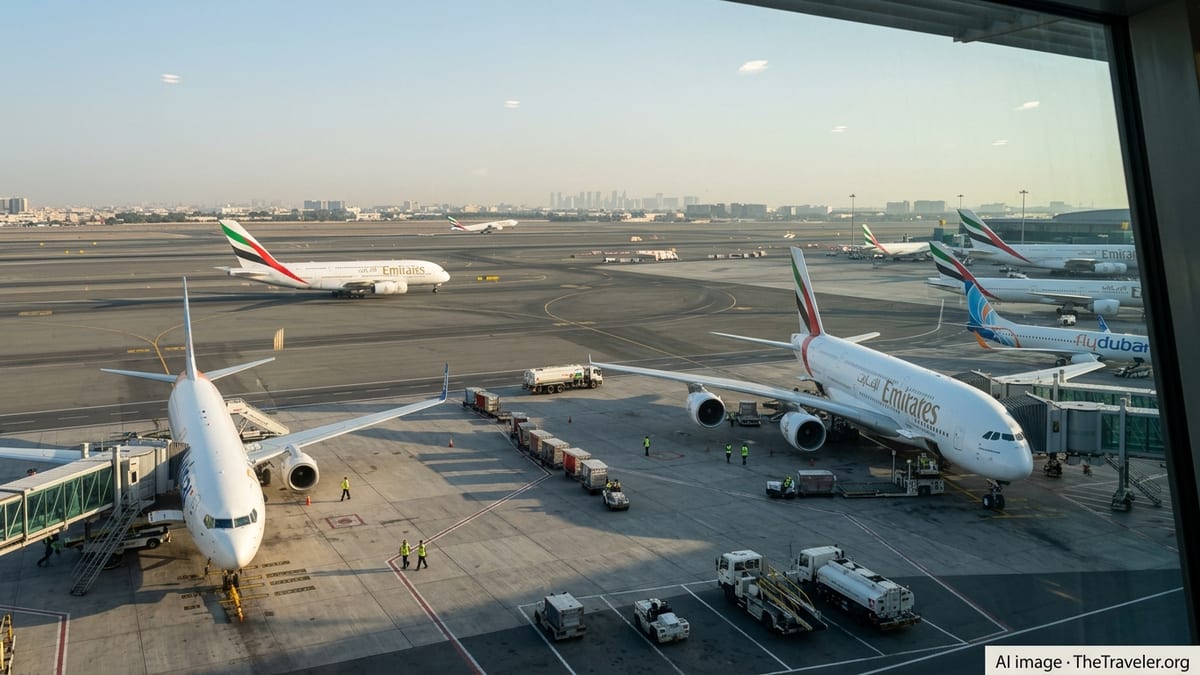
Emirates and Flydubai are maintaining broadly stable operations out of Dubai International Airport this week, with 206 combined departures scheduled for Wednesday, March 25, and 207 for Thursday, March 26, according to publicly available schedule data and recent operational updates.
Get the latest news straight to your inbox!
Stable Departures Signal Next Phase of Recovery
The latest combined schedule figures for Emirates and Flydubai point to a steadying phase in Dubai’s air travel recovery, with only a single additional departure separating Wednesday and Thursday’s operations. Industry schedule data for flights originating at Dubai International Airport indicate that the two carriers have settled into a consistent pattern of just over 200 daily outbound services for March 25 and 26.
This level of activity reflects a move away from the highly constrained operations seen earlier in the month, when regional airspace closures and precautionary restrictions significantly reduced flight volumes across the Gulf. Recent summaries of airline operations show that Emirates has been rebuilding its network in stages, while Flydubai has focused on restoring core regional and short-haul routes from its base at Dubai International.
While the 206 and 207 departure totals are still below the carriers’ pre-disruption peaks, the near-identical figures over consecutive days suggest that the immediate phase of rapid schedule adjustments is giving way to a more predictable, medium-term operating pattern.
For travelers, the relatively stable day-to-day numbers mean that short-notice mass cancellations are becoming less frequent, although airlines continue to caution that individual flights may still be retimed or consolidated as conditions evolve.
Emirates Focuses on Network Breadth From DXB
Emirates remains the dominant long-haul operator at Dubai International, and recent public updates show the airline concentrating on restoring reach across its global network, even if frequencies on some routes remain temporarily reduced. After earlier periods of suspension and limited flying, the carrier has progressively added back destinations, aiming to reconnect major gateways in Europe, Asia, Africa and the Americas.
Operational summaries and schedule snapshots for the week of March 25 indicate that a substantial portion of Emirates departures from Dubai are again focused on high-demand markets such as India, the United Kingdom and key European hubs, alongside a growing number of services to North America and Asia-Pacific. The balance between widebody routes and shorter regional sectors is being adjusted as demand patterns become clearer following the recent disruption.
Emirates’ contribution to the 206 and 207 combined daily departures is understood to account for the majority of long-haul flights from Dubai over both days. Publicly available schedule feeds show that the airline continues to prioritize trunk routes where aircraft can be filled with a mix of point-to-point and connecting traffic, while selectively rebuilding secondary frequencies as aircraft and crew availability allow.
Although some travelers continue to face rebookings, reports on recent operations indicate that passengers with confirmed bookings on active services are increasingly able to complete their journeys as scheduled, especially on the flagship routes that underpin Emirates’ global hub model at Dubai International.
Flydubai Anchors Regional and Short-Haul Connectivity
Flydubai, which is also based at Dubai International, is playing an important role in shoring up regional and short-haul connectivity as the wider network normalizes. The carrier’s Boeing 737 fleet is primarily deployed on routes within the Middle East, North and East Africa, the Indian subcontinent and parts of Central and Eastern Europe, many of which serve as feeders into Emirates’ long-haul network.
According to recent operational updates and airport departure data, Flydubai has been steadily reinstating services that were scaled back during the height of airspace restrictions. The airline’s share of the 206 and 207 combined daily departures from Dubai this Wednesday and Thursday is concentrated on high-frequency regional routes, where demand has rebounded quickly as borders remain open and business and leisure travel resumes.
Flydubai’s presence at Dubai International is particularly significant for point-to-point passengers traveling between Dubai and secondary cities that are not served directly by Emirates. The carrier’s ability to maintain a relatively consistent number of departures across the two days suggests that schedules on many regional routes are now running with fewer last-minute structural changes, even if aircraft swaps and minor retimings still occur.
For connecting travelers, the stabilization of Flydubai’s timetable improves the reliability of itineraries that involve transfers between Flydubai and Emirates at Dubai International’s Terminal 3 complex, a key element of the two airlines’ long-standing partnership.
Regional Context: From Disruption to Managed Normalization
The steady departure figures for March 25 and 26 sit against a backdrop of wider regional disruption earlier in the month, when airspace restrictions across parts of the Middle East led to extensive schedule cuts and route suspensions. Industry advisories and travel management bulletins published in early March highlighted thousands of cancellations across multiple Gulf hubs, including Dubai, Abu Dhabi and Doha, as airlines paused or sharply reduced operations for safety and regulatory reasons.
In the weeks since, publicly available airline advisories have described a phased recovery as regional airspace corridors reopened and operational limitations were gradually eased. Emirates and Flydubai both initially operated very limited schedules before scaling up to higher daily departure counts, such as the 206 and 207 flights now planned from Dubai International on Wednesday and Thursday.
Aviation analysts note that even as schedules appear more regular, airlines are still navigating complex routing constraints, crew duty-time limits and aircraft positioning challenges. As a result, the apparent stability in total daily departures does not mean that all routes have returned to former frequencies, nor that the network has fully recovered to pre-disruption patterns.
Nonetheless, the ability to sustain more than 200 combined outbound flights per day from Dubai International over consecutive days is widely viewed in the industry as a milestone on the path from emergency operations toward a more managed form of normality.
What Passengers Should Expect on March 25 and 26
For travelers booked on Emirates or Flydubai services departing Dubai on Wednesday, March 25, or Thursday, March 26, the latest schedules suggest broadly stable operations with a similar number of flights on both days. Publicly accessible travel advisories continue to emphasize that passengers should monitor airline communication channels closely, as individual flights may still be adjusted in response to operational needs.
Industry guidance circulating this week advises passengers not to proceed to the airport unless they hold a confirmed booking and have checked the latest status of their specific flight on the day of travel. While large-scale, last-minute cancellations have become less common than during the peak of disruption, airports and airlines in the region remain cautious, aiming to avoid overcrowding in terminals and to manage passenger flows in line with the current operating environment.
Travel specialists also note that connection times through Dubai may still be tighter than usual for some itineraries, particularly where rerouted services rely on longer flight paths or constrained airspace corridors. Travelers with complex journeys or short scheduled layovers are being encouraged to build in additional buffer time where possible and to be prepared for schedule adjustments.
As Emirates and Flydubai work within a more predictable daily departure framework of 206 flights on Wednesday and 207 on Thursday, March 25 and 26 are shaping up as test days for how reliably the two-carrier system at Dubai International can operate under an adjusted, yet increasingly steady, regional aviation landscape.