

More news on this day
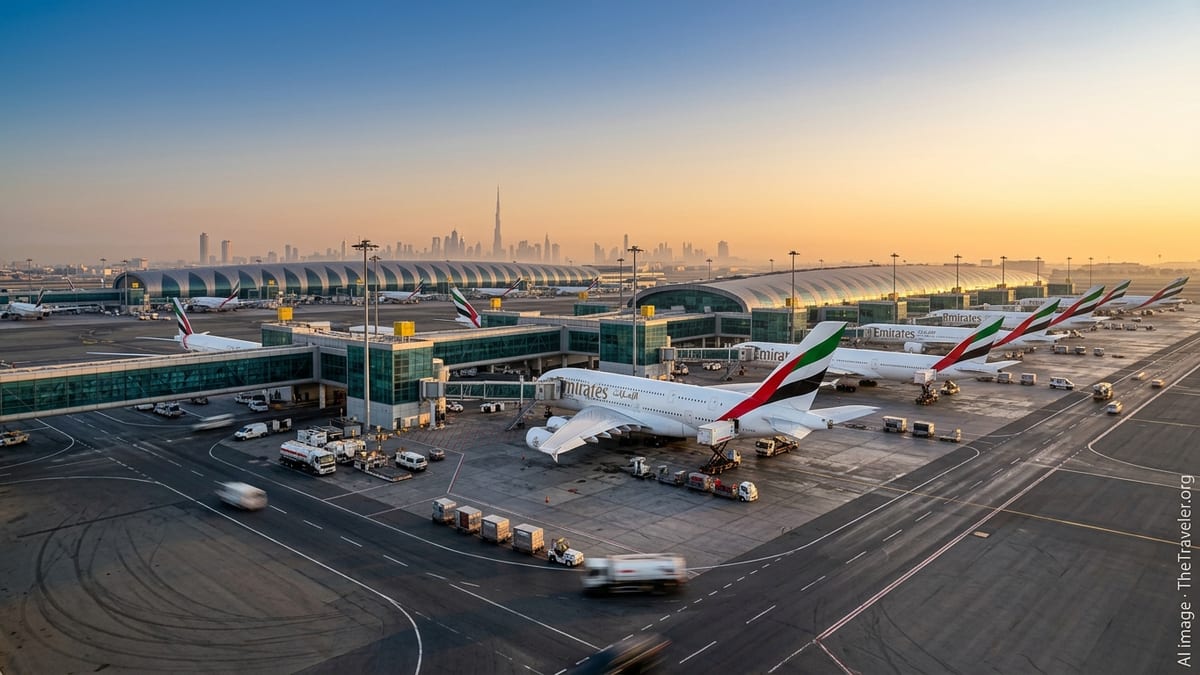
Emirates is moving to restore its full worldwide schedule as the United Arab Emirates reopens key air corridors in March 2026, marking a pivotal restart for Dubai and Abu Dhabi after weeks of war-related airspace closures that brought much of the region’s hub traffic to a standstill.
Get the latest news straight to your inbox!
From Shutdown to Full Schedule in a Matter of Weeks
The UAE’s airspace went from near silence to rapid recovery in late February and early March after regional conflict forced authorities to halt most commercial traffic across Dubai, Abu Dhabi and other key hubs. Flight-tracking data and industry alerts showed thousands of cancellations and diversions at the height of the disruption, with hub carriers scrambling to mount limited repatriation services for stranded travelers.
By early March, notices to airmen signaled a gradual reopening of tightly controlled corridors into Dubai International and other northern UAE airports. Airlines initially focused on evacuation and repositioning flights, while regular commercial services remained sharply reduced and subject to short-notice changes.
Now, mid-March 2026, Emirates is transitioning from this emergency footing to what it describes in public updates and schedule filings as a return to its full pre-disruption network. Industry briefings and aviation data indicate that the carrier has already restored the vast majority of routes and frequencies that were operating before the February closures, with the remaining services due to come back in the coming days as routings stabilize.
The speed of the recovery stands in contrast to earlier regional disruptions in 2025, when partial airspace restrictions lingered for longer and constrained schedules well after the immediate security crisis had passed.
Dubai’s Global Hub Model Proves Its Resilience
The restoration of Emirates’ full capacity underscores Dubai’s dependence on its role as a long-haul connector between Europe, Asia, Africa and the Americas. With virtually no domestic market, the emirate’s aviation strategy rests on maintaining smooth, high-frequency connections for transfer passengers using Dubai International as a one-stop gateway.
Publicly available aviation data for early 2026 already showed Emirates leading the regional market in total seats before the latest crisis, with capacity in January up more than 5 percent year on year and edging past pre-pandemic benchmarks. That trajectory was built on a mix of widebody deployment, growing premium economy offerings and an expanding web of partnerships that extend the airline’s reach far beyond its own metal.
Analysts note that the abrupt shutdown in late February effectively froze that momentum, leaving aircraft and crews out of position and forcing the airline to prioritize essential traffic. The rapid normalization of schedules this month suggests the network was robust enough to absorb the shock and return quickly to its preferred pattern of dense waves of arrivals and departures timed for global connectivity.
For Dubai’s broader economy, the resumption of full Emirates operations is likely to support tourism, conferences and trade flows that depend heavily on predictable air access. Hotel and retail sectors that saw a short-term dip in visitor numbers during the closures are expected to benefit as transit flows resume and long-haul travelers regain confidence in routing via the UAE.
Abu Dhabi Rides a Parallel Wave of Recovery
While Emirates dominates headlines, Abu Dhabi’s aviation rebound is moving in parallel. Etihad Airways entered 2026 on the back of a record 2025 profit and a sharp rise in passenger volumes, supported by a disciplined network strategy and ongoing fleet renewal centered on fuel efficient widebodies.
Traffic figures published for January 2026 showed double digit growth in both passengers and cargo for Etihad, reinforcing Abu Dhabi’s push to position its rebranded Zayed International Airport as a world-class hub in its own right. Those gains were briefly interrupted by the same regional airspace closures that hit Dubai, but Abu Dhabi was among the first UAE gateways to restart controlled operations earlier this month.
Industry reports indicate that Etihad has now restored most of its scheduled destinations and frequencies, coordinating with Emirates and other regional carriers as air traffic management gradually returns to standard routings. The combined effect is a rapid reactivation of the UAE’s dual-hub system, in which Dubai and Abu Dhabi each serve distinct segments of the long-haul market while benefiting from shared infrastructure and regulatory frameworks.
The synchronized recovery strengthens the UAE’s position in the competitive Gulf aviation landscape, where neighboring Qatar and Saudi Arabia are investing heavily to capture transfer traffic and long-haul tourism.
Fleet Growth and Premium Cabins Shape the 2026 Landscape
Emirates’ return to full capacity is not simply a restoration of the status quo. The airline is moving into 2026 with a larger and more diversified fleet profile, including newly delivered Airbus A350s and a future pipeline of Boeing 777-9 aircraft ordered at the 2025 Dubai Airshow. These additions are expected to support both growth and a gradual refresh of older widebodies.
At the same time, Emirates is deepening its commitment to premium economy, a cabin it plans to offer on dozens of routes by mid-2026. Aviation analysts note that the airline is targeting millions of premium economy seats annually as part of a strategy to capture travelers who want an upgraded experience without paying full business class fares. That product focus is likely to be central as the carrier rebuilds yields following the latest disruption.
Other UAE airlines are also expanding fleets and updating cabins. Flydubai has placed a major order for Airbus A321neo aircraft, signaling a long term bet on high efficiency narrowbody operations, while Etihad is inducting new generation widebodies with significantly lower fuel burn. Together, these moves point to an aviation system that is not only recovering capacity but also modernizing for the next phase of growth.
For passengers, the combination of renewed schedules and upgraded aircraft means more options for connecting through Dubai and Abu Dhabi, with an emphasis on comfort and reliability alongside scale.
A New Era of Risk Management for Gulf Airspace
The speed with which Emirates and its UAE peers are restoring full operations masks a more complex underlying reality: regional airspace is likely to remain exposed to geopolitical risk. The February and March 2026 closures followed earlier episodes of tension that had already prompted some airlines to adjust routings or avoid certain corridors.
Aviation security bulletins and insurer advisories suggest that carriers operating through Gulf airspace are refining contingency planning, including alternative routings, additional fuel loads and flexible crew scheduling to cope with potential short-notice restrictions. Hub operators in Dubai and Abu Dhabi are similarly investing in operational resilience, using data and close coordination with regulators to manage sudden surges in diversion and recovery traffic.
For travelers, the new environment may translate into more frequent schedule adjustments even as overall capacity grows. Industry observers expect airlines to keep building slack into networks and to communicate more actively about rerouting options when tensions flare, reflecting lessons learned from the recent shutdown.
Yet despite those risks, the swift return of Emirates to full capacity highlights the enduring pull of the UAE’s hub model. As 2026 unfolds, Dubai and Abu Dhabi appear set not only to reclaim their roles at the heart of global air travel, but to test new strategies for keeping their skies open in an era of heightened volatility.