

More news on this day
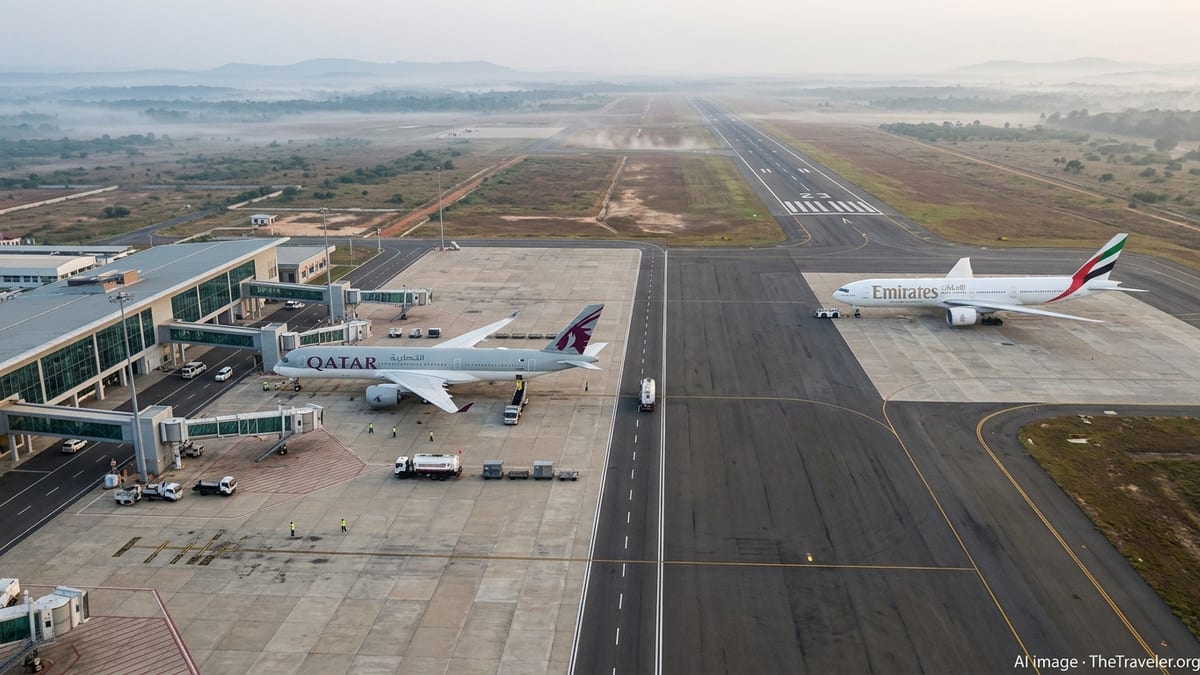
Emirates is reported to be aligning with Qatar Airways on a transformative proposal to position Sri Lanka’s Mattala Rajapaksa International Airport as a principal contingency hub for long-haul flights, as carriers reassess diversion strategies amid ongoing airspace closures and geopolitical uncertainty across parts of the Middle East.
Get the latest news straight to your inbox!
Middle East Turmoil Shifts Attention to Indian Ocean Diversion Options
Recent airspace closures and conflict-related restrictions in and around the Gulf region have forced global airlines to redraw long-haul routings, intensifying the search for reliable diversion and refuelling points along key East–West corridors. Publicly available schedules, airline advisories and passenger accounts point to a sustained period of disruption, with carriers trimming frequencies, adding technical stops and, in some cases, suspending services on short notice.
Qatar Airways has been among the most affected, introducing limited relief flights and special operations as it works within tightly controlled air corridors. Published coverage and regulatory notices describe a network operating under temporary permissions, with rerouted flights carefully sequenced to avoid sensitive zones and to manage congestion at alternate airports.
Against this backdrop, aviation analysts have drawn increasing attention to Sri Lanka’s geographic position in the northern Indian Ocean, directly beneath busy Europe–Asia and Middle East–Asia flight paths. Industry commentary highlights the strategic potential of Sri Lanka’s secondary gateway, Mattala Rajapaksa International Airport, to play a much larger role in contingency planning for widebody operations when primary hubs are constrained.
Reports circulating in regional aviation media now indicate that Emirates is exploring a more structured use of Sri Lankan infrastructure for diversions, placing it in alignment with concepts previously associated with Qatar Airways. The emerging picture is of Gulf super-connectors reassessing their backup options and looking south to Sri Lanka as a stable staging point during periods of heightened regional risk.
Mattala Rajapaksa Airport Quietly Builds a Safety-First Track Record
Mattala Rajapaksa International Airport, located near Hambantota in Sri Lanka’s deep south, has long been portrayed as underutilised, but recent data shows a steady expansion of its operational role. Aviation industry overviews and local business reporting note that the airport has logged its highest-ever passenger movements, handled charter and cargo operations, and supported medical evacuations, underscoring its ability to manage complex missions.
In several high-profile weather and regional disruption events, Sri Lankan authorities have placed Mattala on standby or activated it to receive diverted aircraft. Local news coverage details instances where multiple inbound flights originally bound for Colombo’s Bandaranaike International Airport were rerouted to Mattala during fog and adverse conditions, with widebody jets refuelling and turnaround operations completed within tight windows.
More recently, Sri Lanka’s Civil Aviation Authority has publicly highlighted Mattala’s readiness as part of a formal contingency framework. Statements in Sri Lankan newspapers describe emergency operational plans that explicitly identify Mattala as a diversion field for international traffic when congestion or risk factors affect other airports in the region. This planning work, carried out with airlines and ground-handling partners, has focused on passenger facilitation, fuel availability and runway performance for large aircraft types.
These developments have strengthened the case for using Mattala as a structured contingency node rather than an ad hoc last resort. For long-haul carriers like Emirates and Qatar Airways, which frequently operate twin-engine widebodies over oceanic sectors, such a proven diversion facility near major airways can be a critical asset in designing resilient routings and complying with extended operations requirements.
Gulf Carriers Eye Redundant Hubs as Network Insurance
Across the Gulf, long-haul operators have been revisiting network risk after a series of shocks, from regional conflicts to weather extremes and unplanned airspace closures. Publicly accessible analyses of schedule changes show that airlines have experimented with additional technical stops, temporary tags and capacity shifts toward more southerly corridors, all aimed at maintaining connectivity while avoiding volatile zones.
Industry commentary suggests that Qatar Airways has been at the forefront of discussions about formalising Indian Ocean contingency arrangements, including the use of airports outside its home market as structured alternatives for refuelling and crew changes. Aviation observers note that the carrier’s reliance on a single mega-hub model has exposed it to outsized operational risk when home airspace or surrounding routes are disrupted.
Emirates, with its vast long-haul network radiating from Dubai, is reported to be interested in similar insurance. Analysts point out that having a designated fallback such as Mattala could allow the airline to keep more routes technically open, even if flights must route around restricted zones and make intermediate stops. This approach could preserve aircraft utilisation and customer options in situations where outright cancellations would otherwise be unavoidable.
Emirates and Qatar Airways also both maintain codeshare and alliance ties with SriLankan Airlines and other regional partners, creating a foundation for cooperative use of Sri Lankan infrastructure in emergencies. While there is no indication of a permanent secondary hub on the scale of Doha or Dubai, publicly discussed proposals revolve around a more systematic, pre-agreed use of Mattala as a shared contingency asset.
Opportunities and Constraints for Sri Lanka’s Emerging Aviation Role
For Sri Lanka, a more prominent role for Mattala as an international contingency hub could deliver both opportunities and challenges. Economic commentators argue that increased diversion traffic, fuel uplift and occasional crew layovers would generate incremental foreign exchange earnings, support local service industries and help amortise past investments in the airport.
However, experts also stress that a genuine transformation into a go-to diversion point for Gulf super-connectors would require continued investment. This includes maintaining runway and taxiway standards for fully loaded widebodies, ensuring reliable fuel and ground handling capacity on short notice, and reinforcing air traffic management coordination between Mattala, Colombo and neighbouring flight information regions.
Publicly available planning documents and policy speeches have long referenced Sri Lanka’s ambition to position itself as an aviation and logistics hub for the wider Indian Ocean. In that context, a more formal partnership with carriers such as Emirates and Qatar Airways on contingency operations at Mattala could be seen as a pragmatic, low-visibility step toward that broader vision, allowing the country to leverage geography without overextending financially.
Regional analysts caution that any such arrangement would need to balance commercial interests with security and diplomatic considerations. With multiple Middle Eastern states and external powers involved in shaping overflight permissions, Sri Lanka’s role as a neutral, technically focused safety hub may prove an important part of its foreign policy toolkit as well as its transport strategy.
What a Mattala Contingency Hub Could Mean for Long-Haul Travelers
For passengers, the establishment of Mattala as a recognised diversion and refuelling hub by carriers like Emirates and Qatar Airways would likely be felt most during major disruption events. Instead of outright cancellations or indefinite delays, more flights could proceed on modified routings that include a brief technical stop in southern Sri Lanka, preserving onward connections even if arrival times stretch.
Travel-industry observers note that Mattala’s relatively uncongested infrastructure and modern runway design may allow it to absorb diverted widebody traffic with fewer delays than busier alternates. In practice, this could translate into smoother handling of medical diversions, weather-related reroutes and large-scale airspace closures, particularly on Europe–Australia and Europe–Southeast Asia flows that skirt the northern Indian Ocean.
At the same time, a heavier role for Mattala in contingency operations would highlight the growing importance of backup planning in long-haul travel. Airlines, regulators and airports are placing renewed emphasis on clear passenger communications, transparent rebooking policies and realistic connection guarantees when rerouting over unfamiliar alternates. As Emirates and Qatar Airways refine their approaches, Sri Lanka’s southern gateway looks set to move from aviation curiosity to a quietly pivotal node in global air connectivity planning.