

More news on this day
Emirates is preparing for a robust northern summer 2026 by restoring Airbus A380 services on select routes, adding the double decker to new destinations and increasing frequencies on high-demand city pairs, as the carrier aligns its flagship fleet with resurgent long-haul travel demand.
Get the latest news straight to your inbox!
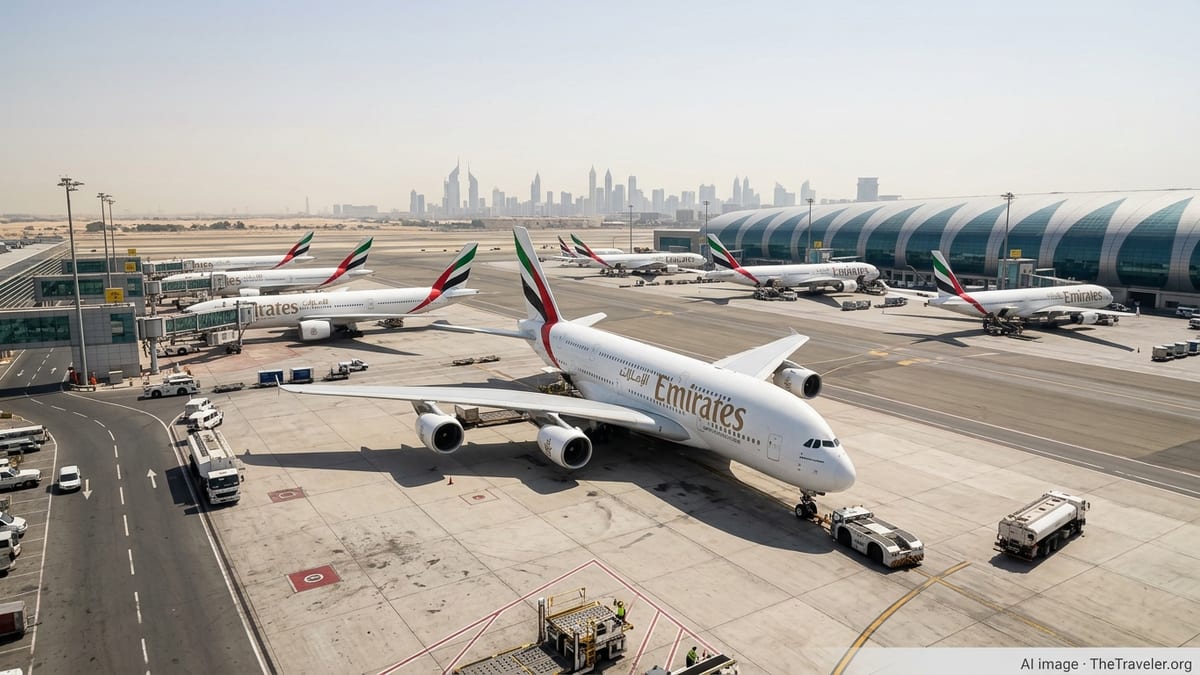
Rising Demand Drives A380 Back to Key Markets
Publicly available schedule data and industry analyses indicate that Emirates is progressively reactivating more of its Airbus A380 fleet in the run-up to summer 2026, targeting trunk routes where premium and leisure demand have rebounded most strongly. The airline has already signaled an ambition to have around 110 A380s active by the end of 2026, underlining its continued commitment to the type even as new-generation twinjets enter the fleet.
Recent network reports show that the A380 continues to anchor Emirates operations on core hubs such as London Heathrow, New York JFK, Sydney and key Southeast Asian destinations, while capacity has been trimmed or reshaped on some secondary routes. Analysts describe the pattern as a shift from blanket deployment to a more surgical use of the double decker, concentrating the aircraft on markets that can consistently support very high seat counts and strong premium cabin uptake.
This recalibration has come alongside a broad recovery in long-haul demand to and through Dubai. Trade publications tracking global capacity note that Emirates has been steadily rebuilding its schedule across Europe, Asia and the Americas since 2024, and is now using the A380 as a strategic tool to capture peak-season flows for 2026, particularly during the June to August travel window.
Industry coverage also points to a gradual reduction in the use of Emirates’ ultra-dense 615-seat A380 configurations on some regional and religious travel corridors in 2026, with the airline instead prioritizing more balanced layouts that feature Premium Economy and refreshed Business Class cabins. This approach is seen as a way to protect yields while still offering substantial capacity uplift where demand allows.
New and Restored A380 Routes for Summer 2026
Route data compiled by specialist aviation outlets shows that Emirates is set to resume or reinforce A380 operations on several previously downgauged or suspended services ahead of summer 2026. Markets in Asia-Pacific and Europe are prominent among the beneficiaries, reflecting strong outbound demand from Dubai and robust inbound tourism flows into the United Arab Emirates.
In the Asia-Pacific region, travel media and schedule filings highlight continued growth on routes such as Bangkok, Singapore and key Australian gateways, where Emirates has been rolling out retrofitted A380s with upgraded cabins since 2025. Reports indicate that additional A380 frequencies are planned on selected days in the peak months of July and August 2026, replacing Boeing 777 services on high-demand waves and improving connectivity to onward destinations in Europe and North America.
European cities are also seeing renewed focus, with capacity increases on major capitals and resort-linked gateways that feed strong summer holiday traffic. Aviation analysis platforms note that Emirates has adjusted the balance between A380 and Boeing 777 aircraft on some German and UK routes in 2025, and is expected to continue fine-tuning that mix into 2026 as demand patterns become clearer. Where load factors support it, the A380 is being restored to at least one of the daily rotations to maximize peak-season volume.
In the Middle East and North Africa, regional coverage suggests that Emirates is selectively reintroducing widebody capacity on shorter flights that support religious travel, expatriate demand and connections through Dubai. While not every such route will see an A380 in summer 2026, analysts anticipate targeted deployments during peak travel periods, mirroring the airline’s strategy of using the type for concentrated bursts of high demand rather than year-round coverage on all sectors.
Increased Frequencies and Capacity on Established Trunk Routes
Beyond new and restored A380 routes, Emirates is also raising frequencies on established trunk pairs where traffic has outgrown pre-pandemic levels. Network summaries in trade publications describe a pattern of additional daily or near-daily flights on city pairs such as Dubai to major Indian gateways, key European capitals and select North American cities, with a mix of A380s, retrofitted Boeing 777s and new Airbus A350s.
For summer 2026, several of these routes are expected to receive a combination of frequency growth and upgauging to the A380 on select rotations. Industry reports highlight how this dual strategy increases total weekly seats while preserving schedule choice across time bands that are popular with both business and leisure travelers. Where slots are constrained, deploying the A380 on at least one daily frequency allows Emirates to add capacity without expanding the number of movements.
Capacity increases are particularly notable on routes that link large diaspora communities with Dubai and onward connections to Australasia, Europe and North America. Publicly available data on booking trends suggests that these markets have recovered strongly, supported by tourism, visiting friends and relatives travel, and rising premium demand from small and medium-size enterprises that value one-stop connectivity via Dubai.
Observers point out that Emirates is also using the A380 to shore up competitive positions against European and Asian network carriers on overlapping city pairs. By fielding its highest-capacity aircraft with refurbished cabins on strategic frequencies, the airline aims to capture both price-sensitive economy passengers and premium travelers attracted by the onboard product and the convenience of its Dubai hub.
Refurbished Cabins and Product Consistency on the A380 Fleet
Emirates has been investing heavily in retrofitting its A380s and Boeing 777s, and travel industry coverage indicates that this program is now a central pillar of the airline’s summer 2026 strategy. Official communications and trade press reports outline a multibillion-dollar cabin upgrade initiative that introduces a new Premium Economy cabin, refreshed Business Class seating and updated finishes across the aircraft.
By late 2025, several dozen A380s had already been refurbished, and the rollout is continuing into 2026. Analysts say this will allow Emirates to concentrate the upgraded aircraft on its most competitive and highest-profile routes for the summer season, including key European capitals, major Asian hubs and core North American gateways. The aim is to offer a consistent product experience for travelers who may be connecting across multiple long-haul sectors on the same trip.
Premium Economy in particular is emerging as a central feature of Emirates’ A380 deployment plans. According to coverage in aviation and travel media, the cabin is proving popular with travelers who seek more space and comfort than standard economy but do not wish to pay for Business Class. Assigning refurbished A380s with Premium Economy to routes where this demand is strongest allows Emirates to fine-tune its revenue mix while still filling the large number of seats on the upper and main decks.
The refurbishment program is also designed to extend the A380’s service life within the Emirates fleet, with analysts noting that the airline now expects to operate the type well into the 2030s and potentially the 2040s. For summer 2026, this translates into a more modern, uniform onboard experience on a growing share of A380 flights, which industry observers view as a competitive advantage on long-haul routes where passenger comfort and amenities are key differentiators.
Strategic Role of the A380 in Emirates’ 2026 Network
Emirates’ evolving A380 deployment for summer 2026 sits alongside a broader fleet strategy that includes the introduction of new Airbus A350s and a significant order book for Boeing 777-9 aircraft. Coverage of the 2025 Dubai Airshow and subsequent briefings describes how the airline is positioning the A380 as a high-capacity flagship for slot-constrained and demand-heavy markets, while newer, more fuel-efficient twinjets will take on thinner or developing routes.
Aviation analysts argue that this blended approach allows Emirates to maintain its status as one of the world’s largest A380 operators while also improving overall fleet efficiency. In practice, it means that some routes previously served exclusively by the A380 are now seeing a mix of aircraft types, with the double decker assigned to the busiest banks of the day and smaller widebodies covering off-peak periods. For passengers, this can translate into more departure time options coupled with the opportunity to experience the A380 on at least one leg of a long-haul journey.
Looking ahead to the peak months of 2026, industry commentary suggests that Emirates will continue to adjust A380 frequencies and route choices in response to booking trends, competitive moves and macroeconomic conditions. The flexibility to add or remove A380 rotations, swap in refurbished aircraft and layer in new A350 capacity gives the airline multiple levers to manage demand without wholesale cuts or expansions.
For travelers planning trips in summer 2026, publicly available information indicates that the A380 will remain a prominent feature of the Emirates network, particularly on flights linking Dubai with major global hubs. As routes are restored and frequencies increased, the aircraft is set to play a central role in the carrier’s effort to capture the latest wave of long-haul travel recovery while reinforcing Dubai’s position as a key connecting hub between East and West.