

More news on this day
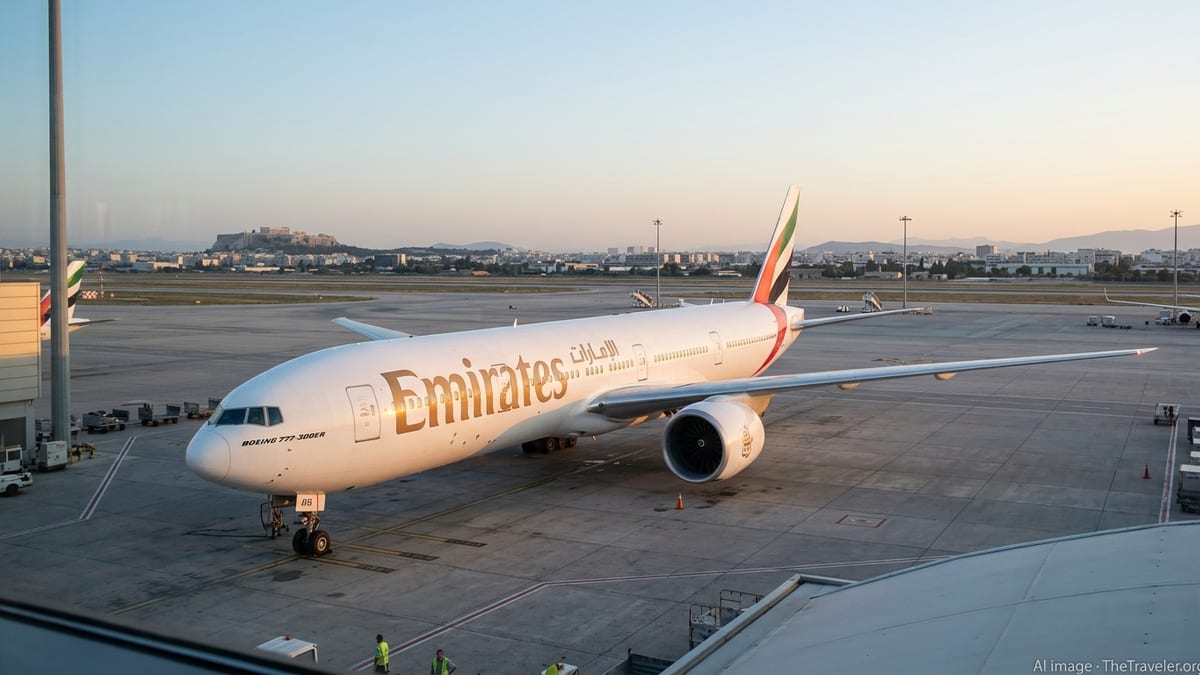
Athens is reappearing on long-haul travel maps as Emirates restores limited services that touch the Greek capital, signaling both a cautious operational comeback and the enduring appeal of Greece as a destination even amid volatile Middle East airspace conditions.
Get the latest news straight to your inbox!
Measured Return After Regional Airspace Shutdown
Emirates’ renewed services involving Athens follow one of the most disruptive aviation episodes the Gulf region has seen in years. In late February 2026, a wave of missile strikes and rapid airspace closures forced the airline to ground the bulk of its Dubai operations. Publicly available information shows that services were progressively reintroduced from March 2 under tight routing constraints, with the network rebuilt in stages as more corridors reopened.
According to airline operations updates and industry tracking, Athens reappeared on the list of destinations receiving flights during the early days of the restart, albeit at sharply reduced frequencies. The focus has been on operating only those services that can be accommodated within newly defined safe corridors across West Asia, often with longer routings and schedule buffers to account for congestion and potential reroutes.
By March 5 and 6, internal disruption schedules made public showed flights operating between Dubai and Athens on a limited basis, while many other routes across the wider region remained suspended or heavily curtailed. Aviation analysts note that placing Athens among the initial European points to regain connectivity reflects both strong underlying demand for Greece and the route’s strategic role in Emirates’ broader transcontinental network.
Reports from travel industry outlets indicate that by the second week of March, Emirates was operating a majority share of its global network again, though still below normal schedules. Within that context, the Athens link is being treated as a carefully managed but high-priority corridor, restored ahead of several other long-haul city pairs that are yet to return to regular operation.
Athens as a Resilient Gateway Between Continents
The decision to bring Athens back into a reduced schedule underscores the city’s status as a resilient gateway linking Europe, the Middle East, and North America. For nearly three decades, Emirates has treated Athens as a strategic bridge market, initially serving it from Dubai and later adding the Dubai–Athens–Newark routing that connected Greece directly to the United States via the Gulf carrier’s hub structure.
Although the Athens–Newark segment has seen intermittent suspensions linked to demand cycles and regulatory conditions, the broader pattern reveals that Athens retains a disproportionate importance in Emirates’ European portfolio. Public information released by the airline ahead of the 2026 summer season shows a dense European network in which Athens features alongside major hubs like London, Paris, and Frankfurt, reinforcing its role as a core leisure and transfer market.
For travelers, the renewed services highlight how Athens can function both as a final destination and as a connection point, particularly when other regional gateways are constrained by airspace or capacity issues. In recent weeks, trip reports have described itineraries that route passengers from long-haul origins through Dubai and Athens before continuing to North American or intra-European points, an illustration of how the Greek capital can absorb some of the pressure created by disruptions elsewhere.
Travel data providers tracking schedules and seat capacity indicate that airlines across Europe and the Middle East are continuing to view Athens as a flexible node for rerouting traffic. This flexibility, combined with strong origin-and-destination demand for Greece itself, helps explain why Emirates prioritized limited Athens services even as the remainder of its network undergoes phased restoration.
Surging Demand Puts Greece’s Popularity in Focus
The limited resumption of Emirates operations involving Athens comes against a backdrop of remarkable demand growth for travel to Greece. Recent coverage in specialist travel and aviation media highlights that Greek airports have been handling significantly higher passenger volumes in early 2026 compared to the previous year, with some reports pointing to increases that far outpace the broader European average.
Airports across the country, including Athens International Airport, are described as grappling with a sharp rise in traffic that is testing terminal capacity, ground handling, and air traffic management. Travel industry commentary suggests that the growth is being driven by a combination of pent-up leisure demand, expanded seasonal programs from European carriers, and continued interest from long-haul markets seeking Mediterranean destinations perceived as safe, culturally rich, and relatively good value.
In this environment, any capacity that a carrier like Emirates can restore, even on a reduced basis, becomes a meaningful signal for tour operators, cruise lines, and travel agencies planning the upcoming peak season. The presence of a Gulf hub carrier offers additional one-stop options for travelers from Asia, Africa, and the Americas, who may otherwise need to connect through already congested European hubs to reach Greece.
Analysts monitoring booking trends note that demand for Greece often proves resilient even during periods of geopolitical uncertainty, shifting more in origin mix than in total volume. Early 2026 patterns appear to follow this script, with long-haul demand adapting to the changed airspace picture while intra-European arrivals continue to climb. Within that narrative, Emirates’ limited Athens service functions as another confirmation that appetite for Greek travel remains strong.
Operational Constraints and Traveler Implications
Despite the symbolic importance of Athens returning to the map, the Emirates schedule touching Greece remains fragile. Aviation bulletins and travel-advisory content stress that frequencies and timings are still subject to late changes as air traffic control units manage heavy congestion along alternative routes that skirt sensitive airspace across West Asia.
In practical terms, travelers using Emirates to reach Athens or connect through it are being advised by airlines and online travel agencies to allow extra buffer time, avoid tight self-connecting itineraries, and monitor their bookings closely. Publicly available airline communication emphasizes that only passengers with confirmed, revalidated bookings should proceed to airports, reflecting the possibility of rolling adjustments as operational conditions evolve day by day.
There is also a knock-on effect on pricing and availability. With capacity constrained and some aircraft still allocated to alternative routings or repositioning flights, fare data from global distribution systems show reduced inventory on certain Athens-linked dates compared with pre-disruption levels. Industry observers expect this to normalize gradually if the airspace situation remains stable and Emirates is able to rebuild toward its usual daily patterns on the route.
For now, the Athens service serves as a test case in how quickly and flexibly Gulf carriers can restore key leisure markets after a shock. The ability to offer even a skeleton schedule demonstrates operational resilience, but it also highlights the limits of planning in a region where airspace access can change with little notice.
What the Restart Signals for Greece’s Tourism Outlook
The reappearance of Emirates flights touching Athens has broader implications for Greece’s tourism outlook for the remainder of 2026. Tour operators and destination marketers keep a close eye on long-haul seat capacity as an early indicator of how robust a season might be, and the limited restoration of Gulf connectivity is being interpreted as a positive, if cautious, sign.
Greece enters the coming peak months with momentum built over several successive strong seasons. International arrivals have been trending upward, regional airports on islands such as Crete, Rhodes, and Santorini are planning fuller summer schedules, and hospitality groups have announced new hotel openings and refurbishments timed for mid-year. The return of Emirates to Athens, even under constrained conditions, reinforces the narrative of Greece as a cornerstone Mediterranean destination with enduring pull in long-haul markets.
At the same time, the episode underscores the vulnerabilities that accompany this global reach. Disruptions tied to conflicts far from Greek shores can reshape access patterns almost overnight, forcing airlines, airports, and the wider tourism sector to adapt quickly. The current period is likely to accelerate conversations around infrastructure resilience, air traffic management upgrades, and diversified access strategies that reduce overreliance on any single corridor.
For travelers, the message is nuanced but clear: Greece remains highly accessible and in demand, with Athens once again connected to the Gulf through Emirates, albeit in a limited fashion. Those planning trips in 2026 are being encouraged by travel advisors and industry guidance to book early, remain flexible on dates and routings, and expect a dynamic environment in which airlines continue to fine-tune schedules right up to the day of departure.