

More news on this day
Thousands of travellers were left stranded in the United Arab Emirates on Saturday after Emirates cancelled 30 flights and delayed at least 118 more, as US and Israeli strikes in Iran triggered sudden airspace closures and choked key routes linking Dubai with Beirut, Amman and Baghdad.
Airspace Closures Ripple Across the Gulf
The latest wave of disruption followed overnight US and Israeli strikes on targets in Iran that prompted authorities across the Gulf and wider Middle East to tighten or temporarily close airspace. Aviation regulators in the United Arab Emirates moved quickly to restrict movements through key corridors used by long-haul carriers, forcing last-minute cancellations and diversions.
Dubai-based Emirates, one of the world’s largest international airlines, said its operations had been significantly affected by changing airspace conditions. The carrier confirmed that 30 services were cancelled and more than a hundred delayed as it worked with air navigation authorities to reroute aircraft around Iranian and Iraqi skies.
While the airline did not publish a full route list, airport and industry sources said flights serving Beirut, Amman and Baghdad were among those most heavily hit. Services to Tehran and other Iranian destinations were also disrupted as carriers sought to avoid conflict-adjacent airspace and comply with new restrictions issued overnight.
Emirates reiterated that safety remained its top priority and urged customers to check the latest status of their flights before travelling to the airport. The airline said it was monitoring the evolving security situation closely and would adjust schedules as conditions allowed.
Stranded Transit Passengers Face Night at Dubai Airport
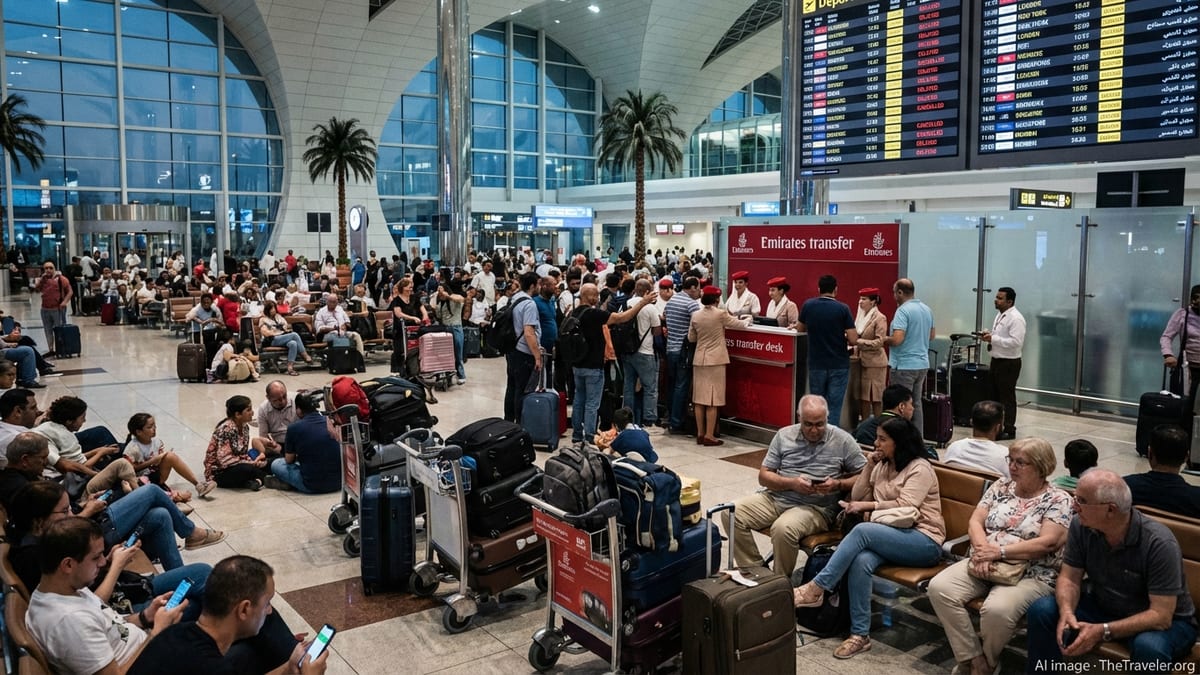
At Dubai International Airport, one of the world’s busiest hubs for international travel, the cancellations cascaded through the transit system, leaving passengers bound for Beirut, Amman, Baghdad and other regional cities marooned in departure halls for hours. Many travellers had already completed long-haul sectors from Europe, Asia and North America before learning that their onward flights were no longer operating.
Airport staff scrambled to rebook affected passengers on later departures or alternative routings, but severely limited capacity and ongoing closures meant some travellers were offered hotel stays and meal vouchers while others tried to sleep on terminal seating. Long queues formed at transfer desks as information filtered through in stages from airline control centres.
Passengers reported receiving text alerts and app notifications advising that they would not be accepted for travel if their final destination was among the suspended cities, even if they held confirmed tickets. Those who had not yet departed their origin airports were being urged by Emirates and its codeshare partners to postpone travel or seek refunds and rebooking options.
Ground handling teams in Dubai said they were operating under “irregular operations” procedures normally reserved for major weather events, with crews and aircraft temporarily out of position and turnaround times stretched by the need to reflight plans around closed airspace.
Routes to Beirut, Amman and Baghdad Hit Hard
Flights linking Dubai with Lebanon, Jordan and Iraq have been particularly vulnerable to the current security flare-up, as they typically overfly or skirt airspace now considered high risk. Aviation analysts noted that even when departure and arrival airports remain operational, the closure of key overflight corridors through Iran, Iraq and Syria can render routes temporarily unviable.
In recent months, Emirates and other Gulf carriers have on several occasions suspended or reduced operations to Beirut, Amman, Baghdad and Tehran when tensions spiked between Israel and Iran and when missile launches or airstrikes raised concerns about debris or miscalculation in busy skies. Saturday’s events marked one of the most extensive coordinated disruptions since those earlier suspensions.
Passengers booked on affected routes were being advised not to start their journeys if their final destination was currently suspended, even if the first leg of their trip to Dubai still appeared to be operating. Travel agents in the region reported a surge in calls from anxious customers seeking clarity on whether upcoming departures would proceed.
Some travellers attempting to reach Beirut and Amman turned to alternative routings via Istanbul, Cairo and European gateways, though capacity on these options was quickly constrained as news of the disruptions spread and other airlines also avoided Iranian and Iraqi airspace.
Knock-On Effects for Global Long-Haul Travel
The airspace closures and reroutings are not only affecting short- and medium-haul services within the Middle East. Long-haul flights connecting Asia, Europe and the Americas via Gulf hubs have also encountered extended flight times, higher fuel burn and potential schedule knock-ons as aircraft are diverted around conflict zones.
Industry trackers showed flights between Europe and destinations in South and Southeast Asia zigzagging to bypass Iranian and Iraqi skies, in some cases adding up to an hour to block times. Airlines were loading additional fuel and adjusting crew rosters to account for the longer detours, while warning travellers to expect delays and last-minute gate changes.
Analysts said that while modern aircraft and flexible routing tools allow carriers to avoid threatened areas, the cumulative impact on timetables, crew duty limits and aircraft utilisation can be severe when large swaths of airspace are effectively off-limits. For hub-and-spoke networks like Emirates, even a short-lived closure can ripple across dozens of connecting banks.
Travel insurers and corporate travel managers were also monitoring the situation as companies reassessed nonessential trips through the Gulf. Some firms have instructed staff to delay journeys to high-risk destinations until airlines and regulators signal that conditions have stabilised.
What Travellers Should Do Now
With the situation in flux and further schedule changes likely, airlines and airports are urging passengers to stay closely engaged with official channels rather than relying on third-party apps or outdated itineraries. Emirates has advised customers to ensure their contact details are up to date so they can receive real-time notifications of cancellations, delays or rebooking options.
Travellers currently in the UAE whose flights have been cancelled are being encouraged to work through official Emirates counters, call centres or authorised travel agents to secure new arrangements. Airport authorities have cautioned that walk-up rebookings without prior confirmation may not be possible during peak disruption periods.
For passengers who have not yet started their journey, experts recommend monitoring the security situation and airline advisories closely over the coming days. Those with critical travel needs are being told to allow generous connection times, prepare for potential overnight stays, and keep essential items, including medication and chargers, in carry-on luggage in case checked bags are delayed.
While carriers stress that such measures are precautionary, the current round of cancellations and delays underlines how quickly geopolitical tensions in and around Iran can spill into global aviation networks, leaving travellers far from home and itineraries in tatters with little warning.