

More news on this day
Thousands of passengers were left stranded on Sunday at major airports across the United Arab Emirates as Emirates suspended operations and cancelled scores of flights in response to sweeping airspace closures triggered by US-Israel strikes on Iran.
Major Gulf Hubs Grind to a Halt
Dubai International, Abu Dhabi’s Zayed International, Sharjah, and Ras Al Khaimah airports all reported severe disruption on March 1, as authorities across the region restricted or closed airspace amid heightened military tensions. Flight tracking data showed large swathes of the Middle East almost devoid of commercial traffic, with key corridors over Iran, Iraq, Israel, Jordan, and parts of the Gulf effectively shut.
Emirates, based at Dubai International, confirmed a broad suspension of services to and from its hub, forcing mass cancellations and diversions. The move followed a temporary and partial closure of UAE airspace, announced after coordinated US-Israel strikes on Iranian targets and subsequent retaliatory fire. Aviation analysts estimate that hub carriers in Dubai and Abu Dhabi typically handle tens of thousands of connecting passengers each day, amplifying the scale of the disruption as aircraft, crews, and travelers were left out of position.
In neighboring Abu Dhabi, home carrier Etihad Airways halted all departures from Zayed International Airport until early afternoon local time, compounding delays for both origin and connecting traffic. Airport authorities warned that arrivals were also being cancelled or diverted while the operational situation evolved, and that further schedule changes were likely as airlines reassessed risk and routing options.
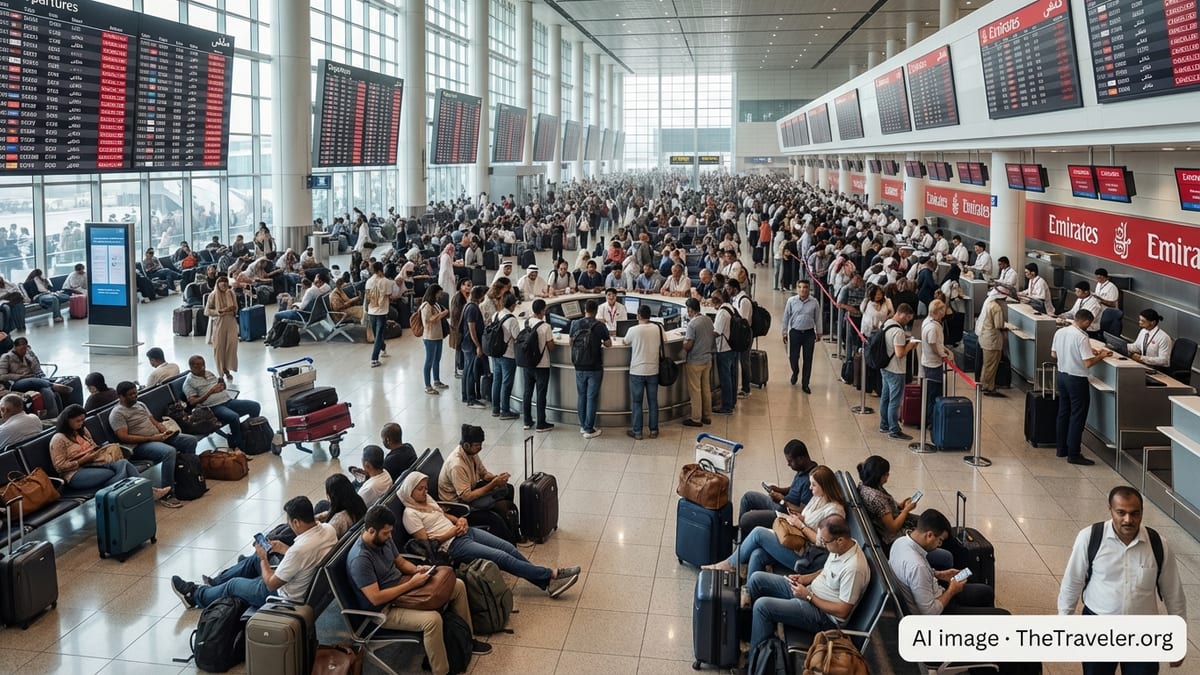
By Sunday morning, terminals across the country were crowded with travelers waiting for updates, as departure boards filled with red cancellation notices. Staff were deployed to manage queues for rebooking and hotel vouchers, but the sudden loss of airspace capacity left limited immediate alternatives for many long-haul passengers.
Emirates Pulls 137 Flights as Safety Concerns Mount
Emirates officials said the airline’s decision to cancel at least 137 flights in and out of the region was driven by safety and airspace availability, not by demand. With multiple neighboring states closing their skies and regional conflict zones expanding, routing options for overflying traffic narrowed to the point where operating many services was no longer feasible within acceptable safety and timing margins.
The carrier issued a broad travel advisory to customers booked to fly over the next 72 hours, offering complimentary rebooking within ten days of the original travel date or full refunds for those no longer wishing to travel. Passengers who had booked via travel agents were urged to contact their agents directly, while those with tickets issued by the airline were directed to Emirates customer service channels and airport counters for assistance.
For transit passengers, the disruption has been particularly acute. Dubai functions as one of the world’s busiest intercontinental hubs, with a large share of travelers using Emirates to connect between Europe, Asia, Africa, and Australasia. With many of those flights grounded or diverted, passengers found themselves stranded in holding patterns at transit points as the airline tried to reassemble a workable network around restricted airspace.
Industry experts note that even once airspace gradually reopens, ripple effects from a cancellation wave of this magnitude can persist for days. Aircraft and crews must be repositioned, maintenance windows reshuffled, and complex long-haul rotations rebuilt, making it likely that schedule instability will linger well beyond the immediate crisis period.
Knock-On Chaos for UAE and Regional Carriers
The suspension of Emirates services was mirrored by similar decisions from other Gulf carriers, underscoring the systemic nature of the crisis. Etihad Airways in Abu Dhabi suspended all outbound flights until mid-afternoon Sunday, warning that early arriving services would also be cancelled. Qatar Airways, operating from Doha, and low-cost UAE carriers serving Sharjah and Ras Al Khaimah have likewise faced widespread cancellations and diversions as they navigate the evolving military and regulatory landscape.
Air Arabia, which operates hubs in Sharjah and Ras Al Khaimah, reported cancellations across its regional network as airspace closures and safety advisories rippled outward. Budget carrier flydubai suspended operations alongside Emirates at Dubai’s two main airports, further limiting options for travelers hoping to reroute through alternative Gulf gateways.
International airlines that rely on Middle Eastern airspace as a bridge between continents are also affected. Carriers from Europe and Asia have curtailed or re-routed services to avoid conflict zones and closed skies, adding hours of flying time and significant fuel costs to long-haul routes. Aviation safety bodies have issued conflict-zone bulletins highlighting a high risk to civil aviation in certain areas, advising airlines to avoid affected airspace until the security picture improves.
With Russian airspace still restricted for many Western airlines due to the ongoing war in Ukraine, the latest closures over the Middle East further constrict already limited route options. Analysts warn that longer routings, congestion in remaining open corridors, and higher insurance and fuel costs could pressure airline margins and potentially filter through to higher fares if the crisis is prolonged.
Scenes of Frustration and Uncertainty at UAE Airports
Inside the terminals at Dubai, Abu Dhabi, Sharjah, and Ras Al Khaimah, the human toll of the disruption has been visible in crowded check-in halls, packed seating areas, and long lines at customer service desks. Families en route to holidays, migrant workers heading back to jobs, and business travelers on tight schedules all found themselves competing for limited information and scarce rebooking options as airlines worked through backlogs of stranded customers.
Airport authorities in the UAE urged passengers not to proceed to the airport unless they had confirmed flight information, seeking to ease pressure on crowded terminals and security lines. Announcements repeated that safety remained the top priority and that airlines were coordinating closely with regulators and air traffic control to restore services as soon as conditions allowed.
Many travelers, however, reported confusion as rapidly changing advisories and the complex nature of global connecting itineraries made it difficult to predict when they might finally reach their destinations. With nearby airports in Qatar, Bahrain, Kuwait, and Oman also affected by airspace restrictions, straightforward alternative routings within the region were in short supply.
Local hotels near major airports saw a surge in last-minute bookings as airlines arranged accommodation for some stranded passengers and others chose to wait out the uncertainty offsite. Travel insurance providers, meanwhile, began fielding a spike in claims related to trip interruptions, delays, and missed onward connections tied directly to the military escalation in and around Iran.
What Travelers Should Expect in the Coming Days
Industry analysts and airline executives caution that while some restrictions could ease as military operations stabilize and risk assessments are updated, travelers should brace for a protracted period of irregular operations across the wider Middle East. Even partial reopening of airspace is unlikely to translate into an immediate return to normal schedules, given the complexity of rebuilding long-haul networks and repositioning aircraft and crews.
Passengers with imminent travel plans through Dubai, Abu Dhabi, Sharjah, Ras Al Khaimah, or other regional hubs are being advised to monitor airline communications closely and to use digital channels where possible to manage bookings. Many carriers are waiving change fees and offering flexible rebooking windows to ease the process, although peak-season demand on some routes may limit available seats for several days.
Travel planners recommend allowing generous buffers for any essential trips that still require transiting the region, and considering alternative routings via Europe, South Asia, or Africa where feasible. However, with global flight schedules already tightly optimized following the post-pandemic recovery, spare capacity to absorb a major Middle Eastern disruption remains limited.
For now, the fate of thousands of stranded passengers at UAE airports and beyond is closely tied to fast-moving geopolitical developments rather than traditional aviation factors such as weather or technical issues. Until the security environment stabilizes and regulators reopen critical airspace, the Gulf’s role as a reliable crossroads of global travel will remain deeply constrained.