

More news on this day
A fast-building Nor’easter pounding the US East Coast has forced Emirates to cancel and reschedule a string of high-profile flights between Dubai and key North American and European gateways, affecting thousands of passengers booked on services to New York, Newark, Milan, Boston and onward destinations.
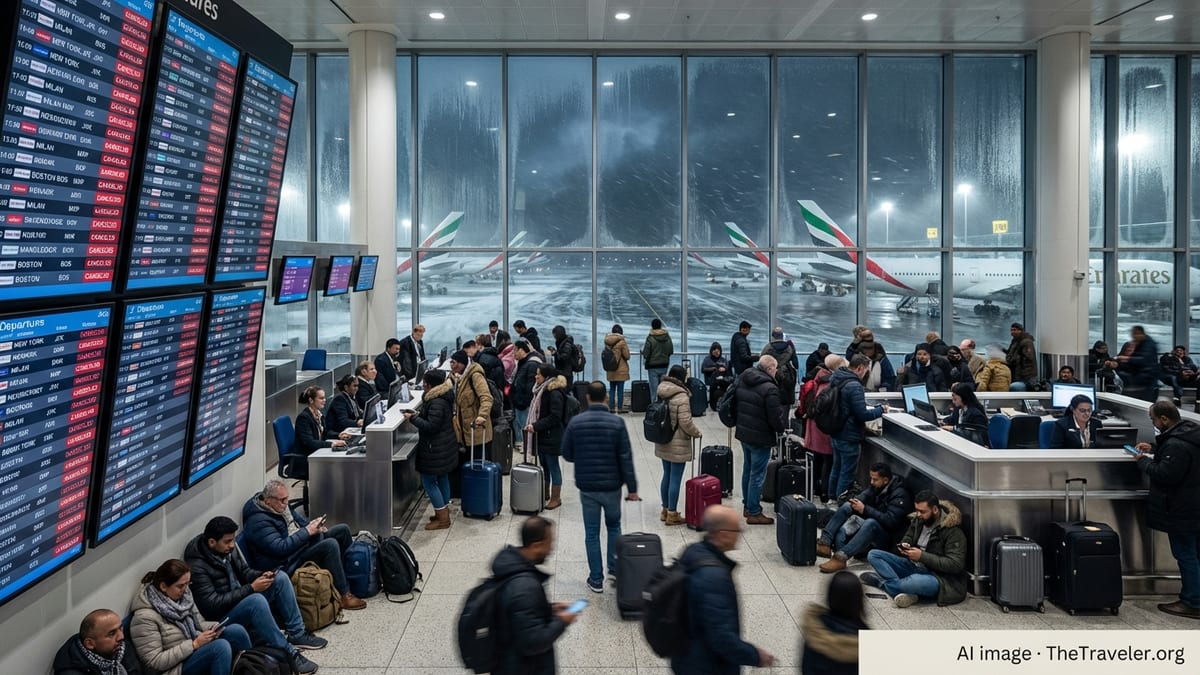
Severe Snowstorm Slams US East Coast and Shuts Down Air Corridors
The winter storm sweeping across the US Northeast has brought blizzard conditions, heavy snow and gale-force winds to major aviation hubs including New York’s John F. Kennedy International Airport, Newark Liberty International Airport and Boston Logan International Airport. Authorities have issued widespread blizzard warnings and urged residents to avoid non-essential travel as visibility plunges and road networks become treacherous.
Air traffic has borne the brunt of the disruption. Airlines across the Atlantic have trimmed schedules, diverted services and imposed rolling cancellations as runway conditions deteriorate and de-icing operations struggle to keep pace with the snowfall. Airport operators in the New York area have warned of extended ground delays and potential temporary shutdowns as the storm peaks.
For Gulf carriers, the impact is most acute on their flagship transatlantic links. Emirates, which typically operates multiple daily rotations between Dubai, New York and other East Coast cities, has moved quickly to pre-empt operational and safety risks by cancelling and retiming some of its busiest long haul flights. The airline has stressed that passenger and crew safety remains the overriding priority as conditions evolve.
Meteorologists expect the Nor’easter to continue affecting the region over the coming 24 to 48 hours, with snow totals in some metropolitan areas forecast to reach one to two feet. That outlook has prompted airlines and aviation authorities to caution that more disruption is likely, even after the heaviest snow bands move offshore, as airports work to clear runways and reposition aircraft and crews.
Full List of Emirates Flights Canceled or Heavily Disrupted
Emirates has issued a detailed breakdown of routes affected by the storm, centering on services between Dubai, New York, Newark, Boston and the airline’s transatlantic tag flights via Europe. The most significant cancellations hit the core Dubai to New York corridor and the Athens to Newark sector, which feeds important traffic flows between the Gulf, Europe and the United States.
On February 23, Emirates has confirmed the cancellation of flight EK203 from Dubai to New York JFK and its counterpart EK204 from New York JFK to Dubai. The disruption extends to the carrier’s tag-on flights to Newark via Athens, with EK209 from Athens to Newark and EK210 from Newark to Athens also canceled on key storm-affected days. These cancellations follow earlier suspensions around February 22 as the weather system intensified and moved northward along the coast.
In addition, services linking Dubai with Boston have been hit. Flight EK237 from Dubai to Boston and the return EK238 from Boston to Dubai scheduled for February 23 are among those withdrawn from the timetable as conditions at Boston Logan deteriorate. Emirates has warned that further cancellations are possible if the storm track or airport operating status changes at short notice.
The airline has also restricted acceptance of connecting passengers whose itineraries rely on the canceled US-bound sectors. Travelers booked to connect through Dubai onto New York, Newark or Boston on affected dates are being advised that they will not be accepted for travel from their original departure points and should seek rebooking options before starting their journey.
Key Route Adjustments Between Dubai, New York, Milan and Newark
Beyond outright cancellations, Emirates has retimed several high-demand rotations linking Dubai, New York, Milan and Newark in a bid to maintain some connectivity while navigating airport slot constraints and weather-related closures. These adjusted services are designed to operate outside the worst of the storm window while still offering viable long haul options for travelers.
On the Dubai to New York axis, flight EK201 from Dubai to JFK on February 23 has been shifted to a later departure in the afternoon, with a revised arrival in New York in the evening local time. The corresponding EK202 service from New York to Dubai has also been retimed, leaving JFK earlier than scheduled in order to secure a departure slot before conditions further deteriorate and to preserve onward connections in Dubai the following day.
Emirates’ important Milan to New York tag flights have similarly been adjusted. Flight EK206 from New York JFK to Milan has been rescheduled to depart during a weather window judged more favorable by operations teams, with a revised morning arrival in Milan. The westbound EK205 from Milan to New York has had its departure time pushed back to later in the evening on February 23, aiming to arrive into JFK once runways are cleared and operations begin to normalize.
These retimed flights underscore the delicate balance airlines face during severe winter weather: maintaining as much network integrity as possible without compromising on safety or risking diversions and extended tarmac delays. Emirates has indicated that passengers booked on these adjusted services who are connecting through Dubai will be rebooked automatically to their final destinations where feasible.
How Many Travelers Are Affected and Which Airports Are Hit Hardest
The cancellations and schedule changes come at a busy time for transatlantic traffic between the Gulf and the United States, with strong demand from both business and leisure passengers. Emirates’ double daily operations on the Dubai to New York route normally carry several hundred passengers per flight, meaning that the removal or retiming of multiple rotations over consecutive days affects thousands of travelers in both directions.
New York’s JFK and Newark Liberty airports are bearing much of the impact from the Emirates cutbacks, compounded by similar moves from other global carriers as the storm reduces runway capacity. With multiple long haul flights arriving and departing in tightly coordinated banks, the ripple effects of even a few cancellations can cascade across connecting networks in Europe, the Middle East and Asia.
Boston Logan, though handling fewer Gulf services than New York, is also experiencing significant disruption. The cancellation of Emirates’ Dubai to Boston pairing on February 23 removes a key non-stop option for passengers traveling between New England, the Middle East and South Asia. Regional US carriers and transatlantic operators have also trimmed their Boston schedules, further reducing options for rerouting.
For Emirates, Dubai International remains fully operational, but the storm-related constraints in North America mean aircraft and crew are out of position, forcing the airline to redesign rotations at short notice. While some passengers can be accommodated on alternative dates or via different gateways, others will face extended delays or the need to cancel and seek refunds, particularly where travel is time-sensitive.
What Affected Emirates Passengers Should Do Right Now
Emirates is urging all customers booked on flights to or from New York, Newark and Boston over the next several days to check the latest status of their services before leaving for the airport. The airline has stressed that its digital channels and customer service centers will carry the most up-to-date information as schedules are adjusted in line with real time weather and airport operations.
Travelers whose flights have been canceled are being advised to contact their travel agent or the airline directly to arrange rebooking on the next available service or to discuss alternative routing options. For those who no longer wish to travel, standard fare rules and any temporary disruption waivers will determine eligibility for refunds or travel credits. Emirates has apologized for the inconvenience and is emphasizing flexibility as teams work through a high volume of change requests.
Passengers on retimed flights should pay careful attention to new departure and arrival times and ensure that any downstream connections, hotel reservations or ground transport bookings are adjusted accordingly. In many cases, Emirates will automatically rebook connections for those transiting through Dubai, but customers are encouraged to verify their itineraries and seat assignments once new schedules are confirmed.
Experts also recommend that travelers maintain up-to-date contact details with the airline, including mobile numbers and email addresses, so that they can receive real time notifications about any further changes. Given the severity of the weather system and its potential to spawn additional delays, even flights that are currently listed as operating may still be subject to disruption.
Why Airlines Cancel Rather Than Risk Flying in Severe Winter Weather
While last minute cancellations can be deeply frustrating for travelers, aviation safety specialists point out that decisions such as those taken by Emirates in the wake of this Nor’easter are driven by strict regulatory and operational considerations. Heavy snowfall, crosswinds, low visibility and icy runway conditions can all compromise aircraft performance, braking distances and the safe execution of take offs and landings.
Modern airports are equipped with extensive snow clearance and de-icing capabilities, but these systems have limits, particularly when snow is falling at rates of several inches per hour. Prolonged ground operations in such conditions can lead to lengthy queues for de-icing, crew duty time overruns and heightened risk of logistical bottlenecks across apron areas and taxiways.
By proactively cancelling flights, airlines can avoid scenarios in which aircraft depart but are unable to land at their planned destinations, forcing diversions to alternate airports that may not have the capacity or facilities to handle large numbers of stranded passengers. Early decisions to trim schedules also give carriers more room to re-accommodate travelers on remaining services once conditions improve.
In regions like the US Northeast, where Nor’easters are a recurring winter hazard, carriers and regulators have developed detailed playbooks to manage storms of this magnitude. That typically involves close coordination between airlines, airport authorities and air traffic control to prioritize safety while restoring normal operations as quickly as weather and infrastructure allow.
Knock-on Effects Across Global Networks and Other Airlines
The disruption to Emirates’ US services is part of a broader pattern of flight cancellations across the Atlantic and within North America as the storm system tracks along the eastern seaboard. Other international airlines have also scrapped or retimed services into New York, Newark and Boston, while US carriers have canceled thousands of domestic flights linking those hubs with secondary cities.
These widespread schedule reductions create a challenging environment for rebooking, as spare seats on remaining flights rapidly disappear. Travelers attempting to reroute through alternative gateways such as Washington, Philadelphia or Chicago may find those options constrained as airlines prioritize passengers from canceled services and manage aircraft availability.
For Emirates and its Gulf peers, the immediate focus is on stabilizing transatlantic operations, but there are likely to be secondary impacts across their wider networks. Aircraft that would normally cycle between Dubai and North America may now be reassigned or left on the ground, altering capacity patterns on routes to Europe, Africa and Asia and potentially triggering minor timetable adjustments elsewhere.
Travel industry analysts say that while storms of this scale can cause short term disruption and customer dissatisfaction, most major carriers are now highly practiced at recovery operations. Once the storm passes and airport infrastructure is restored to full capacity, airlines typically roll out temporary additional flights or upgauge aircraft to help clear backlogs and accommodate displaced passengers.
What to Expect in the Coming Days
Weather forecasters expect conditions along the US East Coast to gradually improve after the peak of the Nor’easter, but residual impacts on air travel could linger for several days. Snow removal operations at major airports must be completed, aircraft and crews repositioned, and disrupted rotations rebalanced before full schedules can resume.
Emirates has indicated that it will continue to monitor the situation closely and update its travel advisories as new information becomes available from airport authorities and meteorological agencies. Further cancellations or retimings remain possible, particularly if secondary bands of snow or strong winds persist or if airport infrastructure suffers any storm related damage.
Passengers planning to travel between Dubai and New York, Newark, Boston or Milan in the coming week are therefore being encouraged to build extra flexibility into their plans. That may include allowing longer connection windows, considering alternative travel dates or preparing for the possibility of extended layovers should their flights be delayed.
For now, the message from airlines and regulators is clear: safety takes precedence over schedule. While the sight of grounded aircraft and departure boards filled with cancellations is never welcome, decisive action as this powerful winter storm moves through the region is intended to protect passengers, crews and airport workers until skies over the US East Coast are once again clear.