

More news on this day
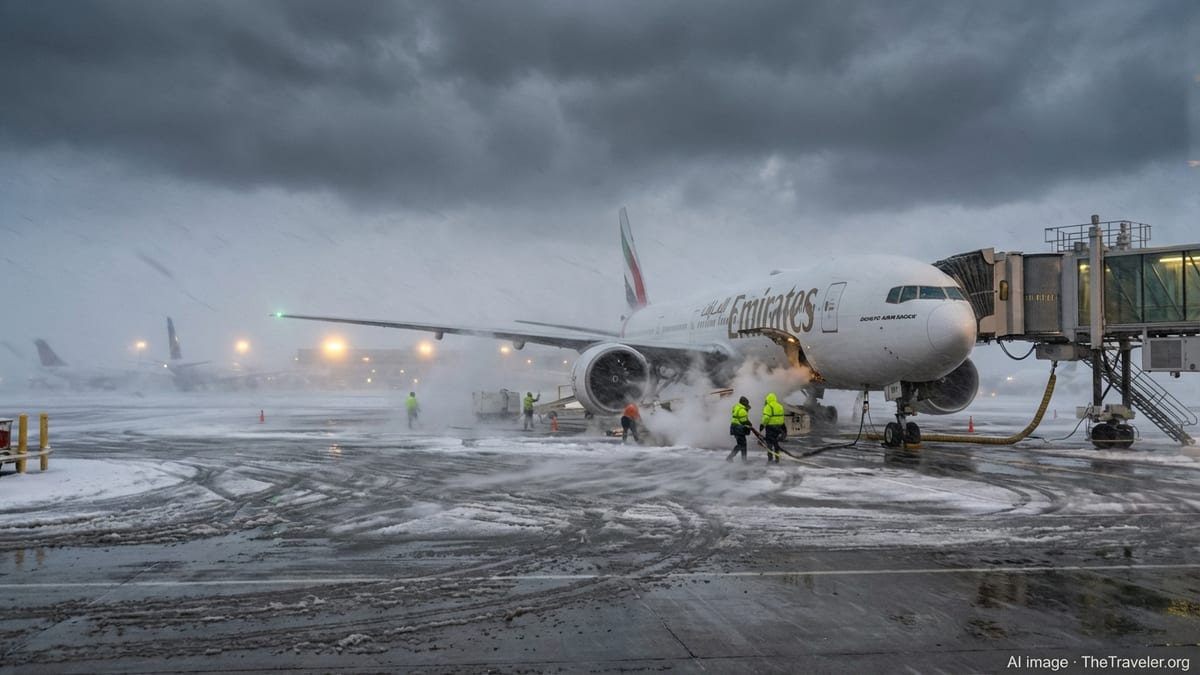
Emirates passengers traveling between Dubai and the United States and Europe are facing major disruption after the airline canceled and rescheduled several key long-haul flights in response to a powerful snowstorm battering the US East Coast, with routes linking Dubai to New York, Milan, Newark and Athens among the worst affected.
Which Emirates Flights Are Canceled and Rescheduled
Emirates confirmed that multiple services between Dubai and New York, as well as connecting routes through Athens and Milan, have been canceled outright, while others have been retimed to avoid the worst of the winter storm. The most significant cancellations affect flights into and out of New York’s John F. Kennedy International Airport and Newark Liberty International Airport, two of the main gateways for travelers flying between the Gulf and North America.
On the Dubai to New York corridor, flight EK203 from Dubai to New York JFK on February 22 has been canceled, along with its counterpart EK204 from New York JFK to Dubai on February 23. On the Athens to Newark tag-on route, Emirates has canceled EK209 from Athens to Newark on February 22 and EK210 from Newark to Athens on February 23. These four services form the core of the airline’s current cancellation list linked to the storm.
In addition to the outright cancellations, several high-profile flights are operating on revised schedules to navigate around the worst weather windows. Emirates has retimed EK202 from New York to Dubai, which is now set to depart JFK at 18:00 local time on February 22 and arrive in Dubai at 15:25 on February 23. The flagship EK201 from Dubai to New York is scheduled to depart Dubai at 14:30 on February 23, arriving at JFK at 19:55 the same day, later than its usual timing.
Services on the New York to Milan rotation have also been adjusted, impacting travelers using the Milan route as a transatlantic bridge. Flight EK206 from New York to Milan will now depart JFK at 20:00 on February 22 and arrive in Milan at 09:35 on February 23, while the westbound leg EK205 from Milan to New York is scheduled to leave Milan at 18:40 on February 23 and reach JFK at 21:55 the same evening. Passengers booked on these flights are being advised to treat them effectively as new services and to reconfirm all onward connections.
How the East Coast Snowstorm Is Disrupting Global Travel
The disruption to Emirates operations is being driven by a powerful late-winter storm sweeping across the northeastern United States, bringing heavy snowfall, gale-force winds and whiteout conditions to major population centers including New York, New Jersey and parts of New England. The fast-developing system has triggered blizzard warnings and severe travel advisories along the East Coast corridor, forcing airports and airlines to cut back traffic and prioritize safety over schedule integrity.
With snowfall totals forecast to reach well over a foot in some areas and wind gusts strong enough to create near-zero visibility, ground operations at key airports have slowed dramatically. De-icing, runway clearing and air traffic control flow restrictions are combining to reduce the number of movements airports can safely handle. Under such constraints, long-haul international flights, which require extended ground handling and precise slot timings, are often among the first to be curtailed.
The timing of the storm is particularly problematic for carriers like Emirates that rely on tightly coordinated global banks of departures and arrivals in Dubai. A single cancellation or extensive delay on a New York service can cascade through the network, disrupting connections to Africa, Asia and the Middle East. By proactively canceling and consolidating flights, the airline is seeking to limit knock-on disruption while maintaining a skeleton schedule that keeps key routes open for essential travel.
The current wave of cancellations also reflects the growing emphasis among airlines and regulators on preemptive action when severe weather is clearly forecast. Rather than attempting to operate until conditions deteriorate, carriers are increasingly opting to trim schedules in advance, giving passengers time to rebook and reducing the risk of aircraft and crews being stranded out of position for days.
Full List of Affected Routes Between Dubai, New York, Milan and Newark
For travelers trying to understand exactly which Emirates routes are currently affected by the snowstorm, the core list as of February 23 centers on services connecting Dubai with New York and on the airline’s key transatlantic tag-on routes via Athens and Milan. The impact is divided between outright cancellations and rescheduled operations.
On the cancellation side, the following services have been removed from the schedule: EK203 from Dubai to New York JFK on February 22, EK204 from New York JFK to Dubai on February 23, EK209 from Athens to Newark on February 22, and EK210 from Newark to Athens on February 23. These cancellations affect both nonstop Dubai–New York passengers and those using Athens as a European gateway to the New York metropolitan area.
Meanwhile, several high-demand flights are operating with modified departure and arrival times. EK202 from New York JFK to Dubai on February 23 is rescheduled to depart at 18:00 local time on February 22, arriving in Dubai at 15:25 on February 23. EK201 from Dubai to New York JFK on February 23 now departs Dubai at 14:30 and arrives in New York at 19:55. On the Italy–US pairing, EK206 from New York JFK to Milan Malpensa is set to leave New York at 20:00 on February 22, reaching Milan at 09:35 on February 23, while EK205 from Milan to New York JFK will depart at 18:40 on February 23 and arrive at 21:55 the same day.
Although these adjustments represent the main changes announced so far, industry watchers note that airline operations during a major storm remain fluid. Further revisions are possible as the system evolves and as airport authorities update their capacity constraints. Travelers booked on any Emirates service touching New York, Newark or connecting through Milan and Athens over the next several days are being urged to monitor their flight status closely and to be prepared for additional timetable changes.
What Affected Passengers Should Do Right Now
For Emirates customers whose flights fall within the list of cancellations or rescheduled services, the immediate priority is to verify booking status and explore rebooking or refund options. The airline is directing passengers who booked through travel agents to contact those agents as a first step, while those who purchased tickets directly from Emirates are advised to reach out to the airline’s customer service channels for assistance.
Rebooking is being handled on a priority basis, with passengers moved onto the next available services once operations stabilize. Given the scale of the storm and the involvement of multiple carriers, available seats on alternative flights may be limited in the short term, particularly in premium cabins. Flexible travelers willing to consider different dates, routings or cabins may find it easier to secure a new itinerary than those whose plans are fixed around specific meetings or events.
Emirates is also encouraging passengers to ensure that their contact information within the “Manage Booking” section of their reservation is fully up to date. Accurate mobile numbers and email addresses allow the airline to push real-time notifications of changes, including gate alterations, departure delays and rebooking confirmations. In a fast-moving weather situation, these alerts can make the difference between a smooth re-accommodation and hours spent queuing at airport desks.
For travelers who no longer wish to make the journey given the uncertainty, standard Emirates disruption policies may allow for travel vouchers or refunds in certain cases, particularly when the airline cancels a flight rather than the passenger voluntarily changing plans. Customers should review the fare conditions attached to their ticket and discuss options directly with the airline or their booking agent, keeping all communications and receipts for potential insurance claims.
Knock-On Effects for Connections Through Dubai and Beyond
The impact of the snowstorm is not limited to passengers traveling directly between Dubai and the affected North American and European cities. Emirates operates a hub-and-spoke model centered on Dubai, meaning that a large share of travelers on its New York, Milan, Newark and Athens flights are connecting to or from other destinations across the Middle East, Africa, Asia and Australasia.
When flights such as EK203, EK204, EK209 and EK210 are canceled, or when services like EK201, EK202, EK205 and EK206 operate on revised schedules, the carefully choreographed wave of arrivals and departures in Dubai is disrupted. Some connecting passengers may miss onward flights, while others may arrive earlier or later than planned, requiring new connections and in some cases overnight accommodation arranged by the airline.
Emirates has said that travelers affected by schedule changes and connecting through Dubai will be rebooked automatically to their final destinations where possible. In practice, that means ground staff and automated systems will search for the next available flights within the Emirates network that maintain a viable itinerary, taking into account minimum connection times and visa requirements for transits through Dubai.
However, with many long-haul routes running near full during peak travel periods, some passengers may face extended layovers or be routed through alternative gateways such as other European hubs to relieve pressure on the most congested flights. Passengers with tight onward connections or critical appointments are strongly advised to contact Emirates early to discuss options, rather than waiting until they arrive at the airport.
How This Storm Compares to Previous Winter Disruptions
Air travel in and out of New York and the wider US Northeast is no stranger to winter disruption, with major snowstorms periodically paralyzing airports and forcing airlines into large-scale cancellations. What distinguishes the current event is both its timing and the interconnectedness of today’s global route networks, which means that a storm centered on the East Coast quickly ripples out to affect travelers as far away as Dubai, Asia and Africa.
In previous significant Nor’easter events, carriers have sometimes attempted to operate limited schedules until conditions deteriorated, leading to aircraft and crews becoming trapped at closed airports and compounding operational headaches. By contrast, the current round of cancellations and reschedulings by Emirates and other international airlines reflects a more proactive stance, one that prioritizes stable restart conditions over short-term schedule preservation.
From a passenger perspective, the scale of the disruption may feel similar to earlier storms, with packed terminal buildings, long waits at call centers and difficulty securing new seats. However, improved forecasting tools and better coordination between airlines and airport authorities have allowed some carriers to target cancellations more precisely, protecting key long-haul links while trimming lower-priority services.
For Emirates, whose long-range fleet and Dubai hub are heavily oriented toward North American and European connectivity, the decision to temporarily trim its New York, Milan, Athens and Newark operations underlines just how central safety and operational integrity have become in an era of heightened weather volatility.
Planning Ahead: Tips for Travelers Facing Winter Weather Risks
For travelers with upcoming trips on Emirates or other carriers during the Northern Hemisphere winter, the current disruption offers several lessons. Booking flexibility can be invaluable when storms threaten: fares that allow date or routing changes without heavy penalties provide a buffer against last-minute weather complications. Travel insurance policies that specifically cover weather-related cancellations and additional accommodation or transport costs can also help offset the financial impact.
Monitoring weather forecasts and airline travel alerts in the days leading up to departure is equally important. When a major storm is clearly signaled, passengers may have the option to move travel a day earlier or later under relaxed change-fee policies that airlines often introduce ahead of severe weather events. Acting early typically yields more seat availability on alternative services and reduces the likelihood of lengthy delays at the airport.
On the day of travel, passengers should check flight status repeatedly, rather than assuming schedules will operate as originally ticketed. Using official airline apps, airport information screens and direct communications from carriers can help travelers respond quickly if a flight is delayed, retimed or canceled. Arriving at the airport earlier than usual can also provide additional time to work with check-in staff on rebooking options if conditions deteriorate.
Finally, those connecting through major hubs such as Dubai should build in realistic connection times, particularly during peak weather seasons. While airlines like Emirates design their schedules to allow smooth transfers, external shocks such as snowstorms, hurricanes or air traffic control disruptions can easily erode tight connections. A slightly longer layover can provide valuable margin for error and reduce the stress of traveling through highly interconnected global networks during periods of instability.