

More news on this day
Emirates is marking UAE-Kuwait Week with a suite of special onboard experiences that blend culinary heritage, cultural storytelling, and a nod to aviation history across its 30 weekly flights between Dubai and Kuwait.
The initiative, unveiled in early February 2026, places traditional desserts and curated in-flight entertainment at the center of a celebration designed to honor decades of close ties between the United Arab Emirates and the State of Kuwait, while underscoring the strategic importance of the busy Gulf route in the airline’s regional network.
More News
- Caribbean Travel to U.S. Upended by New Visa Freezes and Expanded Bans
- Mexico Restores E-Visas for Brazilians, Paving the Way for Borderless Tourism
- Philippine Airlines Joins Regional Carriers Powering Southeast Asia’s Tourism Boom
Marking UAE-Kuwait Week at 40,000 Feet
The UAE-Kuwait Week activation is being rolled out across Emirates’ full schedule of 30 weekly flights connecting Dubai and Kuwait City, turning a routine regional hop into a themed journey that highlights shared history and culture. The carrier has timed the initiative to coincide with a broader program of events celebrating the longstanding political and economic partnership between the two Gulf states, positioning its cabins as a flying showcase of that relationship.
Emirates is using the high-frequency route as a stage to demonstrate how aviation can reflect diplomatic ties in tangible ways, from the food served to the entertainment playing on screen. Passengers on all cabin classes are being offered thoughtfully designed touches that reference Kuwaiti traditions, while still fitting seamlessly into the airline’s premium service model. The result is a travel experience that feels distinctly local even on a short sector.
For Emirates, the campaign also serves as a reminder of its early bet on Kuwait as a key gateway in the Gulf. What began as a modest two-flight weekly operation in the late 1980s has evolved into one of the airline’s most consistently busy regional corridors, now operated mainly by retrofitted Boeing 777s and the latest Airbus A350s equipped with Premium Economy and updated cabins.
Traditional Desserts Take Center Stage
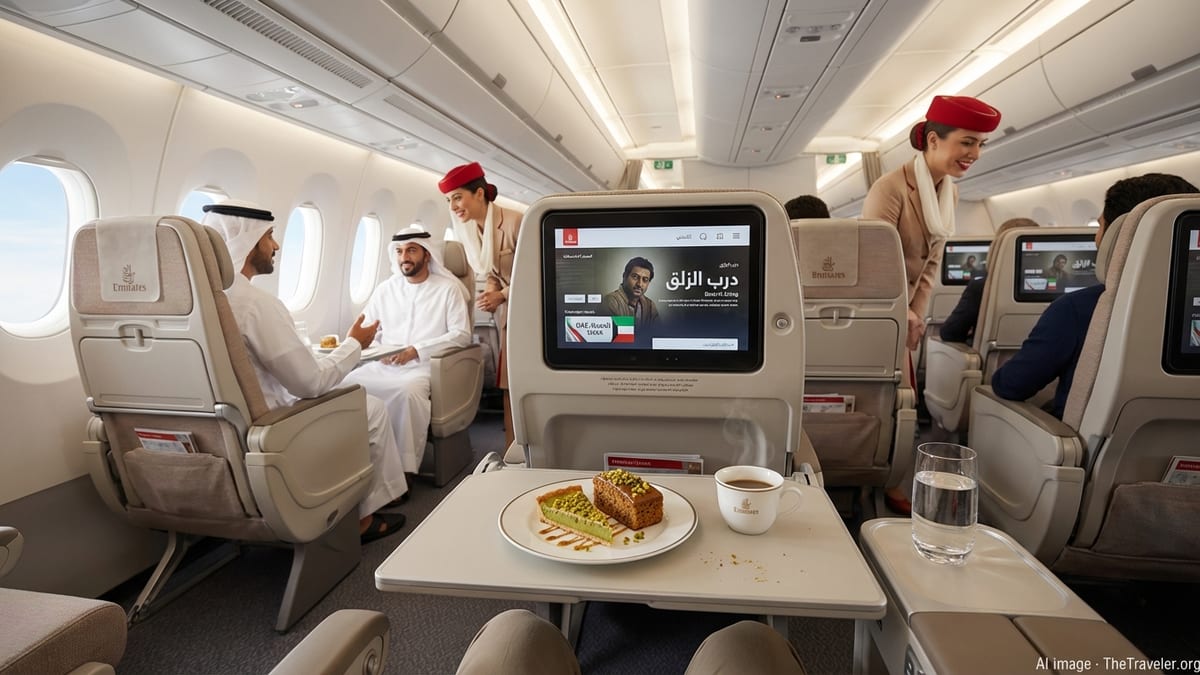
At the heart of the UAE-Kuwait Week celebrations is a dessert-driven culinary concept that leans heavily into flavors associated with the Gulf. Across all cabins, passengers are being served a Pistachio Rahash Tart, a rich, nutty pastry inspired by the region’s traditional sesame-based halwa. The tart is designed to be both familiar to Gulf nationals and intriguing to international travelers, offering a refined interpretation of classic confectionery that is well suited to in-flight service.
Cabin differentiation remains prominent. In First and Business Class, the Pistachio Rahash Tart is joined by a Gahwa Tart, which layers notes of Arabic coffee and spice into a delicate, plated dessert. The creation echoes Emirati and Kuwaiti coffee traditions, where serving gahwa is a gesture of hospitality and respect. By bringing this ritual into the cabin in culinary form, Emirates adds symbolic weight to the gesture of honoring bilateral ties.
Premium Economy and Economy Class customers are meanwhile being treated to a Toffee Date Cake, a warm, comforting dessert that showcases one of the region’s most emblematic ingredients. Dates, widely associated with generosity and celebration in Gulf culture, form the base of a cake that is at once accessible and rooted in local identity. The airline has positioned these sweets as more than seasonal extras, describing them as a tribute to shared customs between the two nations.
The focus on desserts aligns with a broader strategy by Emirates to use food as a storytelling device on culturally significant dates. From Ramadan to national days and festive seasons, the airline has repeatedly turned to regional menus to reinforce a sense of place. In the context of UAE-Kuwait Week, the curated sweets menu is becoming the most visible expression of that approach on the Dubai-Kuwait route.
Curated Kuwaiti Film, TV and Music on Board
Beyond the special menus, Emirates is using its expansive in-flight entertainment platform to shine a spotlight on Kuwaiti media and performing arts. Passengers on flights between Dubai and Kuwait this week will find a dedicated selection of Kuwaiti films and television series available on the airline’s ice system, including titles such as Gergasha, Fath Hesab, Al Sohba Al Holwa and the classic comedy Darb Al Zalag. These additions sit alongside Emirates’ thousands of channels but are given special prominence during the celebratory period.
Music programming has also been tuned to the occasion. Albums from renowned Kuwaiti artists, including Abdallah Al Rowaished, Mutref Al Mutref and Nabeel Shuail, have been placed front and center in curated playlists aimed at both Kuwaiti passengers and those curious about the country’s cultural output. The move reflects a growing trend in aviation to leverage in-flight entertainment as a soft-power tool, introducing global travelers to local talent long before they set foot in a country.
Emirates has been steadily expanding the capabilities of its ice system, which now offers thousands of channels spanning movies, series, documentaries, podcasts and live television. By dedicating a portion of that vast library to Kuwait-focused content during UAE-Kuwait Week, the airline is demonstrating how flexible platforms can be quickly tailored to support diplomatic or cultural milestones. For regular flyers on the route, the refreshed line-up offers a chance to rediscover classics of Kuwaiti screen culture in an environment designed for immersion.
The carrier has complemented the themed content with onboard announcements highlighting the significance of UAE-Kuwait Week, helping contextualize the selection for passengers who may not be familiar with the event. The narrative framing, together with the media choices, underscores an ambition to turn a short Gulf flight into a compact cultural program.
A Symbolic Flight Crew Pairing Underlines Bilateral Ties
One of the most symbolic moments of the celebration unfolded on Emirates flight EK855 on 2 February, operated between Dubai and Kuwait. The flight was commanded by a Kuwaiti captain, Husain Alabdulmohsen, with an Emirati first officer, Ishaq Abdulla, sharing the cockpit. The pairing was highlighted by the airline as a living representation of the cooperation that has long characterized relations between the two states.
While multinational crews are routine across Emirates’ global network, the deliberate spotlight on a Kuwaiti-Emirati flight deck team during UAE-Kuwait Week added a human touch to the airline’s messaging. The image of pilots from both nations jointly operating the route that physically connects their countries resonated as a simple but powerful visual metaphor for collaboration and shared purpose.
Passengers onboard EK855 were informed of the special crew arrangement and the flight’s significance as part of the broader week-long observance. For Kuwaiti and Emirati nationals in particular, the moment served as a reminder of how interlinked the two societies have become, not least through the infrastructure of air travel that enables frequent movement for business, tourism and family visits.
Such symbolic gestures, while modest in operational terms, often carry outsized impact in the realm of public diplomacy. By choosing to highlight individual professionals whose careers bridge the two nations, Emirates positions itself not just as a commercial link but as a carrier of shared stories and identities at altitude.
A Route Steeped in History and Growth
The Dubai-Kuwait corridor holds a special place in Emirates’ history. Kuwait was one of the airline’s first destinations within the Gulf Cooperation Council when operations began in 1989, at a time when the young carrier was still establishing its footprint. Back then, the route was served by a Boeing 727 and offered just two flights per week. The growth since has been substantial, with the schedule now expanded to 30 weekly services and the deployment of wide-body aircraft with significantly upgraded interiors.
Over more than three decades, Emirates has carried upward of 16 million passengers between Dubai and Kuwait, underscoring the route’s role as both a point-to-point connection and a hub link to the airline’s global network of over 150 destinations. For Kuwaiti travelers, Dubai has functioned as a key transit hub to Europe, North America, Asia and Africa, while Emirati and expatriate passengers have used the flights to access Kuwait’s business markets and diaspora communities.
Today, 29 of the 30 weekly flights are operated by retrofitted Boeing 777s and the airline’s newest Airbus A350s, which feature improved cabin layouts, quieter interiors and Emirates’ Premium Economy product on selected rotations. The upgrade reflects a broader modernization of the medium-haul fleet and a strategy to bring long-haul comfort standards to short regional hops across the Gulf.
Beyond passenger traffic, the route plays a role in freight movement. Emirates SkyCargo has transported more than 165,000 tonnes of cargo to and from Kuwait over the past five years, including perishables, pharmaceuticals and mail. For local businesses, this capacity has been essential in maintaining export channels and ensuring reliable imports, further embedding the air corridor within the economic fabric of both countries.
Partnerships and Fleet Investments Deepen Kuwait Presence
The UAE-Kuwait Week initiatives are emerging against a backdrop of deeper aviation cooperation between Emirates and Kuwaiti stakeholders. The airline recently signed an interline agreement with Kuwait Airways, broadening connection options for travelers of both carriers. Under the arrangement, Kuwait Airways passengers can tap into Emirates-operated routes to destinations across Australia, East Asia, the United States and South Africa, while Emirates customers gain improved access to regional points served by Kuwait’s flag carrier, including cities in Egypt, Iraq, Turkey and Azerbaijan.
This layered connectivity bolsters Kuwait’s role as an aviation node and expands the travel choices available to residents and visitors at a time of robust demand for both business and leisure travel. For Emirates, the partnership offers a way to deepen its presence in markets where Kuwait Airways maintains strong local recognition, while contributing to smoother passenger flows across the broader Middle East and beyond.
On the hardware side, Kuwait has been among the earliest beneficiaries of Emirates’ next-generation Airbus A350 deployment. The aircraft began serving the Dubai-Kuwait route in early 2025 and now operates two daily flights, bringing higher ceilings, wider aisles and advanced cabin technology to a flight that is less than two hours in duration. Passengers benefit from improved lighting designed to reduce jet lag, upgraded seat ergonomics and the airline’s latest iteration of the ice entertainment system.
The decision to position the A350 on such a short route reflects the strategic importance Emirates assigns to the Kuwait market. It also signals a shift in how Gulf carriers view intra-regional services, with an increasing focus on delivering a long-haul standard of comfort and service on flights that historically may have relied on older or less spacious aircraft.
Gulf Aviation as a Platform for Cultural Diplomacy
Emirates’ celebration of UAE-Kuwait Week is part of a pattern in which major Gulf airlines lean into cultural and national milestones as opportunities for soft diplomacy. From themed menus during Ramadan to Diwali sweets for Indian passengers and Christmas programming on long-haul sectors, carriers have learned that tailoring the onboard experience to specific events can deepen emotional resonance with passengers and reinforce brand identity.
What distinguishes the current initiative on the Dubai-Kuwait route is its explicit focus on bilateral ties between two neighboring states. By foregrounding Kuwaiti desserts, music and film, alongside Emirati hospitality cues, Emirates is positioning itself as a neutral but enthusiastic platform on which both identities are celebrated. This narrative resonates strongly in a region where cross-border family links, business partnerships and shared history are central to public sentiment.
The activation also demonstrates the increasing sophistication of airline product teams when it comes to rapid, event-based customization. Menus, playlists and in-flight announcements can now be reconfigured for specific routes and date ranges without disrupting the wider global operation. For passengers, that translates into an experience that feels current and relevant, rather than one-size-fits-all.
As Gulf carriers continue to compete not only on hardware and lounges but also on emotional connection and brand storytelling, such culturally grounded activations are likely to become more frequent. For now, UAE-Kuwait Week offers a clear example of how even short regional flights can serve as meaningful stages for soft-power expression.
FAQ
Q1. What is Emirates doing to celebrate UAE-Kuwait Week on its flights?
Emirates is marking UAE-Kuwait Week on its 30 weekly flights between Dubai and Kuwait with special traditional desserts in all cabins, themed in-flight entertainment featuring Kuwaiti films, television and music, and tailored onboard announcements that highlight the historic ties between the two nations.
Q2. Which special desserts are being served on the Dubai-Kuwait route?
Across all cabins, passengers are being offered a Pistachio Rahash Tart inspired by Gulf confectionery. First and Business Class customers also receive a Gahwa Tart infused with Arabic coffee flavors, while Premium Economy and Economy travelers are served a Toffee Date Cake that showcases one of the region’s most emblematic ingredients.
Q3. Are the UAE-Kuwait Week offerings available on all Emirates routes?
No, the initiative is focused specifically on flights between Dubai and Kuwait as part of the official UAE-Kuwait Week celebrations. While Emirates frequently runs themed menus and entertainment on other routes for different occasions, this particular activation is confined to the high-frequency Gulf corridor linking the two countries.
Q4. What kind of Kuwaiti content is featured on Emirates’ in-flight entertainment system?
The ice in-flight entertainment system is highlighting a selection of Kuwaiti films and TV series, including popular titles such as Gergasha, Fath Hesab, Al Sohba Al Holwa and Darb Al Zalag, along with music albums from leading Kuwaiti artists like Abdallah Al Rowaished, Mutref Al Mutref and Nabeel Shuail.
Q5. How many weekly flights does Emirates operate between Dubai and Kuwait?
Emirates currently operates 30 weekly flights on the Dubai-Kuwait route. This represents a significant expansion from the airline’s early days, when it served Kuwait with just two flights per week, and reflects the enduring demand for travel between the two Gulf states.
Q6. Which aircraft types are used for the UAE-Kuwait Week flights?
The majority of Emirates services between Dubai and Kuwait are operated by retrofitted Boeing 777s and the latest Airbus A350s. The A350, which now flies the route twice daily, offers quieter cabins, advanced lighting and the newest version of the ice entertainment system, bringing long-haul comfort standards to the short Gulf sector.
Q7. Why is the Dubai-Kuwait route significant in Emirates’ history?
Kuwait was among Emirates’ earliest destinations in the Gulf region when the airline launched operations there in 1989. Over more than three decades, the route has evolved into a core regional link, carrying more than 16 million passengers and serving as a key connection point between Kuwait and Emirates’ broader global network.
Q8. What was special about Emirates flight EK855 during UAE-Kuwait Week?
On 2 February, flight EK855 between Dubai and Kuwait was operated by a flight deck team featuring a Kuwaiti captain, Husain Alabdulmohsen, and an Emirati first officer, Ishaq Abdulla. Emirates highlighted this pairing as a symbolic representation of the cooperation and shared values that underpin relations between the two countries.
Q9. How does the interline agreement with Kuwait Airways benefit travelers?
The interline agreement allows Kuwait Airways customers to connect onto 19 additional destinations operated by Emirates, while Emirates travelers gain easier access to regional points within Kuwait Airways’ network. This expanded connectivity provides more routing options and smoother transfers for passengers traveling beyond Dubai and Kuwait.
Q10. Will Emirates continue similar cultural initiatives after UAE-Kuwait Week ends?
While the specific UAE-Kuwait Week elements are time-bound, Emirates has a track record of marking key cultural and festive occasions with tailored menus, entertainment and onboard experiences. It is expected that the airline will continue to develop similar initiatives tied to regional celebrations, national days and global holidays across its network.