

More news on this day
Travel across the Middle East has been thrown into fresh turmoil after a drone strike linked to the wider Iran–UAE confrontation ignited a fuel facility fire near Dubai International Airport, forcing Emirates to cancel or reroute large numbers of flights just as the United Kingdom signalled tougher guidance on trips to the region.
Get the latest news straight to your inbox!
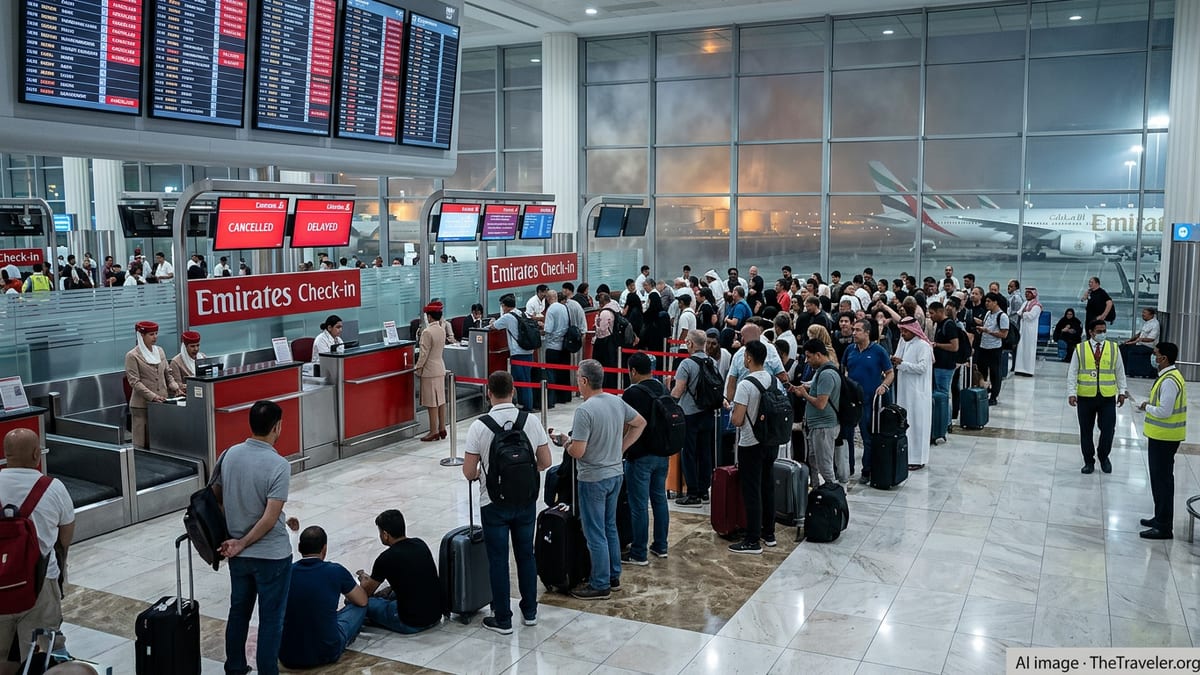
Drone Strike Near Airport Sparks Fire and Operational Shutdown
According to multiple international news reports and open-source timelines, a wave of Iranian missile and drone attacks against the United Arab Emirates reached Dubai on 28 February 2026, with one drone striking fuel infrastructure close to Dubai International Airport. The impact reportedly caused a significant fire in an aviation fuel tank area, prompting an immediate suspension of normal operations at one of the world’s busiest hubs for international traffic.
Publicly available coverage indicates that the blaze and subsequent safety checks led to extended runway and apron closures, with airport authorities prioritising firefighting, damage assessment and the securing of aviation fuel supplies. The incident occurred at a time of already heightened regional tension, compounding existing airspace restrictions and forcing airlines using Dubai as a connecting hub to react quickly to unfolding events.
Initial responses focused on diverting inbound aircraft to alternative airports in the Gulf and beyond, while departures from Dubai were held on the ground or cancelled outright. Passengers already in the terminal reported long queues, frequent gate changes and repeated departure time revisions as operations teams attempted to manage aircraft and crew displaced by the unexpected shutdown.
While the physical damage from the fire appears geographically contained, the operational repercussions have proved far wider, disrupting carefully timed long-haul schedules and exposing the vulnerability of global connectivity to security incidents near critical airport fuel and infrastructure nodes.
Emirates Faces Mass Cancellations and Network Disruption
The impact on Emirates, which bases its global hub-and-spoke network at Dubai International Airport, has been severe. Statements posted on the airline’s public channels and widely shared in travel forums indicate that all scheduled Emirates passenger flights to and from Dubai were temporarily suspended in the immediate aftermath of the strike as UAE airspace restrictions came into force.
Over the following days, Emirates began operating only a limited number of services on select routes as airspace corridors reopened and safety assessments progressed. Published disruption summaries describe mass cancellations across key long-haul markets, including services linking Dubai with major cities in Europe, North America, Asia and Australia, along with last-minute schedule changes that left aircraft and crew out of position.
Travelers reported receiving short-notice text messages and emails advising them not to travel to the airport unless they held a confirmed seat on a flight explicitly listed as active. Many itineraries involving Dubai as a transit point were either rerouted via alternative hubs or placed on open tickets, with customers instructed to rebook once a more stable schedule became clear. Those already in Dubai described extended layovers, unexpected hotel stays arranged by the airline and difficulties securing onward connections as capacity remained constrained.
Industry analysts note that the disruption arrives at a time when Emirates had been rebuilding long-haul capacity after previous global shocks. The sudden loss of predictability across its network highlights how quickly a single critical event, such as a strike on airport-adjacent infrastructure, can ripple through a carrier that relies heavily on a single mega-hub for global connectivity.
UK Tightens Travel Advice as Safety Concerns Mount
In parallel with the operational crisis, the United Kingdom has sharpened its travel advice for the United Arab Emirates and the wider region. Updated government guidance, reflected in travel risk briefings and echoed by insurers, urges heightened caution for non-essential journeys in light of active missile and drone activity, including the incident affecting Dubai’s aviation facilities.
Publicly accessible advisories stress that further attacks on infrastructure, including airports, cannot be ruled out, and that airspace closures may occur at short notice. Travelers are encouraged to monitor official channels closely, maintain flexible plans and recognise that consular assistance and insurance coverage may be constrained where events are categorised under conflict or war-risk exclusions.
Insurance specialists referenced in recent commentary warn that many standard travel policies may not respond to disruption directly linked to acts of war, leaving travellers potentially exposed to out-of-pocket costs for additional accommodation, alternative flights or abandoned trips. This has particular implications for UK holidaymakers who had scheduled spring travel via Dubai, often using Emirates as a connecting carrier to Asia, Australia and Africa.
Some risk assessments circulated to corporate clients describe leisure trips to Dubai as “highly disruption-prone” in the short term, advising companies to defer non-essential business travel and to explore routings that avoid the most exposed airports until the regional security situation stabilises.
Knock-on Effects for Global Air Travel and Tourism
The crisis at Dubai International is also reverberating across the wider aviation and tourism sectors. As Emirates recalibrates its schedules, downstream airports from London and Manchester to Dublin, Sydney and Kuala Lumpur have reported waves of cancellations and reduced frequencies on Dubai-linked services, affecting passenger volumes and airport operations far from the Gulf.
Travel forums and airline tracking services show that some long-haul passengers have already rebooked via alternative hubs such as Istanbul, Doha and various European gateways to avoid potential additional disruption in Dubai. This shift places short-term pressure on rival carriers and airports, which must accommodate passengers displaced from cancelled Emirates itineraries while managing their own operational challenges amid an unsettled regional security environment.
Dubai’s tourism sector, heavily reliant on the city’s role as a convenient stopover and destination for European, Asian and Australasian travellers, faces an uncertain period. Hotel operators and tour providers are now confronting a wave of cancellations and rebookings as consumers weigh the appeal of Dubai’s attractions against concerns about regional instability and the reliability of air links.
Observers note that the speed and transparency with which airlines and tourism authorities communicate evolving risks and operational status will be crucial in shaping traveller confidence. Clear messaging around which flights are operating, what protections are available to customers, and how changing travel advisories intersect with insurance rights may help reduce confusion for those caught up in the disruption.
What Travellers Need to Know Right Now
For travellers with near-term plans involving Emirates or transit through Dubai, publicly available guidance from airlines, travel risk consultancies and consumer groups converges on several core recommendations. Passengers are being urged to verify the status of every flight segment on the day of travel, avoid going to the airport without written confirmation that their specific service is operating, and prepare for the possibility of extended delays or unexpected diversions.
Specialists also advise passengers to review the fine print of their travel insurance, paying particular attention to exclusions related to war, terrorism and civil unrest, and to request written clarification from insurers where coverage is uncertain. Those yet to depart may find that airlines are offering limited-time fee waivers, date changes or route alterations, but the availability of these options can vary by ticket type and point of sale.
For travellers who decide to proceed with journeys through Dubai despite the heightened risk environment, current best practice includes maintaining flexible onward arrangements, carrying essential medications and valuables in hand luggage in case of sudden stopovers, and allowing for significant extra time between connecting flights. Many industry commentators suggest that, where alternative routings of comparable cost and duration exist, it may be prudent to avoid the most affected hubs until flight patterns and regional security conditions show sustained signs of stabilising.
As events continue to evolve, the situation at Dubai International Airport and across Emirates’ network remains fluid. Prospective passengers are likely to face a period of continued uncertainty, in which the ability to adapt plans quickly and respond to updated travel advice will be key to managing the disruption generated by the drone strike, airport fire and tightening UK guidance on travel to the region.