

More news on this day
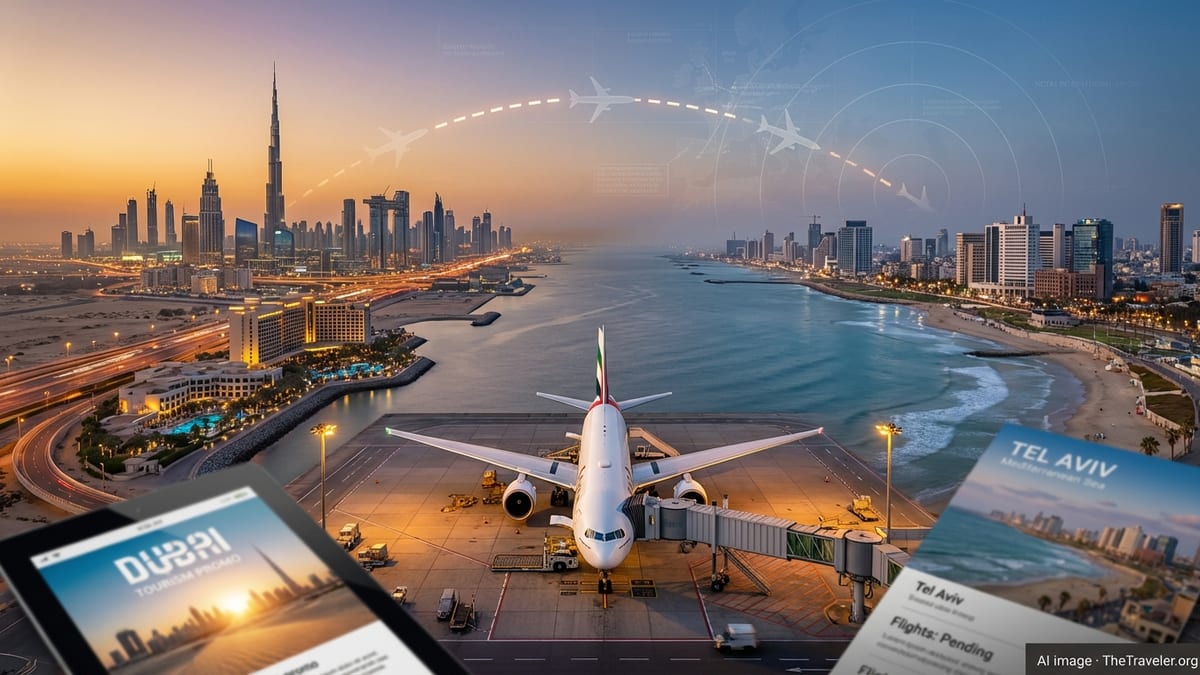
Speculation about Emirates reopening its Dubai to Tel Aviv route has intensified in recent weeks, raising hopes among tourism stakeholders in both Israel and the United Arab Emirates that one of the region’s most lucrative new air corridors could soon be restored.
Yet as of early February 2026, the picture is far more complex than headlines might suggest, with the airline publicly denying any “firm plans” to resume flights even as Israeli officials and industry analysts continue to talk up a potential restart and the tourism boost it could bring.
More News
- TSA Rolls Out $45 ConfirmID Fee for Travelers Without REAL ID at Security
- Flying Blue Launches February 25% Promo Rewards on Transatlantic and Regional Routes
- United Fast-Tracks Starlink Wi‑Fi Across Fleet, Free for MileagePlus Members
From Breakthrough Route to Sudden Suspension
When Emirates launched daily services between Dubai and Tel Aviv in June 2022, it was heralded as a flagship achievement of the Abraham Accords, which normalized relations between Israel and the UAE. The Dubai carrier initially operated a single daily Boeing 777 service, quickly upgrading capacity and frequencies as demand surged from both leisure and business travelers. Within a short period, Emirates grew the route to multiple daily flights, reflecting strong two-way traffic and robust connecting flows beyond Dubai toward Asia, Australia and the Indian Ocean.
For Tel Aviv, Emirates’ arrival significantly deepened global connectivity. Ben Gurion International Airport gained nonstop access to one of the world’s largest long-haul hubs, giving Israeli travelers seamless one-stop options to cities that previously required more complex routings. For Dubai, Israel rapidly became a top-tier source market. Data from Dubai’s tourism authorities showed visitor numbers from Israel rising sharply in 2022 and 2023, positioning the country among Dubai’s leading origin markets.
The momentum came to an abrupt halt in October 2023. Following the Hamas attacks of October 7 and the outbreak of war in Gaza, Emirates suspended its Tel Aviv flights on safety grounds. The airline initially set short-term suspension dates but repeatedly extended them through late November 2023, eventually announcing that services would be halted until further notice. Like many global carriers, Emirates cited security concerns and the need to coordinate closely with regulators before considering a return to Israel’s main airport.
Conflicting Signals on a 2026 Relaunch
In late 2025, hopes for a revival of the Emirates Tel Aviv route were rekindled by reports in Israeli media. Public broadcaster KAN and other outlets, including the Jerusalem Post, said that after meetings in Dubai between Israel’s transportation minister and senior Emirates executives, the airline had expressed willingness to restart Dubai to Tel Aviv operations in the first quarter of 2026. According to those reports, the intention was to restore flights early this year, potentially reestablishing a key bridge for tourism and trade.
Crucially, however, these discussions never translated into a formal schedule filing or ticket sales. Industry observers noted that Emirates had not secured new landing slots at Ben Gurion Airport and had not opened reservations for passengers, a standard prerequisite before any relaunch can be considered confirmed. The absence of concrete operational details suggested that the airline was signaling interest rather than a firm commitment.
That tentative picture shifted again at the start of February 2026. After a Bloomberg report suggested the carrier was preparing to resume Tel Aviv flights, Emirates issued a pointed clarification to regional media, stating that services to and from Tel Aviv remain suspended and that there are no firm plans to restart operations. The airline reiterated that it continues to monitor the security environment and coordinate with authorities, but declined to endorse any specific restart timeline that had circulated in public discourse.
Tourism Stakes for Tel Aviv and Dubai
The potential restoration of Emirates’ Dubai to Tel Aviv route continues to be watched closely across the travel trade because of its outsized impact on tourism flows. Before the suspension, the route had quickly become one of the busiest post-Abraham Accords corridors, channeling Israeli visitors to Dubai’s beaches, malls, and resorts while drawing Emirati and international travelers to Tel Aviv’s culture, nightlife and Mediterranean coastline.
For Tel Aviv’s tourism sector, Emirates offered far more than point-to-point traffic from the Gulf. The Dubai hub functioned as a gateway, plugging Israel into a global network of destinations across South and Southeast Asia, the Pacific, and Africa. Tour operators and hoteliers in Israel reported strong bookings driven by Emirates’ connecting traffic, particularly from markets such as India, Australia and Thailand, where awareness of Tel Aviv as a leisure destination had been growing.
Dubai, meanwhile, benefited from a wave of Israeli leisure travelers drawn by visa-free entry, short flight times and an image of safety and high service standards. Travel agencies in Israel rapidly built Dubai into winter-sun and short-break packages, while corporate travelers used the route to access conferences, exhibitions and investment forums in the UAE. The strong demand convinced Emirates to increase frequencies and capacity before 2023, underscoring how pivotal the link had become for both sides.
Security, Geopolitics and Airline Caution
The central reason Emirates has not yet reactivated its Tel Aviv services is the broader security context in the Middle East. Since late 2023, the region has been shaken by ongoing conflict in Gaza, periodic escalations involving Iran and allied groups, and incidents that directly affected civil aviation, including missile attacks near Tel Aviv’s Ben Gurion Airport and intermittent airspace closures over parts of the region.
Global carriers have responded with a mix of route suspensions, diversions and schedule adjustments. United Airlines and Delta, among others, have repeatedly paused and then resumed Tel Aviv operations in response to security assessments, sometimes only to halt flights again after new incidents. European and Asian airlines have also rerouted or canceled flights when tensions spike, especially when airspace closures in Iran, Iraq or Israel add complexity and risk to flight planning.
Emirates, as the world’s largest international airline by some measures, has taken a notably conservative stance on Israel operations. The carrier extended its suspension of Tel Aviv flights multiple times and, unlike some peers, has not pursued a stop-start approach. Its recent comments stressing the absence of firm plans to resume suggest that the airline sees the risk environment as still too fluid to support a stable and commercially viable schedule, particularly given its reliance on widebody aircraft and connecting flows.
Workarounds: Codeshares and Alternative Carriers
Despite the ongoing suspension of Emirates-operated flights, travel between Dubai and Tel Aviv has not ceased. The route continues to be served by flydubai, the UAE’s low-cost carrier based at Dubai International. Emirates maintains a codeshare agreement with flydubai, allowing passengers to book itineraries that combine flydubai’s narrowbody services on the Dubai to Tel Aviv sector with onward Emirates flights to other destinations.
This arrangement offers a partial workaround for travelers who once relied on Emirates’ own Boeing 777 service. Customers can still travel between Israel and a broad swathe of Emirates destinations, albeit with a change of aircraft in Dubai and, in some cases, differences in cabin product and service standards. For price-sensitive leisure travelers, the flydubai option may be adequate; for premium passengers accustomed to Emirates’ long-haul cabins, it is a compromise solution.
Beyond the UAE, other foreign airlines have gradually reintroduced Tel Aviv flights as their risk assessments permit. Major European carriers such as KLM have resumed services to Israel after temporary suspensions, often operating with adjusted schedules and routing to avoid specific airspace. These returning services help keep Tel Aviv connected to key source markets in Europe and North America, even as some Gulf routes remain on hold.
What Travelers Should Expect Next
For travelers in 2026 looking at the Dubai to Tel Aviv corridor, the immediate reality is that Emirates-branded flights remain suspended indefinitely, despite earlier suggestions of an early-2026 restart. Passengers should not assume that media reports about internal planning or political meetings equate to bookable flights. Until Emirates publishes a schedule and opens ticket sales, the route’s return remains speculative.
Industry analysts note that when a relaunch does happen, it is likely to be carefully phased. Emirates might begin with a daily or near-daily service using a Boeing 777 configured for both business and economy cabins, closely monitoring demand and security conditions before adding capacity. The airline will also need to coordinate with Israeli authorities on slot allocations at Ben Gurion and align its schedule with banked waves of departures and arrivals in Dubai to maximize connections.
Travelers considering future trips between the UAE and Israel are advised to build flexibility into their plans. Using flydubai, European carriers or Israel’s own airlines may be the most practical options in the near term. Should Emirates announce a firm restart date, agents expect a surge of bookings, particularly for premium cabins and high-demand holiday periods, as pent-up demand is released after more than two years of suspension.
Implications for Tel Aviv’s Tourism Recovery
Tel Aviv’s tourism industry has faced a challenging environment since late 2023, with the conflict in Gaza and subsequent regional tensions deterring some international travelers and prompting airlines to reassess their networks. While visitor numbers from certain core markets have begun to recover as carriers restore flights, the absence of Emirates represents a notable gap in long-haul connectivity, especially from Asia-Pacific and parts of Africa.
Stakeholders in Israel’s tourism and hospitality sectors see the eventual return of Emirates as an important milestone in signaling broader normalization and stability. The Dubai-based carrier not only brings in high-spend tourists but also enhances Tel Aviv’s visibility in distant markets where the airline’s marketing reach is substantial. Tour operators who once built packages around Emirates’ connections to places such as Sydney, Mumbai or Singapore are keen to revive those offerings when conditions allow.
On the UAE side, the Tel Aviv route is one piece of a larger strategy to position Dubai as the region’s premier travel and business hub, anchored in open skies and diversified source markets. Re-establishing two-way flows with Israel would support that ambition and underscore the resilience of the post-Abraham Accords travel corridor, even after a prolonged period of geopolitical turbulence.
FAQ
Q1. Has Emirates officially resumed flights between Dubai and Tel Aviv?
As of early February 2026, Emirates has not resumed flights between Dubai and Tel Aviv. The airline says services remain suspended and that there are no firm plans currently in place to restart operations.
Q2. Why did Emirates suspend its Tel Aviv route in the first place?
Emirates halted Tel Aviv flights in October 2023 following the outbreak of the Israel–Hamas conflict and heightened security risks in and around Ben Gurion Airport. The suspension, initially temporary, was extended several times and then left in place until further notice.
Q3. Are there any confirmed dates for Emirates to restart Tel Aviv flights?
No. While Israeli media previously reported that Emirates was considering an early-2026 return, the airline has since clarified that there are no firm restart dates or schedules. Until flights appear in official timetables with tickets on sale, any dates should be treated as speculative.
Q4. Can I still travel between Dubai and Tel Aviv using Emirates in some form?
Yes, but indirectly. Travelers can book itineraries that combine Emirates long-haul flights with services operated by flydubai, its codeshare partner, which continues to fly directly between Dubai and Tel Aviv. In these cases, Emirates typically handles the long-haul segments while flydubai operates the regional leg.
Q5. How important is the Emirates route for Tel Aviv tourism?
The route was highly significant before its suspension. Emirates connected Tel Aviv to a vast network of destinations via Dubai, channeling tourists from Asia, Australia, Africa and the Indian Ocean. Its return is seen by many in Israel’s tourism industry as a key factor in deepening long-haul demand and high-spend visitor arrivals.
Q6. Are other international airlines currently flying to Tel Aviv?
Yes. Several European and North American carriers have resumed Tel Aviv flights after earlier pauses, although schedules can change quickly with the security situation. Airlines typically adjust frequencies, routings or aircraft types based on ongoing risk assessments and regional airspace restrictions.
Q7. Is it safe to plan a trip to Tel Aviv that relies on connecting through Dubai?
Many travelers are successfully flying between Tel Aviv and Dubai using carriers that currently operate the route, including flydubai. However, given the region’s volatility, passengers should remain flexible, monitor airline advisories and consider travel insurance that covers disruptions or cancellations linked to security developments.
Q8. If Emirates does relaunch the route, what kind of service can passengers expect?
Before the suspension, Emirates used widebody Boeing 777 aircraft on the route, offering business and economy cabins, and in some cases first class. Analysts expect a similar configuration if flights return, with schedules timed to connect efficiently into Emirates’ global network through Dubai.
Q9. Will the return of Emirates flights instantly restore Tel Aviv tourism to previous levels?
Probably not immediately. While Emirates’ return would be a strong signal of confidence and would improve connectivity, broader tourism recovery will also depend on perceptions of safety, political stability and economic conditions in source markets. The impact is likely to be positive but gradual.
Q10. What should travelers do to stay updated on the status of Emirates’ Tel Aviv flights?
Travelers should regularly check official communications from Emirates and monitor reputable aviation and travel news outlets for updates. Relying on airline statements and published schedules, rather than rumors or early media reports, is the best way to avoid surprises when planning trips.