

More news on this day
Emirates is accelerating a major fleet transformation by deploying its new Airbus A350-900 aircraft on a growing list of routes from Dubai to Asia, Africa, and Europe, a move the airline says will redefine long-haul travel with quieter cabins, improved fuel efficiency, and significantly expanded premium seating.
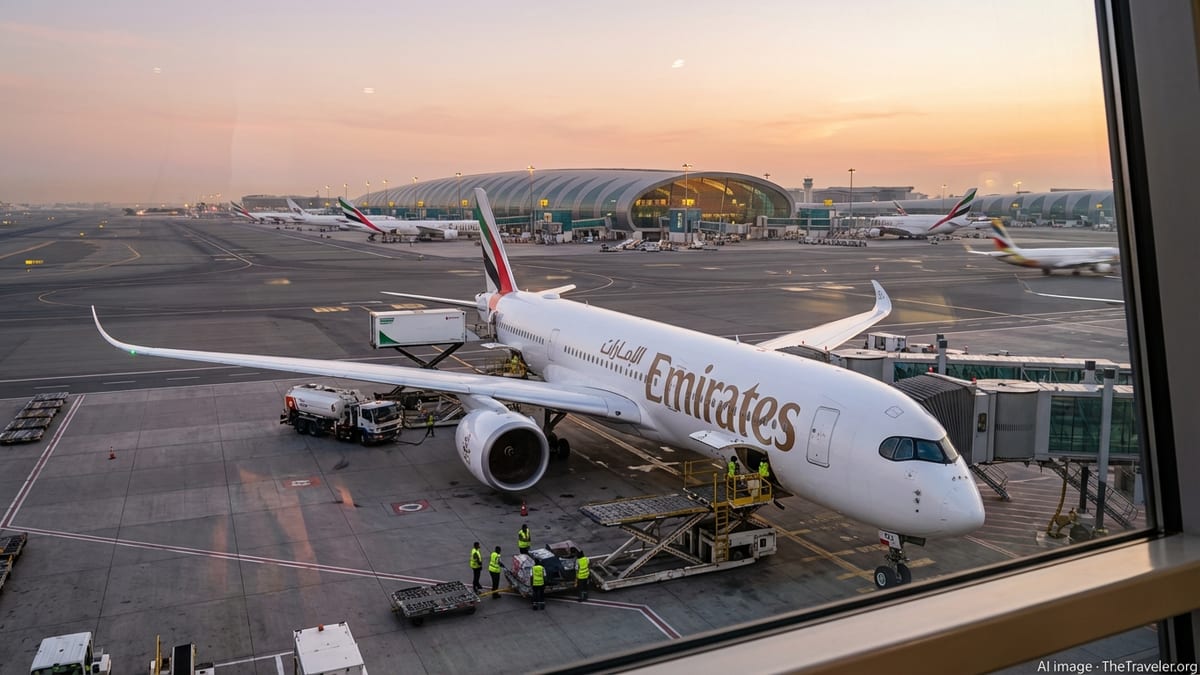
New-Generation Aircraft at the Heart of Emirates Strategy
The Airbus A350-900 has become central to Emirates’ long-term growth plans, complementing its flagship Airbus A380 and Boeing 777 fleets while opening up new network opportunities. The airline has ordered 65 A350-900s, part of a multibillion-dollar investment program designed to modernize its widebody fleet and support Dubai’s ambitions to strengthen its role as a global aviation hub.
Emirates’ A350-900s are configured with 312 seats in three classes: 32 lie-flat business class seats in a 1-2-1 layout, 21 premium economy seats in a 2-3-2 layout, and 259 economy seats in a 3-3-3 configuration. The cabins are built around Airbus’s Airspace concept, featuring higher ceilings, wider aisles, and larger windows, with an emphasis on passenger comfort on flights of up to 15 hours.
The aircraft’s latest-generation Rolls-Royce Trent engines and advanced aerodynamics are designed to deliver around 25 percent lower fuel burn and carbon emissions compared with previous-generation widebodies. For Emirates, that translates into lower operating costs and the ability to serve thinner, longer routes that may not support the capacity of an A380 but still require a high level of onboard product.
Emirates plans to deploy the A350 in two main versions: one optimized for regional and medium-haul missions and another prepared for ultra long-haul flying, including flights of more than 14,000 kilometers. This flexibility underpins the airline’s strategy to grow in mature markets while entering new city pairs where demand is strong but runway or market size constrains the use of very large aircraft.
First Wave: Building the A350 Network from Dubai
The first commercial services with the Emirates A350 entered operation in early 2025, initially focusing on routes within the Gulf, to the Indian subcontinent, and to select European cities. Early deployments included Bahrain, Kuwait, Muscat, Mumbai, Ahmedabad, Colombo, Lyon, Bologna, and Edinburgh, giving the airline a controlled introduction of the new type on high-demand but relatively short to medium-haul segments.
From June 2025, Emirates began a broader roll-out of the A350 across its network. Schedules filed and later confirmed by the airline show the 312-seat A350-900 entering regular service from Dubai to Tunis and Amman from 1 June, to Istanbul and Dammam from 1 July, to Ho Chi Minh City from 1 August, to Baghdad from 3 August, and to Oslo from 1 September. These moves rapidly expanded the presence of the A350 on routes spanning the Middle East, North Africa, Europe, and Southeast Asia.
On some existing routes, the A350 is being layered onto current frequencies rather than outright replacing older aircraft types. In Bahrain and Kuwait, for example, additional A350 rotations are gradually increasing the share of flights operated with the new type, giving passengers greater choice of schedules that include the latest cabins. In Europe, Bologna’s A350 debut was brought forward to June to capture peak summer demand, signaling the airline’s confidence in the aircraft’s performance.
Emirates executives have described the A350 as a network “bridge” that will allow the carrier to stitch together an even denser web of one-stop connections from Dubai. By pairing the A350’s range and economics with its extensive connecting bank structure at Dubai International Airport, the airline aims to attract more connecting passengers traveling between Europe, Africa, and Asia without adding unsustainable capacity.
Breakthrough African and Middle Eastern Deployments
Although the A350’s first missions for Emirates focused on Gulf and South Asian markets, the aircraft has since moved decisively into Africa and broader Middle East routes. Tunis became one of the first African capitals to receive the A350 from Dubai, with near-daily frequencies designed to serve both leisure and diaspora traffic as well as growing business links between North Africa and the Gulf.
In the Middle East and Gulf region, the A350 is now scheduled on services to Amman, Dammam, Kuwait, and Bahrain, supporting a mix of point-to-point and connecting traffic. These relatively short sectors are being used to showcase Emirates’ newest cabin interior to a large base of regional travelers, while also giving the airline operational flexibility for crew training and aircraft familiarization before ramping up ultra long-haul services.
Emirates has signaled that more African destinations will join the A350 network as additional airframes are delivered. Existing strongholds such as Johannesburg, Addis Ababa, and other sub-Saharan gateways are considered natural candidates, particularly where premium demand is high and cargo flows are robust. The aircraft’s lower fuel burn is especially attractive on long, fuel-intensive African sectors where margins can be thin.
For travelers from African markets, the introduction of the A350 from Dubai offers a more modern alternative to older widebodies, with features such as quieter cabins and upgraded inflight entertainment. Crucially, it also gives Emirates another lever to compete for high-yield corporate traffic and affluent leisure passengers who might otherwise opt for European or African carriers fielding newer-generation fleets.
Expanding Footprint Across Europe and Northern Latitudes
Europe has emerged as a key testing ground for Emirates’ A350 deployment strategy. Beyond early A350 routes like Lyon and Bologna, the airline has earmarked Oslo as a showcase for the type in Northern Europe, with daily Dubai–Oslo services scheduled on the A350. The route targets both leisure travelers heading to Scandinavia and business passengers from Norway accessing Emirates’ vast network across Asia and Africa.
The A350’s economics allow Emirates to serve medium-density European cities year-round with a high-quality onboard product, without needing the very large capacity of the A380. This is particularly relevant in markets where demand fluctuates seasonally, or where airport slots and runway performance constraints favor a lighter, more efficient twin-engine aircraft.
In the United Kingdom and wider Europe, industry analysts expect more A350 deployments on routes where Emirates sees steady corporate demand but wants to introduce or grow premium economy without over-committing capacity. The airline’s broader plan is to have roughly half of its network served by aircraft featuring its newest interiors, including the A350 and retrofitted A380s and Boeing 777s, by the end of 2025.
The A350 also provides operational flexibility during periods of maintenance or retrofit work on older aircraft. By reallocating A380s and 777s to trunk routes and using A350s to backfill or open secondary European cities, Emirates is seeking to keep load factors high while pushing more of its customer base onto cabins equipped with premium economy and the latest digital and comfort features.
New Horizons in Asia and Southeast Asia
In Asia, Emirates is using the A350 to deepen its presence in both established and emerging markets. The aircraft has been scheduled on flights from Dubai to Ho Chi Minh City, a fast-growing Vietnamese metropolis that serves as a key gateway for both business and leisure traffic. The choice of Ho Chi Minh City as one of the first Southeast Asian A350 destinations reflects the airline’s focus on connecting the Gulf with rapidly developing economies in the region.
Additional A350 deployments are planned across West Asia, reinforcing services to Mumbai, Ahmedabad, and Colombo. These cities are among Emirates’ highest-volume markets, and the introduction of the A350 adds more premium capacity while also offering operational cost savings. The combination of three-class cabins and improved fuel efficiency enables the airline to compete aggressively on fares while maintaining strong yields in the front cabins.
Southeast Asian expansion with the A350 is expected to continue as more aircraft enter service. Industry reports point to future deployment on routes into major tourism and trade centers where the A380 may be too large or where airport infrastructure favors twin-engine widebodies. Emirates is also paying close attention to schedule coordination, ensuring that A350 services align with key connecting banks in Dubai to maximize one-stop itineraries between Asia, Europe, and Africa.
For passengers in Asia, the arrival of the A350 on Emirates routes means a quieter flight with more advanced cabin features, including the airline’s latest inflight entertainment platform and enhanced connectivity. On longer routes from Dubai to Asia, the aircraft’s lower cabin altitude and higher humidity can also help reduce fatigue, particularly for travelers continuing onward to Europe or North America.
Cabin Experience: Quieter, Smarter, More Premium
Emirates has framed the A350 rollout as not just a fleet upgrade but a step change in passenger experience. The Airspace cabin design, combined with advanced sound-insulating materials, yields what is billed as one of the quietest twin-aisle cabins in the sky. Higher ceilings, enhanced lighting, and wider aisles are aimed at making both short and ultra long-haul flights feel less claustrophobic and more spacious.
In business class, all 32 seats on the A350 offer direct aisle access, lie-flat beds, and larger personal storage spaces. Premium economy, which Emirates continues to expand aggressively, is a focal point on the A350 with seven-abreast seating, increased legroom, and wider seats. Economy class has nine-abreast seating with improved ergonomics and larger overhead bins, reflecting the airline’s effort to enhance comfort even in the highest-density cabin.
Technology upgrades are present throughout the aircraft. Every seat features 60-watt USB-C charging, with higher-powered options in premium cabins, and the inflight entertainment system includes enhanced touchscreen functionality, better mapping, and more personalization features. Electric window shades, including dual blind systems in business and premium economy, allow passengers to fine-tune light levels, while digital menus and a wider choice of content bring the experience closer to that of a modern connected lounge.
The A350 is also equipped to support next-generation high-bandwidth inflight connectivity, enabling passengers to stream, work, and stay connected more reliably. Emirates has positioned these improvements as critical to capturing tech-savvy leisure travelers and remote-working professionals who increasingly expect ground-like connectivity at cruising altitude.
Environmental and Operational Edge for Long-Haul Growth
Beyond passenger amenities, the A350’s technical performance underpins Emirates’ narrative of more sustainable growth. The aircraft’s composite fuselage, advanced wing design, and latest-generation engines contribute to a sizable reduction in fuel consumption and associated emissions compared with older widebody models. This gives Emirates a tool to reduce its per-seat environmental footprint while continuing to operate a long-haul network from a desert hub.
The A350’s design allows it to operate efficiently across a wide range of stage lengths, from short regional hops to flights exceeding 15 hours. This range capability is proving especially relevant as Emirates introduces ultra long-range versions of the A350-900 on routes that push the limits of its existing twin-engine fleet. The aircraft is also certified to use higher blends of sustainable aviation fuel, positioning Emirates to take advantage of future SAF availability in Dubai and at key outstations.
Operationally, the A350’s commonality with other Airbus types and its modern flight deck technology can reduce pilot workload and support more efficient turnaround times. For Emirates, which operates a tightly banked hub with narrow connection windows, any reduction in ground time translates directly into network resilience and schedule reliability.
As more A350s join the fleet, Emirates is expected to redeploy older, less efficient aircraft or place them into retrofit programs, concentrating the newest interiors on routes where competition is intense. The twin benefits of better fuel economics and a refreshed onboard product are central to the airline’s plan to sustain its long-haul dominance at a time when global carriers are racing to modernize their fleets.
Positioning Dubai as the Next-Generation Connecting Hub
The rapid integration of the A350-900 into Emirates’ schedule is closely tied to Dubai’s wider aviation and economic agenda. Authorities are advancing plans for the Dubai World Central mega hub, which is intended to eventually handle more passengers than the current Dubai International Airport. A modern, fuel-efficient widebody fleet is viewed as essential to feeding this next-generation hub with a dense web of long-haul and ultra long-haul routes.
By deploying the A350 across Asia, Africa, and Europe, Emirates is reinforcing Dubai’s appeal as a one-stop gateway between many of the world’s major economic and tourism regions. The new aircraft enables the airline to serve mid-sized cities that might not support an A380 while still offering a full three-class product, including premium economy. That diversification of gateways is expected to draw more visitors to Dubai itself as a stopover destination.
For travelers, the expanding A350 network translates into more choice of destinations, more flights operated with next-generation cabins, and the promise of a quieter, more comfortable ride on long-haul journeys. For Emirates and Dubai, the aircraft represents a strategic platform to sustain growth, defend market share, and push further into new city pairs at a time when competition on key long-haul corridors is intensifying.
As additional A350-900s and ultra long-range variants are delivered through the coming years, observers expect Emirates to unveil more routes linking Dubai directly to secondary and emerging cities across Asia, Africa, and Europe. Those moves will determine just how transformative the new aircraft becomes in reshaping long-haul travel patterns through the Gulf’s busiest hub.