

More news on this day
As Middle East airspace closures, rising fuel costs, and labor unrest converge in early 2026, major global airlines including Emirates, Qatar Airways, Lufthansa, and Turkish Airlines are cancelling, rerouting, and delaying hundreds of flights, raising urgent questions about how safe travelers’ vacation plans really are for the year ahead.
Get the latest news straight to your inbox!
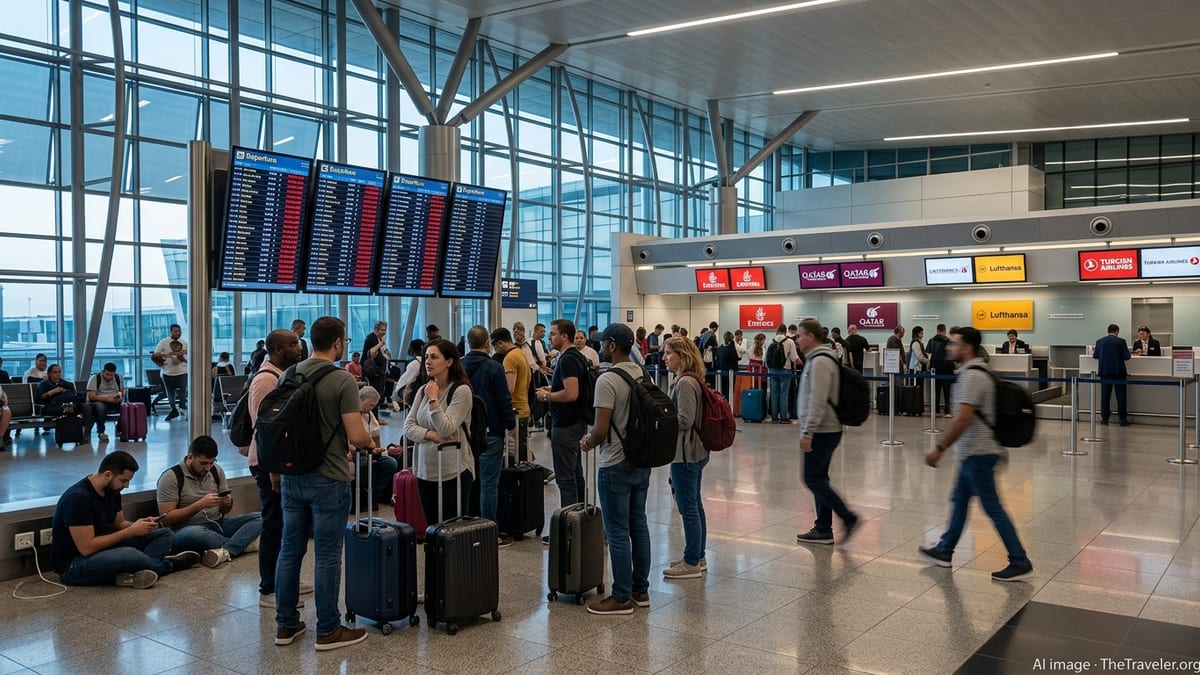
Middle East Airspace Closures Hit Global Hubs
Ongoing conflict involving Iran and its neighbors has led to extensive airspace restrictions across key Middle Eastern countries since late February 2026. Publicly available aviation notices and travel-management bulletins show that airspace over the United Arab Emirates, Qatar, Israel, Iran, Iraq, and parts of the wider Gulf region remains tightly restricted, forcing airlines to suspend or reroute traffic that normally passes through some of the world’s busiest transit corridors.
Industry analyses describe the current disruption as the most severe aviation shock since the COVID-19 pandemic. Several major airports in the region, including hubs in Dubai, Doha, and Abu Dhabi, have faced periods of closure or heavily curtailed operations. These facilities collectively handle a significant share of global long-haul traffic between Europe, Asia, Africa, and Australasia, so any shutdown quickly ripples outward into schedules on multiple continents.
According to recent disruption tracking by air passenger rights platforms, March 11 alone saw close to 200 cancellations and more than 800 delays across Europe linked to the Middle East airspace crisis. Reroutes around closed or restricted zones are lengthening flight times, increasing fuel burn, and complicating crew rotations, all of which make it harder for airlines to keep to their planned timetables.
For travelers, the immediate effect is a surge in last-minute flight changes, extended layovers, and short-notice cancellations, particularly on itineraries that would normally connect through Gulf hubs. Even passengers on routes that do not touch the region are seeing secondary delays as aircraft and crew are repositioned to work around the bottlenecks.
Emirates: Waivers, Repatriation Flights, and Rolling Cancellations
Emirates, which relies on Dubai as a mega-hub, has been at the center of the turmoil. Public notices shared via travel agencies, passenger communications, and online customer advisories indicate that the airline has introduced a broad “disruption waiver” policy covering tickets on affected dates from late February into mid‑April 2026, allowing many customers to rebook or refund without standard penalties.
Reports from passengers and travel intermediaries show that Emirates has been cancelling many scheduled services while simultaneously mounting special repatriation flights to move stranded travelers out of Dubai and other affected points. One crowdsourced list circulating among travelers referenced more than one hundred dedicated flights operating on a single day in early March, illustrating the scale of the recovery effort required to clear backlogs.
At several European airports, Emirates has temporarily suspended specific frequencies or entire rotations, with some travelers only learning of cancellations a few days before departure. Experiences shared by passengers indicate that certain routes, such as late‑evening departures from secondary European cities, have been paused for multiple days in a row, prompting ad hoc reroutes via alternative hubs or later travel dates.
Despite the disruption, published guidance stresses that safety remains the overriding factor in route planning and operational decisions. However, as the waiver window is currently defined with an end date in April, travelers holding Emirates tickets for summer and late‑2026 holidays are facing uncertainty over whether similar flexibility will be extended if the crisis drags on.
Qatar Airways, Lufthansa, Turkish Airlines and the Wider Domino Effect
Emirates is not alone in grappling with rapidly changing conditions. Following the closure of Qatari airspace on February 28, publicly available reporting noted cancellations and diversions at Doha’s Hamad International Airport, a central node in Qatar Airways’ global network. Combined with airspace restrictions affecting neighboring states, this has further constrained long‑haul connectivity between Europe, Asia, and Africa.
Lufthansa and its group carriers have been dealing with both geopolitical and labor-related pressures. In mid‑March, a 48‑hour pilot strike targeting Lufthansa’s main hubs in Frankfurt and Munich led the airline to ground the vast majority of its domestic and European operations and trim long‑haul services. Official customer updates outline temporary rebooking options for passengers scheduled to travel during the strike period, but the combination of industrial action and the Middle East crisis has tightened capacity at a difficult time.
Turkish Airlines, which relies heavily on Istanbul as a bridge between Europe and Asia, has also adjusted its program. Government and media reports from Türkiye describe suspended or reduced services to several Middle Eastern destinations amid heightened security concerns, as well as extended suspensions of certain routes into Iran. These measures, layered on top of airspace limitations further east and south, add yet another constraint for travelers looking for alternative routings.
Other carriers, including regional and low‑cost airlines, are reshaping their schedules to avoid the most exposed air corridors. In aggregate, these changes are reinforcing a global “domino effect” where even airlines with limited direct exposure to the Gulf are contending with tighter aircraft availability, congested alternative routings through South Asia or southern Europe, and reduced buffer capacity to absorb further shocks.
Reroutes, Flight Times, and Rising Costs for 2026 Travelers
With key airspace segments closed or heavily restricted, airlines are resorting to longer routings that skirt the Middle East, often via central Asia, the Caucasus, or southern Indian Ocean corridors. Aviation and logistics briefings note that these detours can add hours to flight times on some Europe–Asia and Asia–Africa sectors, significantly raising fuel consumption and crew costs.
At the same time, jet fuel prices have surged on the back of disrupted oil exports from the Gulf region. Recent energy-market coverage indicates that fuel is among the fastest-rising expense lines for airlines as the northern summer travel season approaches. Analysts suggest that fare increases, surcharges, or capacity reductions are increasingly likely on long‑haul routes if current price and security trends persist.
The combined effect for leisure travelers planning 2026 vacations could be fewer non‑stop options, longer overall journey times, and higher ticket prices, especially on itineraries that would typically rely on Gulf or Turkish hubs as convenient one‑stop connections. Travel demand remains strong after several years of pandemic‑era restrictions, so constrained capacity on popular school‑holiday and summer dates may translate into earlier sell‑outs and limited flexibility to change plans at short notice.
Travel industry observers also point to knock‑on effects in the hotel and tour sectors. Destinations that depend heavily on Middle Eastern or European feeder traffic may see volatile booking patterns, with some travelers postponing or redirecting trips to regions less exposed to the current aviation chokepoints.
How to Stress-Test Your 2026 Vacation Plans
For travelers who have already booked 2026 holidays with Emirates, Qatar Airways, Lufthansa, Turkish Airlines, or their partners, experts recommend treating plans as provisional while the situation in the Middle East and global fuel markets remains fluid. Publicly available airline advisories consistently urge passengers to monitor their booking status closely via official apps and flight‑status tools, as same‑week or even same‑day schedule changes have become more common.
Travel risk consultants and consumer organizations advise checking not only the airline’s current waiver policies but also the routing of each ticket. Itineraries that rely on transiting closed or heavily restricted airspace, or that route through hubs facing repeated operational suspensions, are more vulnerable to disruption than those using alternative corridors in Europe, North America, or parts of Asia‑Pacific.
Comprehensive travel insurance that covers schedule disruptions, missed connections, and involuntary itinerary changes may also prove more important than in previous years. Travelers are encouraged to read policy terms carefully, as some products may treat war‑related or government‑ordered airspace closures differently from weather or technical delays.
Finally, travelers booking new 2026 trips might consider building in additional buffer time at key points in their journey, avoiding tight self‑made connections on separate tickets, and favoring refundable or changeable fares where budgets allow. While no itinerary is completely risk‑free in the current environment, a more flexible approach can improve the odds that long‑awaited vacations remain achievable even as global aviation weathers another period of intense turbulence.