

More news on this day
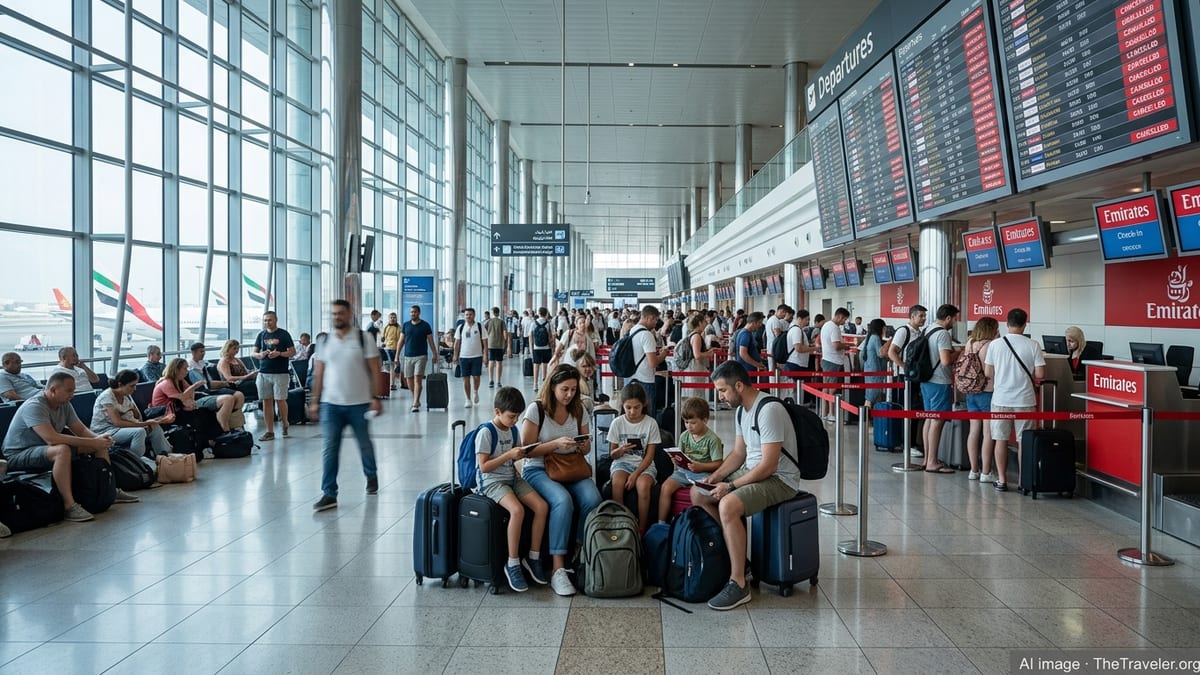
Widespread Emirates flight cancellations triggered by ongoing airspace closures in the Gulf region are causing severe travel disruption for passengers across the United Arab Emirates, Egypt, Thailand, the Seychelles and other major destinations, with thousands stranded or scrambling to rebook at short notice.
Get the latest news straight to your inbox!
Regional Conflict Sparks Prolonged Airspace Closures
Publicly available information links the current wave of cancellations to a sharp escalation in regional tensions, including recent missile and drone strikes on targets in the United Arab Emirates. As a result, large sections of airspace around the Gulf have either been closed or heavily restricted, forcing long-haul carriers to suspend or radically curtail operations.
According to published coverage, Emirates initially responded by suspending all flights to and from Dubai for several days, before gradually introducing a limited schedule on selected routes. Operational updates cited airspace closures rather than technical or weather issues as the primary cause, underscoring that the disruption is rooted in security considerations outside the airline’s direct control.
Travel advisories circulated in early March described smoke and debris reported in the vicinity of Dubai International Airport after air defenses intercepted incoming projectiles. While core airport infrastructure has remained intact, the combination of safety concerns, route restrictions and knock-on congestion has significantly reduced the number of flights airlines are able to operate through the region.
Industry analysts note that Emirates, as one of the world’s largest long-haul carriers and the main tenant at Dubai International, is particularly exposed to any prolonged closure of UAE airspace. The airline’s hub-and-spoke model depends on high-frequency connections through Dubai, meaning even short-term suspensions can quickly cascade into widespread delays and cancellations affecting multiple continents.
Stranded Passengers in Dubai, Cairo, Bangkok and Beyond
Reports from travelers and aviation forums describe scenes of uncertainty at major hubs including Dubai, Cairo and Bangkok as Emirates has cancelled or rescheduled flights with limited advance notice. Passengers transiting through Dubai have been especially vulnerable, with many only learning of cancellations shortly before departure and then struggling to secure alternative routings.
From Bangkok, travelers recount receiving overnight notifications that their Emirates services to Dubai and onward to Europe had been scrubbed, leaving families and tour groups competing for scarce seats on other airlines. Some passengers report being stuck in Thailand for several days while waiting for space to open up on replacement flights or while arranging entirely new itineraries via alternative hubs.
Similar accounts have emerged from Cairo, where travelers booked on Emirates connections to Asia and North America describe confusion over which services will actually operate. Publicly accessible discussions indicate that certain Cairo and Bangkok flights continued on select days as part of a slimmed-down schedule, while others disappeared from online timetables altogether, adding to passenger anxiety.
In the Seychelles and other Indian Ocean destinations, the interruption of Emirates’ regular services has cut a critical link to Europe and the Middle East at the height of the winter travel season. Tourists report disrupted honeymoons and holidays, with some turning to multi-stop routings via African or Asian hubs to return home, often at substantial additional cost.
Patchwork Schedules and Overloaded Support Channels
Emirates has been operating what observers describe as a patchwork schedule, publishing lists of specific flights operating to and from Dubai on certain dates. Updates shared by passengers show that routes such as Dubai to Cairo and Dubai to Bangkok have seen intermittent service, with some rotations operating while others on the same route and day are cancelled.
Publicly available information from airport boards and airline status tools shows that a flight still listed as “scheduled” in one system may be missing entirely from another, indicating late operational decisions as the airline navigates airspace restrictions and crew availability. This lack of clarity has made it difficult for travelers to plan ahead, especially for journeys involving long-haul connections.
Customer-service channels have come under heavy strain. Travelers describe long wait times on phone lines and frequent disconnections from chat services as thousands seek rebooking, refunds or travel credits at the same time. Many passengers report better outcomes by visiting city ticket offices or airport desks in person, although queues there have also been lengthy.
Airline guidance shared publicly has encouraged customers to track their booking via digital channels and to avoid heading to the airport until their flight’s operating status is confirmed. However, the rapidly changing situation has meant that some travelers still arrive at the terminal only to learn that their flights have been cancelled or heavily delayed.
Knock-On Effects on Fares, Insurance and Alternative Routes
The abrupt removal of a large volume of Emirates capacity has had immediate ripple effects across the wider aviation network. Travelers in Bangkok, Cairo and other cities report sharp increases in fares on competing carriers to Europe, Africa and North America, as remaining seats are quickly snapped up by displaced Emirates customers.
Some passengers who opted to cancel upcoming trips preemptively, wary of transiting Dubai while conflict persists, have encountered complex refund conditions. Discussions shared by affected travelers suggest that Emirates has applied more flexible rebooking and cancellation terms for departures scheduled in March, although specific outcomes appear to vary by fare type and route.
Travel insurance has emerged as another point of friction. In several reported cases, passengers who cancelled before an airline-issued disruption notice have been left negotiating partial reimbursements, while those whose flights were formally cancelled by the carrier have generally found it easier to claim full refunds or alternative arrangements.
With limited direct options via Dubai, many travelers are re-routing through other hubs in Europe, the Middle East and Asia. This has increased pressure on carriers based in Doha, Istanbul and major European capitals, with some flights now departing at or near full capacity as they absorb passengers originally booked on Emirates services.
Uncertain Timeline for Full Recovery
A clear timeline for a full restoration of Emirates’ network remains uncertain and appears closely tied to the evolution of regional security conditions. While the airline has incrementally added flights back to the schedule as airspace restrictions have eased on particular days, observers note that even a modest escalation in tensions could trigger fresh suspensions.
Aviation analysts point out that the longer the disruption continues, the more challenging it becomes to re-balance fleets and crew rosters, and to clear the backlog of rebookings. High-demand leisure destinations such as Thailand and the Seychelles, along with key regional gateways like Cairo, may continue to see irregular frequencies until confidence in the stability of the airspace returns.
For now, publicly available guidance consistently advises Emirates passengers to closely monitor their bookings, remain flexible with travel dates where possible and consider alternative routings that avoid heavily affected corridors. With the busy spring and early summer travel periods approaching, the scale and duration of the current disruptions are likely to shape travel planning decisions for months to come.