

More news on this day
Dubai’s role as the world’s busiest international air hub has been abruptly curtailed as Emirates and other Gulf carriers grapple with more than 12,000 flight cancellations, rapidly evolving refund policies, and sweeping regional airspace closures triggered by escalating conflict in the Middle East.
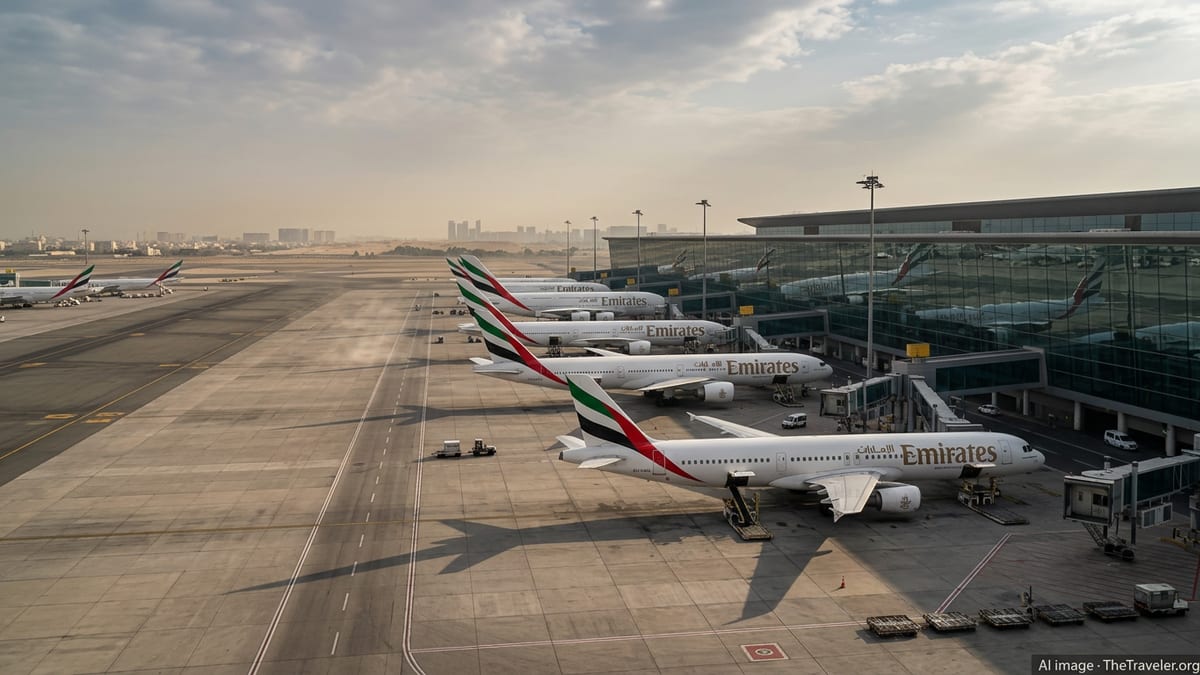
Severe Disruption as Cancellations Top 12,000
Air travel through Dubai and the wider Gulf has been thrown into turmoil, with Emirates at the epicentre of a cascading operational crisis that has now led to more than 12,000 flights being cancelled across key Middle Eastern hubs. Data compiled by aviation analysts and industry trackers over recent days shows cancellations mounting at Dubai, Abu Dhabi, Doha, Sharjah, Kuwait City and Bahrain as carriers suspend most scheduled services and operate only a skeleton roster of repatriation and cargo flights.
Emirates, the largest operator at Dubai International Airport, has confirmed that all regular scheduled flights to and from Dubai remain suspended until at least late on March 4, even as a handful of long-haul departures have begun to operate under special clearances. The airline is focusing on limited departures using widebody aircraft such as the A380 and Boeing 777 on key trunk routes to Europe, Asia and the Gulf, while warning customers that capacity is extremely constrained and subject to late operational changes.
Industry estimates on Tuesday suggest that, when combined with cancellations by Etihad, Qatar Airways, flydubai, Air Arabia and other regional carriers, the total number of axed flights since the start of the airspace crisis has already exceeded the 12,000 mark. Analysts note that this figure is likely to rise further over the coming days as schedules continue to be rewritten and authorities reassess the security picture.
For passengers, the scale of the disruption is being felt in crowded terminals, mounting hotel bills and lengthy waits on customer-service lines. With Dubai normally handling more than a quarter of a million passengers per day, even a partial shutdown translates into tens of thousands of travelers stranded on any given day as airlines attempt to untangle complex connecting itineraries.
New Refund and Rebooking Rules for Emirates Customers
In response to the unprecedented disruption, Emirates has rolled out updated refund, rebooking and travel credit options aimed at providing clearer pathways for affected ticket holders. The carrier is offering complimentary date changes for most passengers whose travel falls within the suspension window, allowing them to move journeys to later dates without standard change penalties, subject to fare conditions and seat availability on alternative flights.
Customers booked directly with Emirates can generally choose between free rebooking, a full refund to their original form of payment, or conversion of the ticket value into a travel voucher that can be used on future journeys. The airline has encouraged travelers to use digital channels to manage their bookings, stressing that those who purchased tickets via travel agents, tour operators or third-party sites must request changes through the original point of sale, which may apply its own processing timelines.
Travel advisors say one of the biggest challenges for passengers is the lack of certainty over when normal schedules will resume, making decisions between rebooking and refund more complex. While some customers are opting to shift their dates into late March and April, others are choosing immediate refunds so they can replan trips through alternative hubs that are less affected by the current wave of restrictions.
Emirates has also adjusted priority handling rules as it restarts a limited number of flights. The carrier is first re-accommodating passengers with the earliest original departure dates, followed by those with critical travel needs such as medical appointments, family emergencies or imminent visa expiries. Travelers without confirmed rebooked itineraries are being urged not to go to the airport, as they are unlikely to be accepted on standby and risk being turned away at check-in.
Regional Airspace Closures Reshape Global Routes
The immediate trigger for the cancellation wave has been a series of temporary airspace closures and restrictions across the United Arab Emirates, Qatar, Iran, Iraq and parts of neighboring states, ordered after missile and drone attacks and heightened military activity in the region. Aviation authorities in the UAE announced a partial closure of national airspace as a precautionary safety measure, forcing carriers to suspend or sharply curtail operations while alternative routings are evaluated.
With several key corridors over the Gulf and West Asia effectively off limits or tightly constrained, airlines are facing lengthy detours that can add hours to flight times between Europe, Africa, Asia and the South Pacific. In many cases, the extra distance, air-traffic congestion and crew duty limits make rerouting commercially or operationally unviable, leading carriers to cancel services outright rather than operate heavily delayed and fuel-intensive flights.
The impact is particularly acute for hub-and-spoke giants such as Emirates, Qatar Airways and Etihad, which rely on dense traffic through their Gulf hubs to connect long-haul passengers across continents. Analysts note that the closures have disrupted an estimated 90,000 daily connecting journeys that typically pass through these hubs, with ripple effects visible at airports as far away as London, Sydney, Johannesburg and Mumbai.
Global carriers outside the region are also adapting. Some European and Asian airlines have temporarily suspended services to Gulf destinations, while others are operating with technical stops or circuitous routings via more southerly tracks. Industry groups have warned that if airspace closures persist, travelers should expect higher fares, longer journey times and reduced choice of nonstop routes on many key intercontinental corridors.
Limited Operations Resume but Chaos Persists
Despite the grim overall picture, there are tentative signs of stabilisation at Dubai International. Airport authorities have confirmed that limited operations have resumed, with a small number of Emirates A380 and Boeing 777 flights departing for major European and regional destinations under closely coordinated security and air-traffic arrangements. Nonetheless, insiders estimate that more than 80 percent of scheduled services remain cancelled, and that full restoration of pre-crisis capacity is still some distance away.
Terminal damage, disrupted crew positioning and aircraft scattered across multiple outstations are all contributing to the slow pace of recovery. Airlines are prioritising repatriation flights to return stranded passengers and crew to their home bases, while cargo operations are being ramped up selectively to maintain critical supply chains for medical goods, food and high-value freight.
On the ground in Dubai, scenes at the airport have ranged from relatively calm check-in areas for the small number of confirmed departures to packed waiting zones where transit passengers are bedding down on benches or in makeshift rest areas. Local authorities have coordinated with hotels to secure additional rooms for those unable to travel, while some governments have begun organising evacuation or special charter flights to bring their citizens home.
For many travelers, the uncertainty is proving more stressful than the delays themselves. With flight schedules being updated in rolling batches and last-minute operational decisions common, passengers are being advised to monitor airline communications closely and avoid speculative trips to the airport without confirmed bookings and check-in instructions.
What Travelers Should Expect in the Coming Days
Looking ahead, aviation experts say the pace at which Dubai’s air hub can recover will depend heavily on security assessments by regional governments, the reopening of key air corridors and the ability of airlines to reassemble aircraft and crew in the right places. If hostilities ease and authorities progressively lift restrictions, carriers such as Emirates are expected to add back flights in phases, prioritising high-demand trunk routes and essential connectivity to major partner markets.
Even under an optimistic scenario, however, travelers are being warned to brace for days or weeks of residual disruption. Backlogs of displaced passengers, the need to rebuild complex wave-based bank structures at hub airports, and ongoing air-traffic constraints are all likely to limit capacity well after formal suspensions expire. This means that some customers with March tickets could still find themselves rebooked into later travel dates or different routings than originally planned.
Industry observers also point out that the current crisis may prompt a broader rethink of risk management and network planning among airlines heavily reliant on Gulf hubs. Carriers and corporate travel buyers alike are likely to examine diversification strategies, including alternative routings, greater reliance on point-to-point services where feasible, and more flexible ticket conditions to protect passengers when geopolitical tensions flare.
For now, the most consistent advice to Emirates customers remains clear. Treat upcoming trips as disrupted unless you have received specific confirmation of a rebooked flight, keep contact details up to date in your booking, and be prepared to pivot between refund, rebooking and alternative routing options as the situation around Dubai’s skies continues to evolve.