

More news on this day
Emirates flights to, from, and through Dubai are operating again in March 2026, but schedules remain heavily adjusted following war-related airspace closures and temporary shutdowns at Dubai International Airport.
Get the latest news straight to your inbox!
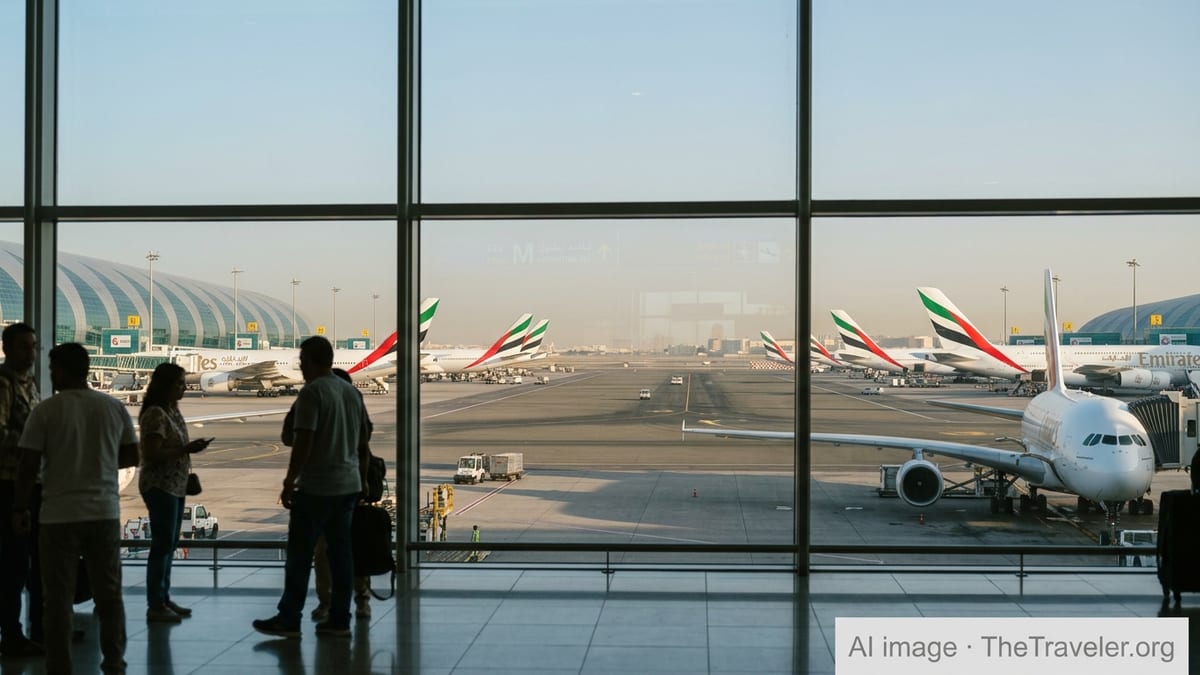
Emirates Operations After March 2026 Disruptions
In early March 2026, a sharp escalation in regional conflict led to widespread airspace closures across the Gulf and much of the Middle East. Publicly available flight data and news coverage show that Dubai International Airport temporarily halted most commercial movements after nearby strikes and missile interceptions, with thousands of flights across multiple airlines affected.
Emirates, whose global network is built almost entirely around its Dubai hub, initially responded by suspending regular passenger services to and from Dubai. Travel advisories and news reports from the first days of March indicated that only a small number of evacuation, cargo, and repositioning flights were allowed to operate while authorities assessed damage and airspace safety. Passengers were advised not to travel to the airport unless specifically instructed and many itineraries were automatically cancelled or placed in limbo.
Over the following days, Emirates began a phased restart. According to industry route-tracking sites and travel-industry reporting, the airline reintroduced a limited schedule from Dubai from around 2 to 7 March, focusing first on key long haul routes and repatriation needs. The network was far from normal, with many destinations still paused, wide detours to avoid closed airspace, and frequent last-minute changes.
By mid-March 2026, published schedule data suggests that Emirates had restored large parts of its route map but with reduced frequencies on several city pairs and persistent delays. The carrier continues to describe its Dubai hub as operating under “limited” or “adjusted” conditions, and travelers are being told to verify that both their inbound and connecting flights are confirmed before attempting to transit through the city.
Can You Fly Into Dubai With Emirates Right Now?
As of late March 2026, travelers can generally book and board Emirates flights into Dubai, but the experience is not the same as during normal operations. Airport management and aviation analysts report that Dubai International Airport is open, with passenger volumes gradually returning, yet still below the forecasts that had projected close to 100 million travelers in 2026 before the latest crisis.
Route and schedule data compiled by airline intelligence services show that Emirates is flying into Dubai from many of its major long haul markets, including Europe, North America, Asia, and Australasia. However, frequencies on some routes are temporarily lower than they were at the beginning of the year, and select secondary destinations remain suspended or operate only a few times a week. Travelers from certain nearby Middle Eastern cities may find fewer options or longer connections than usual.
Operational reliability remains a key concern. Reports from passenger forums and travel advisories suggest that even flights listed as operating can be retimed, rerouted, or cancelled at short notice. Some services have been documented turning back or diverting mid-flight due to changing airspace restrictions, adding uncertainty for anyone flying into Dubai for time-sensitive events or onward connections.
For travelers whose journey ends in Dubai, the main practical implications are possible delays and schedule changes. Arriving passengers should plan for longer travel days, monitor their flight status closely, and consider flexible hotel and ground transport arrangements in case of late arrivals or rebookings.
Transiting Through Dubai on an Emirates Connection
Dubai’s role as a global connecting hub has been particularly affected by the regional situation. Emirates’ business model relies on seamless transfers through its dedicated facilities at Dubai International Terminal 3, and March’s disruptions temporarily undermined that connectivity. Advisory notices during the worst of the crisis indicated that passengers would only be accepted on a first leg into Dubai if their onward connection was confirmed as operating.
Current information suggests that this cautious approach is still influencing how connections are handled. Many travelers report that rebooking priorities are being given to those with long haul, intercontinental itineraries and to passengers who were previously stranded by cancellations. Schedules published by route-data services show that while much of the long haul network is back in place, some short haul and regional spokes that normally feed the hub are still running at reduced levels, increasing the risk of misaligned connections.
Detours around restricted airspace are also adding hours to certain itineraries, particularly flights linking Europe or North America with South and Southeast Asia. These longer routings can compress connection windows or trigger missed connections even when flights depart roughly on time. Transit passengers should therefore allow extra margin between flights wherever possible and avoid very tight minimum connection times that may have been acceptable before March 2026.
Travel experts also highlight that lounge capacity, ground handling, and baggage transfer operations may be under strain as Emirates rebuilds its network. While Terminal 3 remains fully functional, passengers connecting through Dubai should be prepared for queues at security and transfer desks, and for occasional baggage delays as systems adapt to evolving schedules.
Flying Out of Dubai on Emirates in 2026
For residents of the United Arab Emirates and visitors currently in the country, Emirates departures from Dubai are once again available to a wide range of destinations, albeit with an emphasis on major gateways. Published coverage and airline timetables show that flights to core cities such as London, New York, Sydney, and key Asian and African hubs are among the most consistently operated.
At the same time, some outbound flights continue to be consolidated, downgraded in frequency, or retimed. Industry bulletins for the second half of March list temporary schedule reductions on a number of routes, including parts of central and eastern Europe, some African destinations, and a selection of regional cities. In practice, this means that while it is usually possible to leave Dubai with Emirates, travelers may have fewer departure time choices and may need to accept alternative routings.
Airspace restrictions remain a fundamental factor. Aviation risk advisories updated in mid-March still warn of hazards over parts of Iran and neighboring states, prompting many airlines, including Emirates, to use longer detours over safer corridors. These workarounds add fuel costs and block time, which can ripple through the network as delayed arrivals and knock-on disruptions to subsequent departures.
For travelers planning medium or long haul trips out of Dubai, flexible tickets and comprehensive travel insurance that covers disruption are especially important in the current environment. Publicly available policy information shows that Emirates is continuing to offer rebooking and, in some cases, refunds for itineraries materially affected by the March 2026 disruptions, although processing times can be slow due to high volumes.
What Prospective Emirates Passengers Should Do Now
Anyone considering flying to, from, or through Dubai with Emirates in the coming weeks should treat the situation as fluid. While the airline is again operating a large number of flights and positioning itself to rebuild to its pre-crisis network, the regional security backdrop and airspace status can still change quickly. Travel planners recommend checking flight status repeatedly in the days and hours before departure and registering for airline notifications so that changes are not missed.
Travelers booking new tickets for 2026 should be aware that schedules later in the year may not fully reflect final operating plans. Airlines typically adjust timetables in response to evolving demand and operational constraints, and the current Middle East environment adds an additional layer of uncertainty. Choosing itineraries with generous connection times, avoiding unnecessary backtracking, and favoring nonstop options where available can reduce exposure to disruption.
For those uncomfortable with routing through the Gulf in the near term, alternative hubs in Europe and Asia are absorbing some of the displaced demand. However, Dubai remains one of the region’s most important aviation centers, and current data indicates that Emirates is committed to maintaining its role as a global connector even under constrained conditions. As airspace gradually reopens and risk assessments evolve, further increases in frequency and network breadth are likely, although no timeline can be guaranteed.
Ultimately, it is currently possible to fly with Emirates to, from, or via Dubai, but not with the level of predictability that travelers had come to expect before March 2026. Those who choose to travel should build flexibility into their plans, stay closely informed, and be prepared for last-minute changes as the airline and its home hub navigate a complex and fast-moving situation.