

More news on this day
As Ramadan 2026 begins, Emirates is rolling out an expanded suite of services designed specifically for fasting passengers, positioning the Dubai-based carrier as a global case study in how airlines can blend operational precision with cultural sensitivity at scale.
Ramadan 2026 Begins With a New Focus on the Passenger Journey
Ramadan 2026 is set to run from mid-February to mid-March, coinciding with one of the busiest travel periods across the Gulf and key long-haul corridors linking Europe, Asia and North America. For Emirates, whose network connects many of the world’s largest Muslim communities, the holy month is both a logistical test and an opportunity to showcase a more personalized form of hospitality.
This year the airline is emphasizing what it describes as an end-to-end Ramadan journey, expanding on several long-standing initiatives while adding new touches for customers who are fasting. The goal is to ensure that from the moment travelers arrive at the airport until they reach their destination, their needs during Ramadan are anticipated rather than improvised.
Industry observers note that carriers across the Middle East have steadily refined their Ramadan offerings over the past decade, but Emirates’ 2026 program underscores a broader shift toward more granular tailoring. Rather than a single set of services, the airline is adapting timing, menus and onboard routines in line with both flight profiles and passenger expectations.
Tailored Dining: Precision Timing for Iftar and Suhoor in the Sky
Central to Emirates’ Ramadan approach is the timing of meals. The airline continues to use a dedicated calculation system based on aircraft position to determine the exact imsak and iftar times on every applicable flight. The system tracks latitude, longitude and altitude to pinpoint sunset and daybreak, with the captain announcing when passengers may break their fast.
Onboard, dining schedules in all cabins are adjusted where possible so that the main service aligns more closely with iftar. On flights that span multiple time zones or cross sunset mid-flight, cabin crew are briefed to offer flexible options, allowing fasting passengers to delay or bring forward their meal service according to their observance and comfort.
For passengers not observing the fast, Emirates maintains its regular hot meal program, with crew instructed to minimize disruption for those who may be breaking their fast quietly or praying. The airline’s training materials emphasize discreet service flows, softer lighting where appropriate and clear communication so that passengers can choose how and when they wish to dine.
New-Generation Iftar Boxes: Design, Nutrition and Convenience
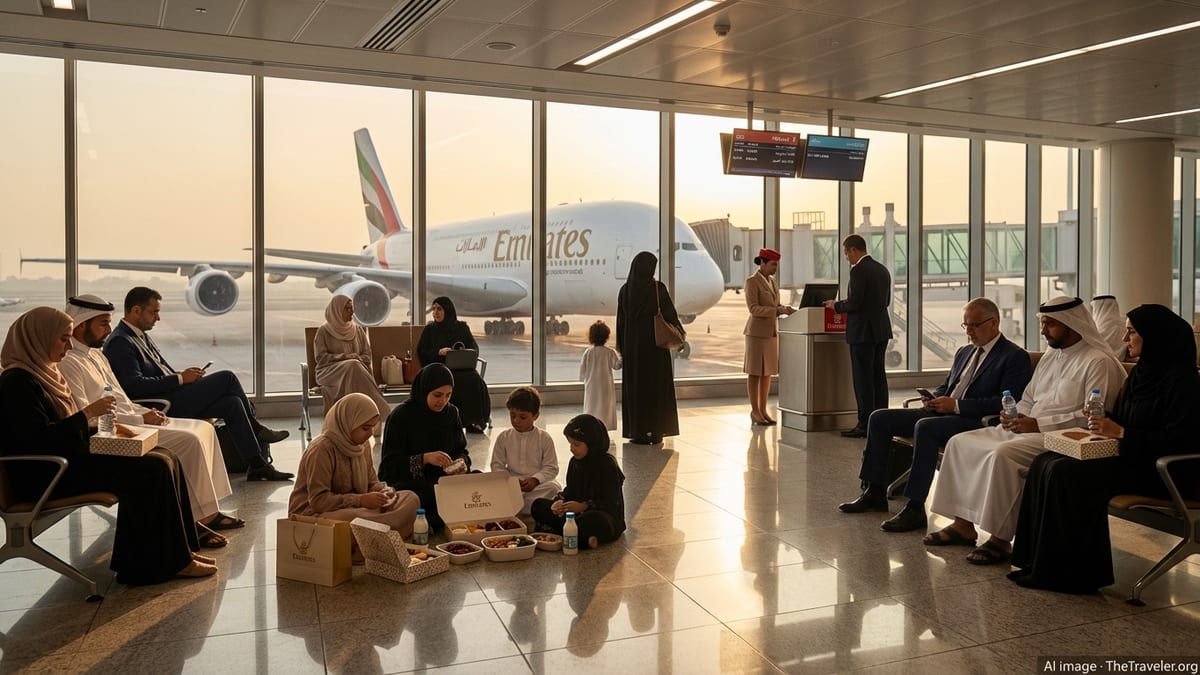
The most visible symbol of Emirates’ Ramadan preparations in 2026 is the latest evolution of its dedicated iftar boxes, now a familiar feature on selected flights and at key boarding gates. The boxes are provided to fasting passengers when iftar coincides with boarding, departure or time spent in the air, allowing them to break their fast even if full meal service is still some way off.
This year’s boxes feature geometric artwork inspired by traditional Islamic design, a motif Emirates has refined over recent seasons. Inside, the contents are curated to be both familiar and nutritionally balanced: typically a selection of mezze such as hummus, moutabel or muhammara with Arabic bread, a light main item like a chicken mossakan or herbed chicken sandwich, and sweet elements including chocolate-covered almonds, baklawa or pistachio mamoul, alongside dates and laban.
Operationally, the boxes are designed to be compact, easy to handle and quick to distribute. Crew can hand them out individually at passengers’ seats, while ground teams in Dubai and at select outstations provide similar boxes at boarding gates around iftar time, often including water, laban, dates and a banana for those who prefer to break their fast before stepping onto the aircraft.
Crucially, the iftar boxes supplement rather than replace the standard meal service. Fasting passengers can use the box to break their fast at the correct time and then opt to enjoy the full hot meal later in the flight, a flexibility that has proven particularly valuable on long-haul sectors and for business travelers whose workdays extend right up to departure.
Lounges and Airports: Extending Ramadan Hospitality on the Ground
Beyond the cabin, Emirates has again turned its Dubai International Airport lounges into focal points for Ramadan hospitality, with satellite initiatives in Cairo and Jeddah. During the holy month, buffet counters in premium lounges feature a rotating selection of traditional dishes such as lamb mandi, chicken machboos, Arabic mixed grill and lentil soup, alongside an expanded line-up of sweets like pistachio kunafa, halawet al jibn, basbousa and chocolate baklava.
Dates, Arabic coffee and Ramadan-specific beverages, including jallab and laban, are readily available, while lounge teams are briefed to ensure that food stations remain well stocked around iftar and suhoor rather than peaking only at conventional meal times. This reconfiguration of service rhythms is especially important for transit passengers whose fasting schedules do not always align neatly with airport timetables.
Dedicated prayer rooms and ablution facilities in Emirates’ lounges, already a standard feature, take on heightened importance during Ramadan. Signage, prayer-time information and wayfinding are updated to allow passengers to move efficiently between prayer, dining and boarding, reflecting a growing awareness within the aviation sector that spiritual routines are an integral part of the travel experience for many customers during the holy month.
At selected Dubai boarding gates, Ramadan-branded distribution points for iftar snack boxes underscore how far the airline has integrated religious observance into its operational planning. Gate staff are tasked with starting distribution shortly before sunset, easing congestion and enabling passengers to board without rushing their fast-breaking rituals.
Cultural Sensitivity and Crew Training as a Service Standard
Underpinning the visible Ramadan offerings is a layer of staff training that Emirates has continued to expand. Cabin crew and ground teams receive refreshed guidance ahead of the holy month on topics ranging from basic principles of fasting to how best to support passengers who may be tired, dehydrated or traveling with children while observing the fast.
Briefings highlight subtle but practical details: avoiding offering food or drink directly to visibly fasting passengers during daylight hours unless requested, timing service around prayer and iftar announcements, and using clear, neutral language when explaining onboard options. In mixed cabins where some passengers are fasting and others are not, crew are encouraged to create a calm environment that respects both groups.
For many employees based in Dubai or on Middle East routes, Ramadan is a familiar part of the working year. However, Emirates’ multinational workforce and increasingly global network mean that not all crew have first-hand experience of the holy month. The airline’s training modules aim to bridge that gap, framing cultural sensitivity not as a niche skill but as a core component of modern hospitality.
Industry analysts suggest this emphasis is not purely altruistic. In a marketplace where customer experience is a key differentiator, demonstrating a nuanced understanding of passengers’ religious and cultural needs can reinforce brand loyalty, particularly among frequent flyers from majority Muslim markets.
Supporting Umrah and Religious Travel Across the Network
Ramadan traditionally coincides with a surge in religious travel, particularly among pilgrims heading to Saudi Arabia for Umrah. Emirates continues to calibrate its services on routes to Jeddah and Medina accordingly, with additional iftar boxes loaded for these sectors and ground teams prepared for group check-ins and special handling requests.
Passengers traveling on Umrah itineraries are allowed to check in a dedicated allowance of Zamzam water, typically up to five liters per person in specially packed containers from approved points of sale. For many travelers, being able to carry Zamzam water home is an integral part of the pilgrimage experience, and codifying this allowance into airline policy helps reduce uncertainty at the airport.
Aircraft operating to and from the Kingdom of Saudi Arabia during Ramadan may see further adjustments to cold versus hot meal offerings, depending on scheduling and the volume of fasting passengers on board. In practice, this often means more emphasis on light, hydrating options and flexibility in when meal items are presented.
By positioning its Umrah-related services within the broader framework of its Ramadan program, Emirates is signaling that religious travel is not an exception to be managed but a core, predictable segment of its annual schedule, deserving of dedicated planning and resources.
Entertainment, Storytelling and the Ramadan Mood Onboard
While food and scheduling are among the most discussed aspects of Ramadan travel, Emirates has also invested in the softer elements that shape the overall journey experience, particularly through its ice inflight entertainment system. During Ramadan, ice highlights religious and cultural content in Arabic and other languages relevant to fasting passengers, including faith-based series, lectures and documentaries about the history and traditions of the holy month.
The curated Ramadan section sits alongside the platform’s broader catalogue of films, television and audio channels, giving passengers the choice between explicitly religious programming and more general entertainment. For some travelers, particularly families, this mix allows them to set a reflective tone early in the flight and then transition to lighter content as the journey progresses.
Cabin ambience is another area where airlines can subtly reinforce the Ramadan mood without imposing it. Emirates typically maintains its standard lighting schemes for safety and consistency, but crew are encouraged to synchronize small touches, such as serving dates and Arabic coffee where appropriate or offering warm towels and beverages shortly after iftar announcements, in a way that reflects the spirit of generosity associated with the month.
These additions, while modest compared with core operational changes, contribute to what frequent flyers describe as an atmosphere of considered hospitality, where Ramadan is acknowledged as part of the shared context of the journey rather than treated as a logistical complication.
Ramadan 2026 as a Template for Future Culturally Aware Travel
As global airlines increasingly compete on the quality and personalization of their service, Emirates’ Ramadan 2026 program is likely to be studied as an example of how targeted cultural offerings can be scaled across a large network. The combination of precise meal timing tools, redesigned iftar boxes, lounge adaptations and enhanced crew training reflects an integrated approach rather than a collection of isolated gestures.
For travelers, the impact is experienced in small but meaningful ways: a correctly timed captain’s announcement, a thoughtfully packed snack box offered at exactly the right moment, or a quiet corner in a busy hub where they can break their fast and pray without feeling rushed. In aggregate, these details shape how passengers remember their journey long after they land.
Looking beyond 2026, the framework developed for Ramadan may inform how airlines respond to other religious and cultural observances, from major festivals to region-specific holidays. For now, as the first flights of the holy month depart Dubai, Emirates is positioning its expanded Ramadan services as both a reflection of its home city’s diverse identity and a signal of where culturally aware travel is headed next.