

More news on this day
Emirates is widening its autism-friendly “travel rehearsal” programme from Dubai to Denpasar and other global gateways, marking a significant step in how major airlines support neurodiverse travelers and their families.
Bali Joins Emirates’ Global Accessible Travel Network
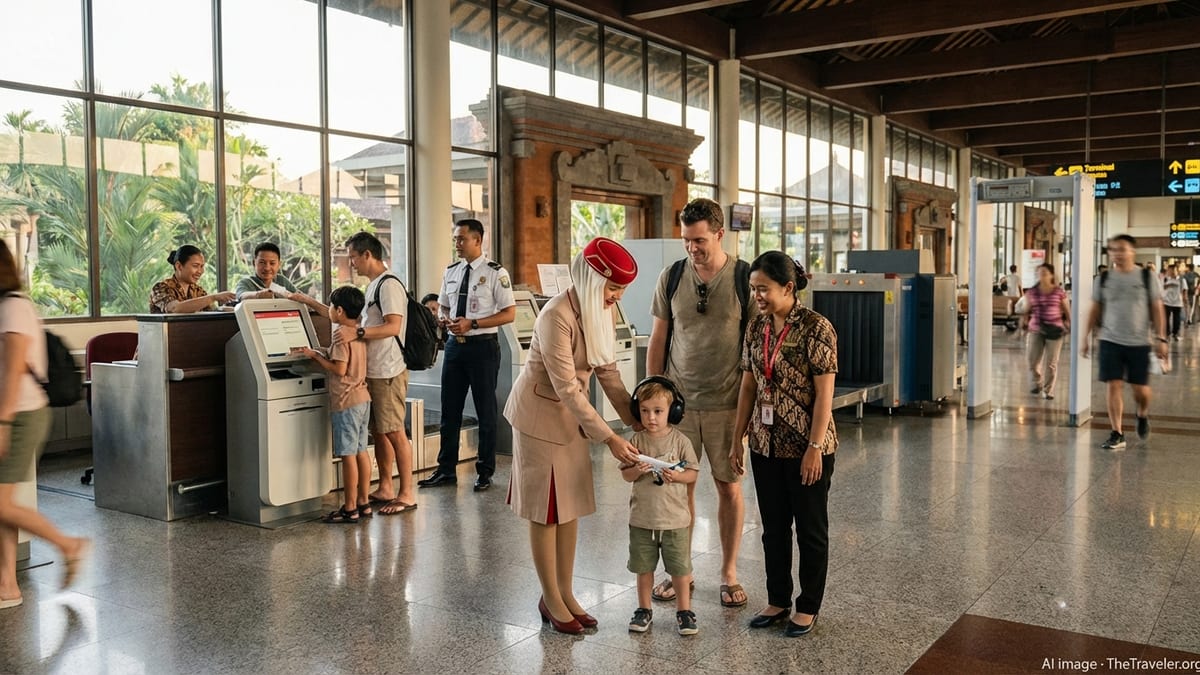
The Indonesian island of Bali has become the latest destination to host Emirates’ travel rehearsal programme, underscoring how the carrier’s inclusive strategy is moving beyond its Dubai hub. On 18 February 2026, Denpasar International Airport welcomed a group of 17 participants, including eight neurodiverse children, for a full simulation of the airport and flight experience, from check in to baggage claim. The session, conducted in partnership with local educators and caregivers, allowed families to walk through every step of the journey in a calm, controlled setting.
During the rehearsal in Denpasar, children practiced arriving at the international drop off area, completing check in and security, navigating immigration and boarding, settling into a cabin mock up, and later disembarking and collecting their bags. Each stage was paced to accommodate sensory needs, with opportunities to pause, ask questions and repeat steps. For many families, it was the first time their children had been able to explore a busy terminal without the pressure of catching a real flight.
The Bali launch comes as Emirates positions the travel rehearsal concept as a cornerstone of its accessibility agenda. Airline representatives said feedback from participants in Denpasar would help fine tune future sessions, both in Indonesia and across the airline’s wider network. For Bali’s tourism industry, which has been working to broaden its appeal to families and visitors with diverse needs, the collaboration is being seen as a timely boost to its reputation as an inclusive long haul destination.
From Dubai Concept to Global Autism-Friendly Model
The travel rehearsal idea was first tested in Dubai in 2023 as a community initiative involving Emirates, Dubai Airports, Dubai’s Department of Economy and Tourism, and several local autism centres. Children with autism and other sensory needs were invited to Dubai International Airport to practice checking in, passing through immigration and security, and boarding an Emirates aircraft in a carefully structured environment. The early pilots showed that rehearsing the journey could significantly reduce anxiety and help families feel more confident about future trips.
Following those trials, Emirates arranged a dedicated autism familiarisation flight in April 2024 for 30 families, operating a one hour round trip from Dubai International. Participants experienced the full sequence of boarding, safety announcements, cabin service, engine noise and landing, while crews and airport staff gathered insights on triggers, communication preferences and environmental adjustments that could make real flights more manageable. That exercise, alongside further rehearsals, laid the groundwork for scaling the programme to other cities.
By April 2025, Emirates announced that its travel rehearsals were being rolled out to 17 destinations, including global hubs such as Dubai, Barcelona, Manchester, Madrid, Brisbane, Mauritius, Manila, Montreal, Paris and Toronto. The airline describes the programme as an evolving collaboration with airports, authorities and local autism organisations in each location. While sessions are not yet a bookable commercial product, Emirates works through schools, clinics and community groups to invite families who may benefit most from the experience.
How the ‘Travel Rehearsal’ Works in Denpasar, Dubai and Beyond
Although each airport has its own layout and procedures, Emirates’ travel rehearsal sessions are built around a consistent structure designed to mirror the real end to end journey. In Denpasar, as in Dubai, participants begin outside the terminal, moving through drop off areas and entrances to demystify the initial arrival. Families then proceed to check in counters, practice handing over documents, tagging bags and receiving boarding passes, with extra time given to explain sounds, signage and queuing.
Security screening and immigration, often the most stressful stages for children with sensory sensitivities, are approached gradually. Staff demonstrate metal detectors and baggage scanners, explain what officers will ask and allow children to walk through as many times as they wish. Noise, bright lighting and crowds can be overwhelming, so organisers aim to hold rehearsals during quieter periods, and may adjust lighting or sound where possible. Visual aids and social stories are used to prepare children for each segment.
The experience continues at the boarding gate and inside the aircraft cabin, where participants can test seat belts, tray tables, window shades and inflight entertainment controls without time pressure. Crew rehearse safety demonstrations at a slower pace and answer questions about engine sounds, turbulence and cabin announcements. At the end of the session, passengers disembark, pass through arrival immigration, collect baggage from carousels and exit to the pick up area, closing the loop that families will later follow on an actual trip.
For airports and airline teams, these rehearsals function as live learning labs. Emirates staff, airport authorities and security agencies observe how neurodiverse passengers react at different touchpoints, then refine signage, communication strategies and training content. In Dubai, for example, insights from rehearsals helped shape the Autism Friendly Route through the terminal, which uses priority lanes and trained staff to support travelers with hidden disabilities.
World’s First Autism Certified Airline and Trained Frontline Teams
The expansion of travel rehearsals is part of a broader push that has led Emirates to be recognised as the world’s first Autism Certified Airline. Working with the International Board of Credentialing and Continuing Education Standards, the carrier has trained more than 30,000 cabin crew and ground staff in autism awareness and sensory support. The curriculum covers recognising signs of neurodiversity, adapting communication styles, and offering practical assistance at moments of high stress such as boarding and disembarkation.
Emirates began rolling out online training modules in 2022 as an introduction to autism and hidden disabilities, anchored by the United Arab Emirates’ national policy for People of Determination. Since then, frontline staff in Dubai and across the network have been encouraged to treat the training not as a one time requirement but as part of a continuous learning process, backed by feedback from passengers and advocacy groups. In many travel rehearsal sessions, educators and parents are invited to share real world examples of what helps and what hinders, informing updates to the programme.
The airline’s accessibility efforts extend beyond neurodiversity. Emirates has created a dedicated Office of Accessibility and Inclusion and adopted a formal accessibility policy guiding decisions on service design, technology investments and partnerships. Recent initiatives include integrating with the Be My Eyes app for blind and low vision customers and expanding sensory guides that explain airport environments in detail. These measures are intended to complement, rather than replace, the hands on support provided during travel rehearsals and on regular flights.
Supporting Neurodiverse Travelers Before, During and After the Flight
While the travel rehearsal initiative focuses on giving families a chance to practice, Emirates has also layered in practical measures that can be requested for any eligible booking. Passengers who declare a hidden disability can have a DPNA service code added to their reservation, signalling to staff that additional assistance may be needed throughout the journey. This can include extra time at check in, guidance through security, or seating allocations designed to reduce sensory overload, such as bulkhead seats where appropriate.
In Dubai, an Autism Friendly Route allows passengers with sunflower lanyards, a recognised symbol of hidden disabilities, to use priority lanes at multiple checkpoints. Emirates encourages families to contact local offices ahead of travel to discuss meal preferences, seating arrangements and boarding options, whether they prefer to board first to settle in or last to minimise waiting on the aircraft. The airline’s accessible travel resources outline how to pre order special meals and pre select entertainment, helping create an environment that feels familiar when the journey begins.
On board, crew trained in autism awareness are expected to balance safety requirements with flexibility. This can include adjusting communication to less direct eye contact, offering noise reducing headsets when available, and checking in discreetly with caregivers about how best to respond to signs of distress. Emirates also emphasises keeping families seated together when possible so that caregivers can provide reassurance quickly. Feedback gathered through post flight surveys and community partners is used to refine these protocols over time.
Dubai’s Role as a Testbed for Inclusive Travel
Dubai has served as a proving ground for many of Emirates’ accessible travel initiatives, with the city’s long term goal of becoming one of the world’s most inclusive destinations. Dubai International Airport was an early adopter of autism friendly standards, working with local organisations such as Dubai Autism Centre to align terminal operations with sensory friendly principles. The airport’s recognition as an autism friendly facility set a precedent for closer collaboration between aviation stakeholders and disability groups.
For Emirates, the partnership with Dubai’s tourism authorities and airport operators has been instrumental in scaling the travel rehearsal model. Joint projects have included developing an Autism Friendly Guide to Dubai International that visually maps the full passenger journey, conducting surveys with visitors with accessibility requirements, and testing new service concepts during events such as the AccessAbilities Expo. These collaborations have helped turn policy ambitions into concrete changes that can be replicated in other cities.
The approach also illustrates how a major airline can influence standards far beyond its home base. As Emirates shares training frameworks, sensory guides and rehearsal outcomes with partner airports and regulators, elements of the Dubai model are beginning to appear in hubs from Europe to Asia Pacific. Denpasar’s adoption of travel rehearsals is being closely watched by other leisure destinations that depend heavily on long haul family travel and are seeking ways to better serve guests who have traditionally been underrepresented in tourism planning.
Implications for Bali, Regional Tourism and Future Expansion
For Bali, integrating Emirates’ travel rehearsal programme is both a symbolic and practical step toward welcoming more neurodiverse visitors. The island has long promoted its hospitality and wellness credentials, but families of children with autism often report that air travel is the most daunting part of any journey. By offering a structured way to experience Denpasar International Airport without the stakes of a real departure, local authorities and the airline hope to reduce that barrier and encourage more families to consider Bali for longer stays.
Industry observers note that Bali’s move may spur similar initiatives in other Southeast Asian gateways, particularly where tourism recovery strategies emphasise inclusivity and family travel. As Emirates signals its intention to bring travel rehearsals to additional cities, pressure may grow on airports and competing carriers to adopt or adapt the model. For now, sessions remain invitation based and are organised with schools and autism centres, but participants in Bali and Dubai have expressed hope that elements of the rehearsal, such as quieter check in windows or tailored briefings, might one day be standard options.
Looking ahead, Emirates has indicated through its accessibility reporting that travel rehearsals will serve as an ongoing listening platform for the airline and its partners. Feedback from Denpasar and other cities will help identify cultural nuances and local infrastructure gaps, from signage and wayfinding to staff deployment and quiet spaces. In turn, those insights could shape broader tourism strategies as destinations like Bali compete on how safe, predictable and welcoming they feel to travelers with diverse needs.