

More news on this day
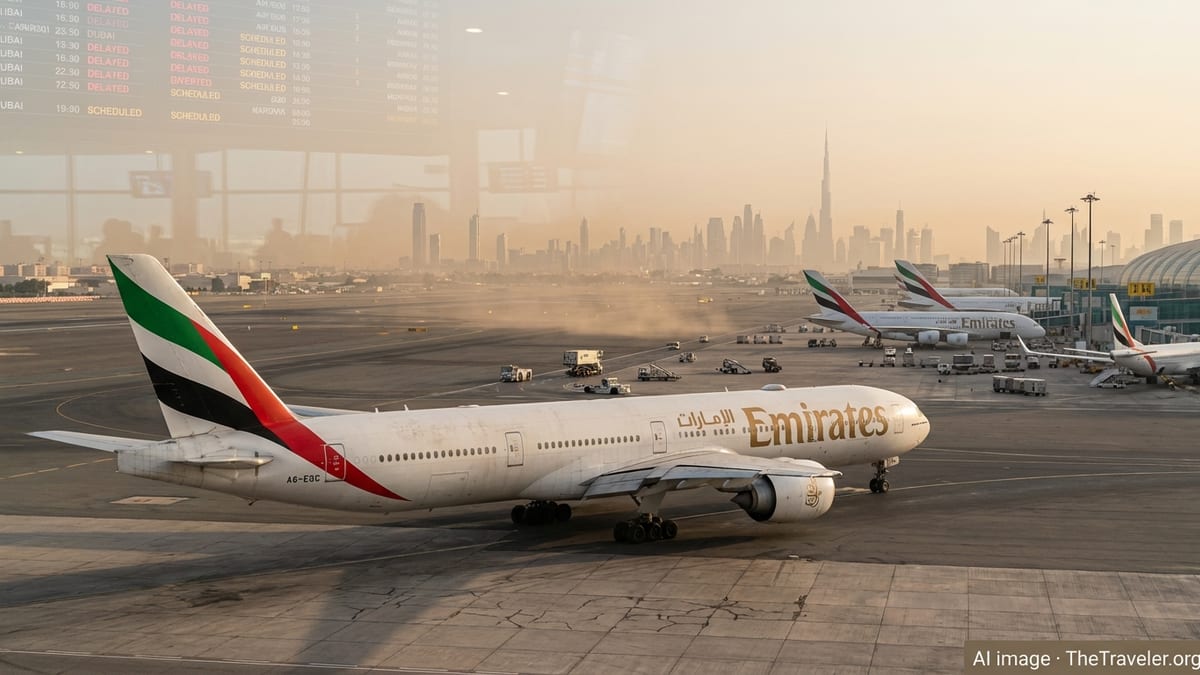
Emirates Airlines flight EK133 from Dubai to Moscow was forced to make an urgent diversion on Saturday after a cascading wave of airspace closures over Iran and the Gulf region followed coordinated US and Israeli strikes on targets inside Iran, triggering fresh chaos across already strained global air routes.
Midair Diversion as Conflict Ripples Into Civil Aviation
Flight-tracking data and passenger reports indicated that EK133, a regularly scheduled morning departure from Dubai to Moscow, was redirected shortly after entering cruise altitude when Iran abruptly closed its airspace to civilian traffic amid the strikes. The aircraft, a Boeing widebody commonly used on the busy route between the United Arab Emirates and Russia, turned away from its planned northbound corridor to avoid the fast-expanding no-fly zones.
Air traffic control advisories issued on Saturday showed Iran suspending nearly all overflights as explosions were reported in Tehran and other locations, while neighboring states began imposing their own restrictions. Within hours, the United Arab Emirates, Qatar and Kuwait announced partial or full airspace closures as a precaution against potential retaliatory attacks, compounding the operational challenges for airlines that rely on Gulf hubs as pivotal east-west transit points.
Although initial reports described EK133’s maneuver as an emergency landing, aviation experts noted that the crew appeared to have executed a controlled diversion in line with international safety protocols, rather than responding to a technical failure onboard. The move nonetheless underscored how quickly a localized military escalation can upend civilian flight plans across an entire region.
Passengers on EK133 faced extended flight time, uncertainty about their eventual arrival in Moscow and the prospect of missed connections, mirroring the wider disruption unfolding for thousands of travelers whose journeys intersect Middle Eastern skies.
US and Israeli Strikes on Iran Trigger Regional Lockdown
The diversion of EK133 came as the United States and Israel launched what officials described as coordinated strikes on Iranian military and strategic facilities in the early hours of Saturday. Loud explosions were reported in the Iranian capital and other cities, while state media in Tehran denounced what it called foreign aggression and vowed a response.
The attacks prompted swift defensive measures across the region. Iran announced the closure of its airspace to most civilian traffic, effectively severing one of the principal high-altitude corridors linking Europe and Asia. Within hours, authorities in the UAE, Qatar and Kuwait followed with their own temporary restrictions, citing safety concerns as missile and drone activity was reported in and around the Gulf.
The United Arab Emirates, home to Emirates and fellow long-haul carrier Etihad, confirmed what it described as a temporary and precautionary partial shutdown of national airspace. Officials emphasized that airports in Dubai and Abu Dhabi remained open, but said movements would be tightly controlled while military operations continued and the risk of stray or misidentified aircraft persisted.
Industry analysts said the coordinated closures marked one of the most severe and sudden constraints on Middle Eastern airspace since earlier rounds of confrontation between Iran and Western powers, with immediate knock-on effects on flight times, fuel planning and crew duty limits.
Emirates Activates Contingency Routing and Passenger Support
Emirates, which operates one of the world’s largest long-haul networks centered on Dubai International Airport, moved quickly to activate contingency protocols. In statements shared with regional media, the airline said it was working closely with civil aviation authorities and air traffic control providers to reroute affected services, including flights to Russia and Europe that would typically overfly Iran or nearby territories now classified as conflict zones.
The carrier indicated that some flights would be forced to return to origin, divert to alternate airports or operate on significantly extended routings skirting the closed airspace, likely via safer corridors over the Arabian Sea, Central Asia or the eastern Mediterranean. Such detours can add hours of flying time, increase fuel burn and push crews toward regulatory duty limits, complicating scheduling across the system.
For passengers on EK133 and other impacted services, Emirates said it would offer rebooking and assistance options, urging customers to monitor flight status updates and remain in contact with the airline or their travel agents. Ground teams at Dubai International were reported to be handling growing numbers of stranded or delayed transit travelers as flight boards filled with cancellations and diversions.
Aviation specialists noted that Emirates has extensive experience in rapid rerouting during previous regional flare-ups, but warned that the simultaneous closure of multiple adjacent airspaces leaves far less flexibility than in past crises. The situation remained fluid on Saturday, with the airline cautioning that further schedule adjustments were likely if the military confrontation persisted.
Wider Shock to Global Flight Networks
The diversion of EK133 highlighted the broader vulnerability of global aviation to geopolitical shocks in the Gulf, a region that hosts several of the world’s busiest connecting hubs and sits astride critical routes between Europe, Asia and Africa. With Iran, parts of the Gulf and portions of the eastern Mediterranean intermittently restricted, airlines faced the prospect of longer, more circuitous journeys or outright cancellations on some of their most profitable long-haul sectors.
Carriers from Europe, Central Asia and the broader Middle East announced route suspensions, diversions and elongated flight paths as they reassessed risk calculations in light of the strikes. Some airlines opted to avoid not only Iranian skies but also the airspace of neighboring countries that could be drawn directly into the confrontation, prioritizing conservative routing even at significant operational cost.
Travel agents reported a spike in inquiries and cancellations from passengers concerned about transiting the region in the coming days, while corporate travel managers re-evaluated itineraries that relied on Gulf connections. Insurers were also closely monitoring the situation, with potential implications for war-risk premiums on aircraft operating near conflict zones.
Observers compared the unfolding disruption with earlier episodes of regional turbulence, noting that while airlines have improved their risk modeling and alternate routing capabilities, the clustering of major hubs around the Gulf means any sustained closure of surrounding skies would almost inevitably ripple far beyond the Middle East.
Uncertain Outlook for Travelers and Airlines
As Saturday progressed, authorities in Iran and the Gulf states did not immediately provide clear timelines for reopening the skies, leaving airlines and passengers facing a prolonged period of uncertainty. Much will depend on whether the initial US and Israeli strikes give way to a broader regional escalation or are followed by diplomatic moves to deescalate the confrontation.
For Emirates and its peers, planners are now juggling safety imperatives, logistical realities and commercial pressures as they decide which routes can continue to operate reliably. Additional aircraft and crews may need to be repositioned to support longer detours, while airlines brace for potential revenue hits from cancellations and weakened passenger confidence on routes touching the Middle East.
Travelers booked on EK133 and similar services over the coming days are being urged to reconfirm itineraries frequently and prepare for sudden changes, including last-minute aircraft swaps, re-routings or overnight stays. Industry bodies have reiterated that passenger safety remains the paramount concern, even as airlines seek to maintain a semblance of normal connectivity across a fractured sky.
For now, the abrupt diversion of Emirates flight EK133 stands as a vivid example of how swiftly geopolitical tensions in one part of the world can reshape the experience of air travel for passengers thousands of kilometers away, turning routine journeys into unpredictable odysseys routed around conflict in real time.