

More news on this day
Thousands of passengers across the United States, the Middle East and Asia are stranded or facing severe delays after Emirates temporarily suspended hundreds of flights in response to sweeping airspace closures linked to escalating conflict involving Iran, the US and Israel.
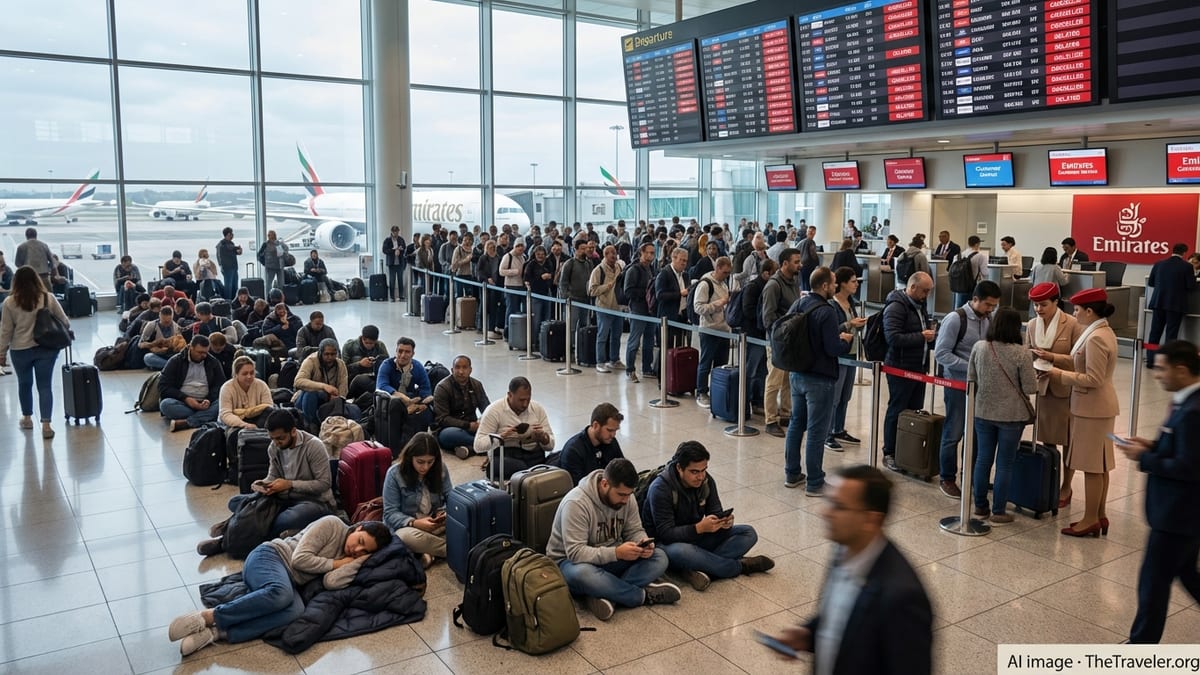
Mass Cancellations Ripple From Dubai to Global Gateways
Emirates, one of the world’s largest long haul carriers, has halted a large portion of its scheduled operations to and from Dubai as airspace over Iran, Iraq and parts of the Gulf remains effectively shut. The unprecedented disruption at the airline’s primary hub has triggered a cascade of cancellations across major international gateways, with services on key routes such as Houston, Orlando, Jeddah, Hong Kong and Kuala Lumpur brought to a standstill or rerouted with extensive delays.
The shutdown at Dubai International Airport and Dubai World Central, which began on February 28, has contributed to thousands of flight cancellations and delays worldwide. Aviation data cited by industry and government sources indicates that more than 5,800 flights were canceled globally over the weekend, with at least 11,000 flights affected since Saturday as airlines scramble to avoid conflict zones and comply with government airspace restrictions.
While Emirates has not publicly itemized all affected routes, the scale of the suspension is evident at major hubs where the carrier normally operates multiple daily services. Long haul flights connecting the US to Asia and Africa via Dubai have been particularly impacted, leaving transit passengers stranded mid journey as aircraft and crews remain out of position.
Authorities in the United Arab Emirates confirmed that only a limited number of flights began departing again on the evening of March 2, and airlines caution that normal schedules are unlikely to resume swiftly given the continuing regional volatility.
Travelers Stranded in the US as Key Connections Collapse
In the United States, the disruption has hit gateways including Houston and Orlando, where Emirates typically offers nonstop links to Dubai that serve as vital connectors to destinations across the Middle East, Africa and Asia. With those flights suspended and alternative routings constrained by closed airspace, many travelers have found themselves stranded with few immediate rebooking options.
Passengers report long lines at airline counters and call centers as they try to secure replacement itineraries. Some US based travelers bound for religious pilgrimages, business meetings or family visits in Saudi Arabia and beyond have been forced to postpone trips altogether as connections through Dubai vanish from booking systems.
US airports and carriers are coordinating with Gulf airlines and federal aviation authorities to manage knock on effects, including aircraft parked out of sequence and crews exceeding duty limits due to diversions and extended routings. Travel agents say that for many long haul itineraries involving the Gulf, the only realistic solutions in the short term involve multi stop journeys through Europe or other Asian hubs, often at significantly higher cost and with long waits for available seats.
For travelers already abroad and trying to return home to American cities, the uncertainty is particularly acute. With Emirates warning that it may take days before a meaningful portion of its network is restored, many passengers are weighing costly hotel stays against the prospect of switching to other carriers whose own schedules are already heavily disrupted.
Saudi Arabia, Hong Kong, Malaysia and Singapore Feel the Shock
The impact of Emirates’ suspension and wider regional airspace closures is being felt sharply in Saudi Arabia, Hong Kong, Malaysia and Singapore, where travelers rely on Gulf carriers for onward connectivity. Airports in Jeddah, Riyadh and Dammam have seen waves of cancellations and delays, not only from Emirates but also from regional and Asian airlines that normally overfly Iranian and Gulf airspace.
In Saudi Arabia, airlines including Malaysia Airlines and Singapore based carriers have suspended or curtailed services to Jeddah and other key gateways through at least the middle of the week. That has stranded thousands of passengers, including religious pilgrims and migrant workers, in both origin and transit cities. Local authorities are working with airlines to organize temporary accommodation and basic support at overstretched terminals.
Hong Kong and Singapore, both major Asian hubs deeply integrated into Middle East traffic flows, are reporting dozens of canceled or diverted flights. Cathay Pacific has halted services on certain Gulf routes, while Singapore Airlines and low cost affiliate Scoot have canceled multiple Dubai and Jeddah flights through at least March 7. Passengers transiting between North Asia, Southeast Asia and Europe via the Gulf are among the hardest hit, with some facing waits of several days for confirmed alternatives.
In Malaysia, Kuala Lumpur International Airport has logged a significant spike in cancellations and delays linked to Gulf and Middle East services. Travelers attempting to reach destinations such as Doha, Jeddah and Dubai report repeated schedule changes as airlines adjust routings and await clarity on when key air corridors might safely reopen.
Airports Across Asia Struggle With Overcrowding and Limited Options
Across Asia, scenes of overcrowded terminals have become common as stranded travelers queue at customer service desks and scramble for information. Reports from airports in Hong Kong, Singapore, Kuala Lumpur, Jakarta and Bali describe passengers camping out on terminal floors, with local authorities bringing in extra staff to manage crowd control and basic assistance.
At several airports, ground handlers are grappling with a backlog of aircraft parked at remote stands, delayed baggage transfers and catering supplies in the wrong locations. With many wide body aircraft unable to operate their regular rotations through Dubai and other Gulf hubs, airlines are redeploying smaller planes where possible, further constraining capacity for rebooked passengers.
Hotel demand near major airports has surged as travelers try to secure rooms for what may turn into multi day waits. In some cases, carriers and local tourism authorities have arranged emergency accommodation and meal vouchers, though coverage is inconsistent and often prioritized for those with imminent rebooking options or special needs.
Travel industry analysts note that the disruption is exposing the vulnerability of global aviation networks to concentrated shocks in a handful of mega hubs. With the Gulf acting as a central bridge between continents, any prolonged closure quickly ripples outward to airports as far away as Hong Kong, Singapore and Sydney, overwhelming local contingency plans.
Limited Flights Resume as Airlines Warn of Prolonged Turbulence
By the evening of March 2, airports in Dubai confirmed that a limited number of flights had begun to operate again, primarily to help clear stranded passengers. Emirates and other Gulf carriers are working with regulators to gradually restart select services while keeping routes that require overflight of active conflict zones suspended.
Airlines across the region emphasize that safety remains the overriding consideration and warn that further last minute changes and cancellations are likely in the coming days. Many carriers are offering flexible rebooking policies and fee free refunds, urging passengers not to travel to airports until they receive direct confirmation of a new departure time.
Travel experts recommend that affected passengers closely monitor airline apps and official social media channels, keep contact details updated within their bookings and be prepared for rapidly evolving conditions. Those with nonessential trips are being advised to postpone travel or explore alternative routings that avoid the Gulf entirely, even if that means longer journeys.
With regional tensions still high and air traffic control authorities cautious about reopening key corridors, the full restoration of Emirates’ global network and the wider Gulf aviation system could take days or even weeks. For now, travelers from Houston to Hong Kong, Jeddah to Kuala Lumpur and beyond are bracing for continued uncertainty as airlines navigate one of the most challenging operational crises since the pandemic.