

More news on this day
Greece has secured a special Emirates-operated flight from Dubai to Athens to repatriate its citizens, providing a rare safe corridor out of the United Arab Emirates as Middle East tensions disrupt normal air traffic across the region.
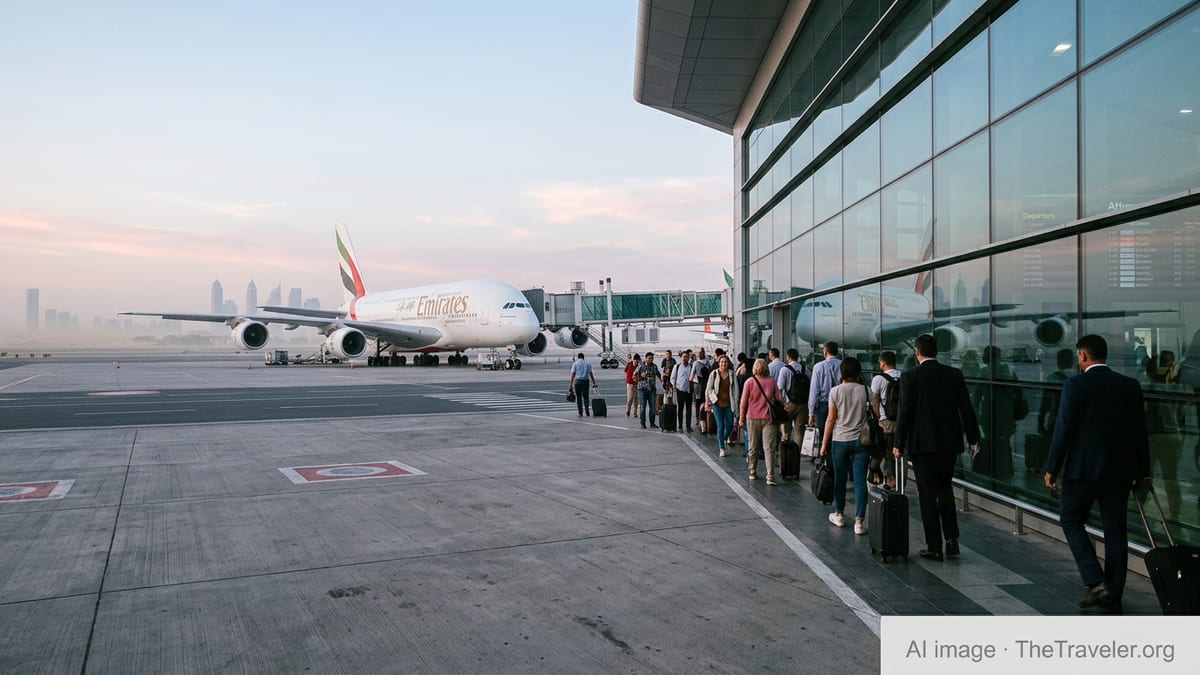
Special Emirates Flight Becomes Lifeline for Stranded Greeks
The Greek Ministry of Foreign Affairs confirmed that an aircraft operated by Emirates will conduct a special flight from Dubai to Athens, scheduled for Saturday, March 7. The operation follows days of widespread airspace closures and cancellations that have left thousands of travelers stranded in Gulf hubs, including Dubai International Airport.
The ministry has called on Greek citizens currently in the United Arab Emirates who wish to be repatriated to register their personal details with authorities so they can be prioritized for boarding. Officials have stressed that the flight is being organized as part of a coordinated crisis response and that places will be allocated according to vulnerability and need, including families with children, the elderly and those with health issues.
The Emirates flight forms part of a broader network of limited repatriation services now threading through the region, at a time when most regular commercial flights remain suspended or heavily restricted because of the conflict and associated security risks.
Greek officials have underlined that the Dubai to Athens operation is contingent on strict safety assessments and real-time coordination with Emirati and European air navigation authorities, reflecting the volatile security picture in parts of the Middle East.
Escalating Middle East Tensions Disrupt Regional Air Travel
The special Emirates service to Athens comes against the backdrop of an escalating conflict involving Iran, Israel and allied forces, which has triggered missile and drone attacks and led to temporary closures of key air corridors. In response, major carriers have sharply reduced or suspended flights across large parts of the Middle East, including services to and from the United Arab Emirates.
Emirates has already suspended its regular schedule to and from Dubai through at least early March, operating only a limited number of evacuation and repatriation flights in cooperation with governments. Other regional and European airlines have taken similar steps, cancelling or consolidating routes to Israel, Iraq, Lebanon, the UAE and Saudi Arabia, while offering affected passengers rebooking options once conditions improve.
For travelers, the result has been a patchwork of ad hoc connections and emergency flights replacing what was previously one of the world’s most reliable air travel networks. Airports that usually serve as global transit hubs, such as Dubai and Abu Dhabi, are now managing a mix of grounded passengers, redirected traffic and carefully planned evacuation operations.
Authorities caution that the situation remains fluid, and flight plans can change with little notice if risk assessments shift or new security incidents occur. Travelers have been urged to stay in close contact with airlines and consular services rather than relying solely on published timetables or mobile applications.
Greek Repatriation Effort Expands Beyond Dubai
Athens has been steadily expanding its evacuation efforts from the wider Middle East, combining government-chartered aircraft, cooperation with foreign carriers and special services operated by Greek airline Aegean. In recent days, hundreds of Greek citizens and their family members have already been flown home on flights from Sharjah in the UAE as well as from Oman and other regional gateways.
The Emirates-operated Dubai to Athens sector is one of several targeted operations designed to reach concentrations of Greek nationals in Gulf states where the conflict’s knock-on effects have been felt most acutely. The Foreign Ministry has reported thousands of requests for assistance from citizens across the region, with consular teams working on a near continuous basis to verify identities, coordinate manifests and manage onward travel within Greece.
Aegean, acting at the request of the Greek government, has mounted its own special flights from Dubai and Muscat to Athens, while simultaneously cancelling some regular services to destinations closer to the conflict zone. The airline has emphasized that every evacuation or repatriation flight is launched only when all safety conditions are satisfied and with the express approval of relevant civil aviation and defense authorities.
Greek officials have stated repeatedly that their guiding principle is that no citizen who seeks help will be left without support, but they acknowledge that limited aircraft capacity, congested airspace and shifting security assessments can slow the pace of repatriation.
Safety Protocols Shape Every Stage of the Journey
The Emirates flight from Dubai to Athens is being organized under heightened security and operational protocols that go well beyond typical commercial standards. Flight planners are working with regional and European aviation authorities to define routes that avoid high-risk airspace, while taking into account restrictions imposed by military operations and temporary flight bans.
On the ground, Greek consular staff and Emirates representatives are coordinating check-in procedures to ensure that only pre-cleared passengers board the aircraft, in line with both security requirements and limited seat availability. Passengers are being advised to arrive early at designated terminals, to bring essential documents and medication in their hand luggage, and to be prepared for extended processing times.
In Athens, officials at Eleftherios Venizelos International Airport have prepared special reception procedures for arriving repatriation flights, including assistance desks, medical support and help with onward connections to other parts of Greece. Particular attention is being paid to vulnerable travelers, who may require immediate care or accommodation after landing.
The Greek government has highlighted that these protocols, while sometimes burdensome for passengers, are central to maintaining a safe corridor between Dubai and Athens at a time when security conditions elsewhere in the region remain unpredictable.
Travel Advice for Greeks Still in the United Arab Emirates
For Greek citizens who remain in the UAE and have not yet been able to secure a seat on a repatriation flight, authorities recommend staying in safe locations, limiting nonessential movement and closely following instructions from local officials. The Greek Embassy has urged citizens to register their contact details with consular services so they can be notified quickly should additional flights become available.
Officials are also advising travelers to check directly with airlines about the status of any existing bookings. Some carriers are offering limited flexibility, including free date changes or credit vouchers, but many scheduled services remain suspended, particularly those crossing contested airspace.
Greek nationals are encouraged to monitor updates from the Ministry of Foreign Affairs and local media outlets, which are publishing near real-time information on new evacuation options, revised flight schedules and any changes to security guidance. Those who can safely delay travel are being asked to do so, to free scarce seats for the most urgent cases.
For now, the special Emirates flight to Athens stands as a crucial link in Greece’s broader effort to bring its citizens home from a region strained by conflict, demonstrating how governments and airlines can cooperate to keep at least a narrow pathway open when much of the sky has effectively closed.