

More news on this day
Thousands of travelers across the United States, the Middle East and Asia are stranded after Emirates suspended hundreds of flights routed through Dubai, as sweeping airspace closures linked to the escalating conflict involving Iran, the United States and Israel ripple through some of the world’s busiest aviation corridors.
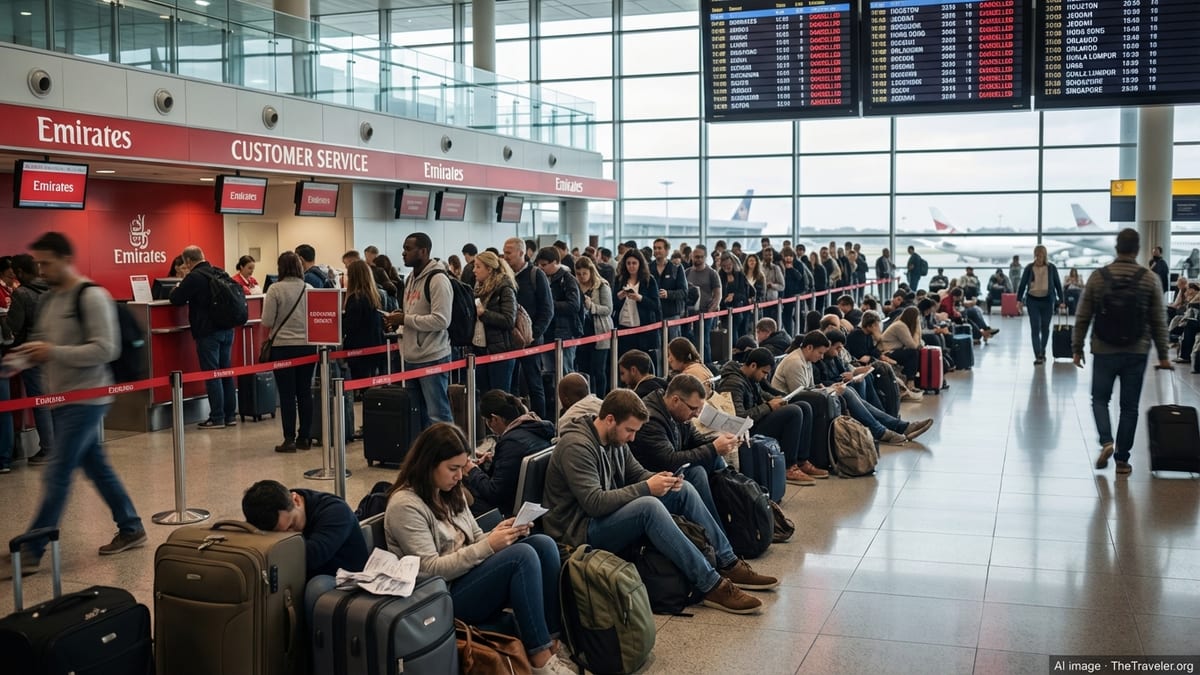
Wide-Ranging Suspension Hits 496 Emirates Flights
Emirates has announced the suspension of 496 flights touching multiple continents, after authorities in several Middle Eastern countries restricted or closed their airspace in response to the latest round of military strikes and missile attacks in the region. The Dubai-based carrier, one of the world’s largest long-haul airlines, temporarily halted all operations to and from its home hub until Monday afternoon local time, disrupting a complex global network that depends on rapid connections through the Gulf.
The widespread cancellations are centered on routes that overfly or connect through the Gulf, but the impact is being felt far beyond the Middle East. Emirates services linking Dubai with major US gateways such as Houston and Orlando, as well as key Asian and Gulf destinations including Jeddah, Hong Kong and Kuala Lumpur, are among those affected. With many of these flights operating daily or multiple times per day, the temporary shutdown quickly translated into hundreds of grounded services and tens of thousands of displaced passengers.
Industry analysts say Emirates’ decision reflects both regulatory constraints and operational risk. With swathes of airspace above Iran, Iraq, Israel, Kuwait, Qatar and parts of the United Arab Emirates restricted or closed, many of the most efficient flight corridors between Europe, North America and Asia are either unavailable or severely constrained, leaving airlines with limited and often impractical routing options.
The airline has offered travelers booked up to March 5 the option to rebook within a limited window or seek refunds, but for many passengers already in transit the suspension has meant unexpected overnight stays and lengthy queues at airport service desks as staff attempt to re-accommodate disrupted itineraries.
Global Knock-On Effects From the US to Asia
Because Emirates positions Dubai as a mega-connecting hub between North America, Europe, Africa and Asia, the suspension of almost 500 flights has produced a domino effect across global schedules. Long-haul travelers originating in US cities including Houston and Orlando, and connecting onward to Jeddah, Kuala Lumpur, Singapore or secondary Asian markets, have found their journeys interrupted mid-way as connection banks in Dubai collapsed.
Airports in Asia are reporting significant disruptions as well. Kuala Lumpur International Airport and Hong Kong International Airport have seen a spike in cancellations and long delays involving services that either operate directly to the Gulf or rely on overflight of now-restricted Middle Eastern skies. Data from regional aviation trackers show hundreds of combined cancellations and delays in recent days at hubs in Singapore, Kuala Lumpur and Bangkok, underscoring how a primarily Middle Eastern airspace crisis has rapidly become a global travel problem.
In Saudi Arabia, Jeddah’s King Abdulaziz International Airport has emerged as one of the most heavily affected Gulf hubs, with more than a hundred flights canceled and additional services delayed as missile threats and airspace adjustments forced airlines, including Emirates, to ground or divert aircraft. Travel industry outlets report thousands of passengers stuck in departure halls across Jeddah and other Saudi airports as airlines attempt to regroup.
The turmoil has also extended to secondary and regional airports far from the conflict zone. Carriers rerouting around closed skies are stretching crew duty limits and aircraft availability, feeding into a wider pattern of late arrivals, missed connections and rolling schedule changes at European and Asian hubs that would not normally be directly impacted by events in the Gulf.
Other Carriers Join Wave of Cancellations
Emirates is far from alone in cutting services as the crisis deepens. Major Asian and European airlines have rolled out their own cancellations and suspensions on routes linking to Dubai, Doha, Tel Aviv and key Saudi gateways. Singapore Airlines and its low-cost arm Scoot have halted flights to Dubai and Jeddah for several days, while Malaysia Airlines has paused operations to Doha and Saudi cities including Jeddah and Madinah.
Indian carriers have also moved aggressively to shield operations from the unfolding conflict. Air India has extended its suspension of flights to the United Arab Emirates, Saudi Arabia, Israel and Qatar, while also trimming select Europe-bound services that would ordinarily overfly the affected region. Budget operators such as IndiGo and Akasa Air have followed with their own extensive list of cancellations touching destinations across the Gulf.
European airlines are similarly recalibrating their networks. Lufthansa, Air France and KLM have scaled back or suspended services to Dubai, Tel Aviv and several Levant and Gulf destinations as they await greater clarity from regulators and air traffic authorities. Qatar Airways and other Gulf carriers have reported temporary halts to operations at Doha and other regional hubs as local airspace rules tighten.
Collectively, these moves have produced a rolling shutdown of air links across West Asia. Industry data providers estimate that well over 1,000 flights into and out of the Middle East were canceled in a single day over the weekend, with the total rising further once disrupted outbound legs and knock-on schedule changes are included.
Scenes of Disruption in Stranded Hubs
At airports from Houston and Orlando to Jeddah, Hong Kong, Kuala Lumpur and Singapore, the human impact of the Emirates suspension and broader regional aviation crisis has become increasingly visible. Images from terminals show long, snaking lines at airline counters, with weary travelers clutching printed itineraries and smartphones as they wait for rebooking assistance or hotel vouchers.
In Gulf and Asian hubs, some passengers have reported spending the night on terminal floors or in makeshift rest areas after nearby hotels reached capacity. Families with young children and older travelers appear particularly affected, as limited seating and stretched airport services struggle to meet surging demand for food, water and information about onward travel options.
Airport staff and airline ground agents are working extended shifts to cope with the influx, but rapidly evolving airspace notices mean that schedules can change by the hour. Travelers with multi-leg itineraries face particular uncertainty, as a single canceled segment via Dubai, Doha or Jeddah often unravels entire journeys spanning three or more continents.
For many stranded passengers, communication has become a critical challenge. While airlines are pushing updates through mobile apps, text alerts and social media, connectivity issues, language barriers and the sheer volume of affected customers have left some travelers complaining that they receive little warning before learning at the airport that their flights have been canceled.
Uncertain Timeline for Recovery
Aviation experts warn that even if airspace restrictions are gradually eased in the coming days, the disruption triggered by Emirates’ 496 suspended flights and broader regional shutdowns could take much longer to unwind. Airlines will need to reposition aircraft and crew around the world, clear backlogs of stranded passengers and rebuild disrupted connection banks at key hubs.
Carriers are currently prioritizing safety and regulatory compliance, often choosing to cancel flights outright rather than attempt complex and fuel-intensive diversions that add hours to long-haul journeys. That conservative stance, while frustrating to travelers, reflects lessons learned from previous conflicts and crises in the region, when rushed resumptions led to further disruption.
Travel advisors recommend that passengers slated to travel through Dubai, Jeddah, Doha or other Gulf hubs in the coming days monitor their flight status closely and prepare for last-minute changes. Those with nonessential trips are being urged to consider postponing or rerouting via alternative corridors that avoid Middle Eastern airspace altogether, although options remain limited given the scale of the closures.
Until tensions in the region ease and airspace fully reopens, Emirates and its global peers face the dual challenge of restoring confidence while managing a bruising operational crunch. For now, terminals from the United States to Saudi Arabia, Hong Kong, Malaysia and Singapore remain crowded reminders of how quickly geopolitical shocks can upend the world’s tightly knit air travel network.