

More news on this day
Emirates services from the United Arab Emirates to several European destinations and Russia faced fresh disruption this week, with seven flights making unplanned landings at nearby airports amid continuing regional airspace volatility.
Get the latest news straight to your inbox!
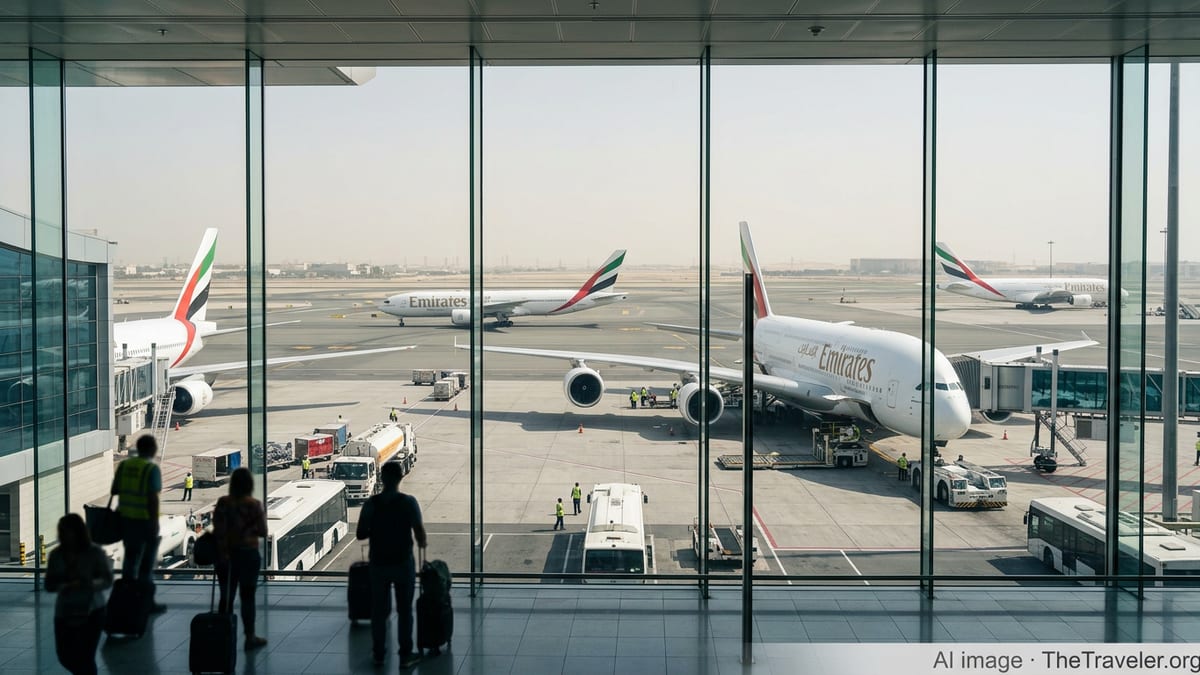
Multiple Emirates Flights Diverted Mid-Route
Recent operational data and live flight-tracking records indicate that seven Emirates flights bound for the United Kingdom, France, Türkiye, Russia, Denmark and Ireland were forced to divert from their intended destinations, landing instead at alternate airports en route. The changes, recorded over a short window during renewed instability affecting Gulf airspace, reflect the level of operational stress facing long-haul carriers using the United Arab Emirates as a hub.
According to publicly available flight status logs, affected services included Europe and Russia rotations that departed from Dubai but did not continue to their planned arrival points. Instead, these aircraft were rerouted toward nearby major hubs that could safely accept unscheduled long-haul widebody arrivals, often after holding patterns or extended route deviations.
Coverage across aviation-tracking platforms describes a pattern of near-simultaneous diversions, rather than isolated technical incidents. The cluster of events has drawn attention from travelers already contending with schedule changes, repatriation operations and capacity constraints triggered by broader regional tensions.
Early indications suggest that the diversions were precautionary in nature, tied to airspace and congestion considerations rather than a single onboard emergency event. In most cases, aircraft landed safely and disembarkation proceeded under standard airport procedures, with onward travel arranged once routes were reassessed.
European Hubs Absorb UK, France, Denmark and Ireland Diversions
European airports have borne the brunt of the disruption for flights originating in Dubai and other UAE gateways. Flight-tracking summaries show Emirates services to the United Kingdom, France, Denmark and Ireland diverting to alternate European hubs that could facilitate rapid ground handling for widebody aircraft and large passenger volumes.
For UK-bound flights, the diversions have largely involved redirection away from primary London and regional airports when arrival slots or routings became constrained. Passengers on these services have faced additional ground transfers or rebooked connections to reach their original destination cities, adding several hours to overall journey times.
Services scheduled for Paris and other French gateways have shown a similar pattern, with aircraft touching down at nearby continental hubs when congestion and changing traffic flows made the originally planned approach less practical. Reports shared by passengers online describe extended taxi times and busy immigration halls as diverted flights arrived in tight clusters.
In northern Europe, travelers on Emirates flights headed for Dublin and Scandinavian capitals have encountered unexpected transit points within the region. While airport operations have generally remained orderly, the diversions are contributing to a rolling backlog of missed connections, hotel rebookings and itinerary changes for both leisure and business travelers.
Türkiye and Russia Routes Reconfigured Amid Airspace Pressures
Routes connecting Dubai with major airports in Türkiye and Russia have also been subject to rapid operational adjustments. Publicly available information suggests that at least one Emirates service bound for a Turkish gateway and another operating to a Russian city diverted to alternative airports, reflecting the complicated web of airspace restrictions, military activity and congestion across parts of the Middle East and Eastern Europe.
Observers note that these corridors, already among the most sensitive from an airspace management perspective, now require frequent real-time rerouting to avoid restricted zones and high-traffic chokepoints. For long-haul services departing the UAE, this can translate into longer flight times, staggered arrival waves and unexpected technical stops.
For passengers, the impact is most visible in extended days of travel and uncertainty around connecting flights. Airline schedules that once followed predictable overnight patterns have been replaced, in some cases, by rolling departure windows and late-notice adjustments, particularly for flights skirting conflict-affected regions.
Despite the complexity, available tracking data shows that diverted Emirates flights have reached safe landing points with fuel margins preserved and contingency plans executed as designed. The main consequences so far have been logistical and commercial, rather than safety-related.
Knock-On Effects for Global Travelers Using Dubai as a Hub
The diversions arrive at a moment when Dubai’s main airport and other Gulf hubs are already handling a mix of reduced regular schedules and dense waves of repatriation and rerouted traffic. Travel-industry advisories describe heavy congestion on the ground, with check-in and security queues periodically swelling as passengers attempt to secure scarce outbound seats.
Travelers relying on Emirates for long-haul connections between Asia, Europe and North America are experiencing a patchwork of outcomes. Some flights continue to operate close to schedule, while others are retimed, consolidated or diverted, often with limited advance notice. Online community reports from recent days refer to late-night notifications, gate changes and extended periods on board waiting for revised routings.
Industry updates indicate that Emirates is attempting to preserve as much of its global network as possible by layering additional operational flexibility into daily plans. This includes selective use of alternative airports, temporary one-way sectors, and equipment swaps aimed at maximizing available capacity on routes with the highest concentration of stranded passengers.
The cumulative result for travelers is a heightened need for real-time information, with many relying on airline apps, airport departure boards and third-party flight-tracking services to understand whether a specific flight is likely to depart on time, divert or be replaced by a later rotation.
What Passengers Should Expect in the Coming Days
Travel-advisory bulletins and corporate travel guidance suggest that disruption related to diversions and route changes may continue in the short term, especially for flights operating across or near affected airspace corridors. Even as some restrictions ease, the system remains finely balanced, and a small shift in regional conditions can quickly cascade into diversions similar to those experienced by the seven Emirates flights this week.
Passengers departing from the UAE are being encouraged, through publicly available guidance, to allow extra time at the airport, verify that their booking is confirmed, and monitor flight status multiple times in the hours before departure. For those in transit, flexible hotel reservations and travel insurance that covers diversions and extended delays may provide additional protection.
Corporate travel managers are also revisiting routing strategies, in some cases steering high-priority or time-sensitive trips toward itineraries with greater redundancy or via hubs perceived as less exposed to sudden airspace closures. This recalibration is likely to continue as airlines publish updated schedules and as operational data makes clear which corridors are stabilizing fastest.
For now, the diversions affecting Emirates flights to the UK, France, Türkiye, Russia, Denmark and Ireland illustrate how quickly long-haul networks can be reshaped by regional events. Travelers planning to pass through Dubai in the coming days and weeks are likely to face a more fluid operating environment than they may be used to, even as airlines work to restore reliability across their global connections.