

More news on this day
A cluster of heavyweight international airlines, including Emirates, Singapore Airlines, Thai Airways, Qatar Airways, Air China and Japan Airlines, is eyeing direct flights to Cambodia’s planned Ratanakiri International Airport, a still-to-be-built project in the country’s remote northeast that officials and tourism leaders tout as a potential game-changer for frontier travel in Southeast Asia.
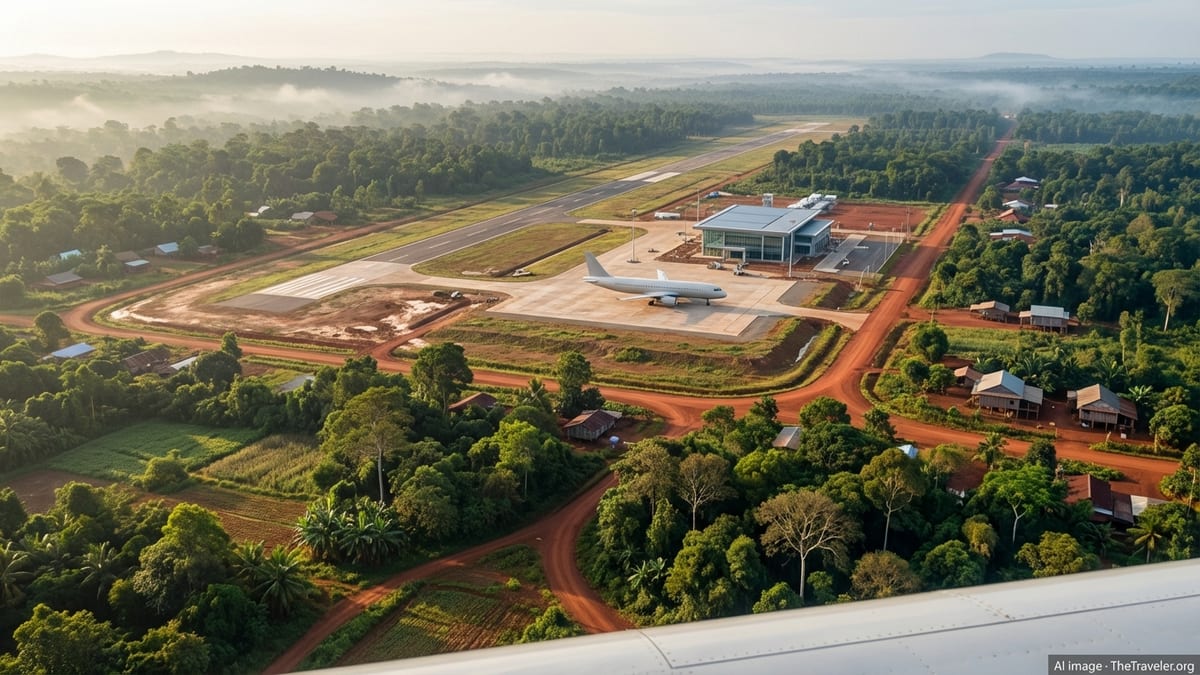
A Future Airport in Cambodia’s Wild Northeast
Ratanakiri, a sparsely populated province bordering Laos and Vietnam, is best known today for its crater lakes, red-dirt roads and dense highland forests rather than air connectivity. There is currently no operational international airport in the province, and travelers typically reach the area via long-distance road journeys or small domestic hops routed through Phnom Penh or Siem Reap. That could change significantly under a government-backed plan to develop a new international-standard airport designed to accommodate narrow-body jets such as the Airbus A320 and Boeing 737 families.
According to project documentation from Cambodia’s State Secretariat of Civil Aviation, the “New Ratanakiri Airport” is at the early identification and selection phase, with a proposed 2,500-meter runway and a 4C design rating, the classification that allows operations by most regional single-aisle aircraft. Authorities have framed the airport as a key piece of infrastructure for the northeast, intended to link Ratanakiri more directly to regional capitals and support both tourism and trade. No opening date has been confirmed, and a private development partner has yet to be formally awarded.
Despite that early-stage status, the prospect of a modern runway in Ratanakiri is already attracting attention in airline boardrooms. Carriers that have rapidly expanded services to Cambodia’s larger new airports in Phnom Penh and Siem Reap are now evaluating whether a more adventurous, nature-focused gateway could be commercially viable in the next wave of network expansion.
Emirates and Gulf Carriers Scan Cambodia’s Next Frontier
Emirates has spent the past several years deepening its Southeast Asia presence, recently adding Siem Reap to its network via Bangkok and positioning Thailand’s capital as a key regional hub. The Dubai-based carrier’s move into Cambodia’s heritage heartland has highlighted the growing appeal of secondary destinations once considered niche. Industry analysts say that as Techo International Airport near Phnom Penh ramps up and Angkor’s new gateway in Siem Reap matures, the search for fresh Cambodian markets will only intensify among long-haul airlines.
Company insiders and regional aviation consultants describe discussions at Emirates and other Gulf carriers around long-term opportunities in Cambodia’s less-developed provinces. While no carrier has filed schedules or announced launch dates for Ratanakiri, direct or one-stop services feeding into a future international airport there are seen as a logical extension of current strategies that favor multi-stop routings and seasonal experimentation. Any Emirates move would likely come only after the airport is built, certified and able to demonstrate stable inbound demand from tour operators and cruise-style overland itineraries.
Other Middle Eastern airlines have already made Cambodia a focus. Etihad Airways inaugurated direct Abu Dhabi–Phnom Penh services in late 2025, and Turkish Airlines is preparing to connect Istanbul with the Cambodian capital via Bangkok. This flurry of Gulf and Eurasian interest gives weight to the idea that once core Cambodian gateways are well served, carriers will look to differentiate by tapping more remote areas such as Ratanakiri, especially if the airport can offer competitive fees and coordinated tourism marketing.
Asian Network Giants Weigh Ratanakiri Links
Alongside Emirates, a roster of Asia-Pacific heavyweights is also watching Cambodia’s airport build-out. Singapore Airlines, Thai Airways, Qatar Airways, Air China and Japan Airlines all operate dense regional networks and have long experience funnelling passengers into emerging destinations across Indochina. Their interest in a prospective Ratanakiri route is less about immediate volume and more about positioning for a future in which “last frontier” locations become mainstream fixtures on multi-country itineraries.
For Singapore Airlines, which already connects Cambodia’s main hubs through its full-service and low-cost subsidiaries, Ratanakiri could eventually slot into a portfolio of eco- and culture-oriented destinations attractive to high-yield travelers originating in North Asia, Europe and North America. Thai Airways, meanwhile, may view a northeastern Cambodian airport as a natural extension of its Bangkok hub, building on Thailand’s long-established overland circuits that stretch into Laos and Cambodia’s border provinces.
Qatar Airways, renowned for pioneering smaller and seasonal routes, has been steadily growing its Southeast Asian footprint, while Air China and Japan Airlines see rising outbound interest in deeper, more authentic regional experiences among Chinese and Japanese travelers. Direct Ratanakiri services, whether operated year-round or in peak seasons, would give these carriers new ways to package nature, culture and cross-border circuits, provided local infrastructure and hospitality capacity can keep pace.
From Phnom Penh and Siem Reap to a Three-Gateway Strategy
Cambodia’s aviation map has been transformed in just a few years. Siem Reap-Angkor International Airport opened as a greenfield gateway to the Angkor temples, replacing the older city airport and allowing for larger aircraft and higher passenger volumes. More recently, Techo International Airport south of Phnom Penh began commercial operations, taking over from the long-serving Phnom Penh International Airport and providing the capital with a multi-runway facility designed for steady expansion over the next decades.
These openings have already shifted airline strategies. Chinese carriers and regional operators from Thailand, Vietnam and Malaysia have launched new point-to-point routes into Cambodia’s coastal and heritage hubs, while Gulf and European airlines have upgraded capacity into the capital. Tourism arrivals have climbed, helped by easier access, more modern terminals and competitive airport charges compared with some neighboring countries. This momentum has encouraged policymakers to pitch a “three-gateway” concept in the medium term, pairing Phnom Penh and Siem Reap with a third international entry point in the northeast.
Ratanakiri’s addition to that triad would give Cambodia a distribution of gateways roughly aligned with its main tourism themes: culture and heritage in Siem Reap, urban and business travel in Phnom Penh, and wilderness and community-based tourism in the northeast. For airlines, this diversification allows for more nuanced capacity deployment, with wide-body jets focused on the capital and major leisure markets while single-aisle aircraft connect high-yield niche segments willing to travel off the beaten path.
Tourism Vision: Jungle Lakes, Hill Tribes and Eco-Lodges
Ratanakiri’s tourism appeal is markedly different from the iconic spires of Angkor Wat or the coastal resorts of Sihanoukville. The province is known for Yeak Laom volcanic lake, waterfalls, forest trekking and visits to indigenous communities whose cultures and livelihoods are intertwined with the surrounding highlands. Until now, reaching these attractions has required determination: long road journeys from Phnom Penh or cross-border trips from Vietnam’s Central Highlands.
Direct international flights into a future Ratanakiri International Airport could reframe that challenge as an advantage. Tourism planners envision small-group eco-lodges, wellness retreats and adventure operators that benefit from limited but targeted airlift, designed to keep visitor numbers at a sustainable level while raising average spend. Airlines, in turn, would market Ratanakiri as part of multi-stop journeys that might combine Angkor’s temples, Mekong river towns and remote forest escapes in a single itinerary.
For regional tourism, the new airport could become a cornerstone of wider circuits linking southern Laos, Vietnam’s Central Highlands and northeastern Cambodia. Cross-border self-drive and coach tours, long discussed among operators, would gain a more reliable air anchor, allowing travelers to start and end their journeys in different countries without backtracking through congested capitals. That type of seamlessness is increasingly seen as essential if Southeast Asia is to compete with other long-haul regions for high-value, experience-driven tourism.
Infrastructure, Sustainability and Community Concerns
The transformational promise of an international airport in Ratanakiri is matched by concerns around environmental impact and community disruption. The province’s forests, wildlife corridors and indigenous lands are particularly sensitive, and conservation groups have argued that any large-scale tourism development must be governed by stringent safeguards and inclusive consultation. Runway construction, access roads and associated real estate projects could fragment habitats if not carefully planned.
Cambodian officials involved in aviation and tourism policy say that lessons learned from recent airport projects will inform Ratanakiri’s development. Environmental and social impact assessments are expected to scrutinize land acquisition, noise, water use and carbon emissions. There is also growing talk of positioning Ratanakiri as a “low-impact” hub, with incentives for airlines operating newer, more efficient aircraft and for resorts that adopt verifiable sustainability standards, including waste management and community benefit-sharing.
Local communities are likely to have a decisive voice in shaping the airport’s ultimate footprint. Indigenous leaders have previously stressed that tourism must deliver tangible gains, from employment and training to infrastructure upgrades in health and education. Airlines seeking to market Ratanakiri as an authentic and ethical destination will face pressure from travelers and partners to demonstrate that their presence supports, rather than sidelines, the people who have long stewarded the region’s landscapes.
Commercial Risk, Phased Routes and Seasonal Strategies
Even with enthusiastic rhetoric about a future “game-changer,” airline planners remain acutely aware of the commercial risks associated with launching routes into relatively unknown markets. Demand forecasts for Ratanakiri hinge on several variables: the speed of airport construction, the quality of supporting infrastructure such as roads and power, the depth of the local hospitality sector and the effectiveness of destination marketing in key source markets. Any delays or shortcomings in those areas could push back the timeline for direct international flights.
Industry experts suggest that if and when Ratanakiri International Airport is operational, carriers such as Emirates, Singapore Airlines, Thai Airways, Qatar Airways, Air China and Japan Airlines are more likely to test the waters through limited, seasonal or triangular services rather than daily nonstops. Routes might initially operate a few times a week, possibly combined with stops in Phnom Penh, Siem Reap or neighboring countries, allowing airlines to build awareness and refine itineraries without overcommitting capacity.
Low-cost and regional airlines could also play a bridging role, feeding passengers from major hubs into Ratanakiri and providing data on demand patterns that larger network carriers can later use. Charter operations tied to specific resorts or tour operators are another likely stepping stone, particularly for high-end wellness and adventure products targeting affluent travelers from Europe, the Middle East and East Asia.
Regional Competition and the Race for New Icons
The broader backdrop to the Ratanakiri airport conversation is an increasingly competitive tourism landscape in mainland Southeast Asia. Thailand, Vietnam and Laos are all investing in new airports and secondary city upgrades, while Cambodia itself has opened large new facilities in Siem Reap and near Phnom Penh. Airlines are therefore constantly searching for destinations that can stand out amid a crowded field of beaches, cities and heritage sites.
For Cambodia, turning Ratanakiri into a recognizable name on the tourism map could help rebalance visitor flows away from a narrow focus on Angkor and the capital. That diversification would not only ease pressure on heritage sites but also spread economic benefits more evenly across the country. For airlines, being among the first to establish direct connectivity to a genuinely new destination offers marketing advantages and the chance to shape traveler perceptions from the outset.
Whether and when those ambitions are realized will depend on decisions made in the coming years by Cambodian authorities, private investors and carrier executives. Ratanakiri International Airport currently remains a proposal moving through early planning stages, but the fact that some of the world’s most influential airlines are already modeling scenarios around a potential launch illustrates how quickly Southeast Asia’s tourism geography is evolving.