

More news on this day
Emirates has suspended almost all passenger flights from its Dubai hub as a fast-moving regional conflict involving Iran, Israel and the Gulf states triggers sweeping airspace closures and plunges global aviation into turmoil.
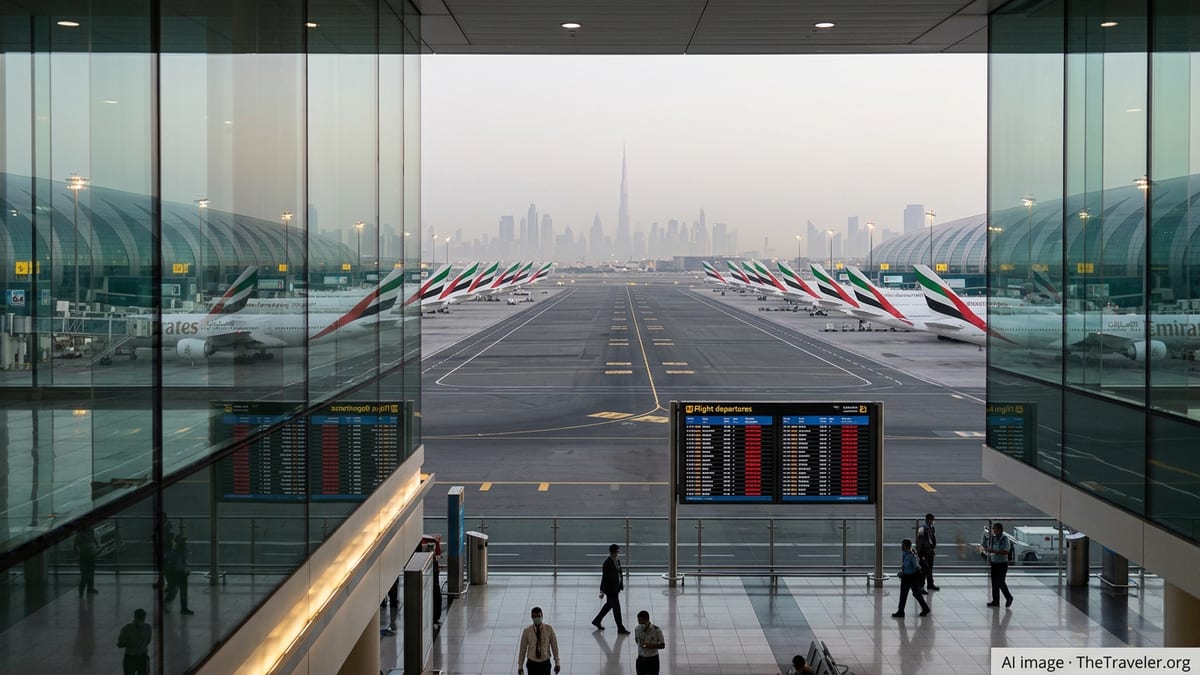
Emirates Issues Sweeping Suspension as Conflict Escalates
The Dubai-based carrier confirmed that all scheduled flights to and from Dubai remain suspended following multiple regional airspace closures, with only a limited number of carefully controlled repatriation and freighter services operating on March 3 and 4. The airline has framed the move as a necessary response to rapidly evolving security risks and government flight restrictions, stressing that passenger and crew safety is its overriding priority.
Emirates has advised customers not to travel to the airport unless they have received explicit confirmation that their flight will operate. Affected travelers are being offered rebooking within a defined window or refunds, but the carrier warns that schedules remain highly fluid and subject to last minute change as military activity and airspace rules shift from hour to hour.
The suspension comes as a joint United States and Israeli military campaign against Iran and subsequent Iranian missile and drone strikes have led to widespread closures of civilian airspace. Dubai International Airport, normally the world’s busiest international hub, has been brought to an almost complete standstill, upending itineraries for tens of thousands of travelers who rely on Emirates for long haul connections between Europe, Asia, Africa and Australasia.
UAE, Qatar and Bahrain Hubs Paralyzed by Airspace Closures
Across the Gulf, aviation authorities in the United Arab Emirates, Qatar and Bahrain have imposed full or partial airspace shutdowns in response to the conflict, immediately crippling operations at key regional hubs. Dubai and Abu Dhabi in the UAE, Doha in Qatar and Bahrain International Airport have all seen large scale cancellations and groundings as airlines adjust to fast changing safety assessments.
While the UAE has begun to reopen tightly controlled corridors in its airspace, these are limited mainly to specific arrival and departure routes and do not yet permit normal through traffic. Industry flight operations specialists note that there is currently no viable east west routing corridor across the central Gulf, leaving many carriers with no choice but to cancel services outright or divert around the region via far longer paths.
Qatar’s airspace remains effectively closed, forcing Qatar Airways to suspend most passenger and cargo operations from Doha. Bahrain has also halted flights due to the shutdown of its airspace, adding to the congestion and complexity facing any airline attempting to navigate the region. The cumulative effect has been to choke off much of the Middle East’s accustomed role as a global connecting bridge between continents.
Israel and Iran at the Heart of a Wider Aviation Shock
The immediate trigger for the aviation crisis has been the sharp escalation in hostilities between Israel and Iran, including strikes that have targeted critical infrastructure and military sites. Authorities in both countries have severely restricted civilian movements in their skies, with Israel limiting access to its main airspace and Iran seeing its own skies largely emptied of commercial traffic as neighboring states close adjoining routes.
These local closures have rippled outward as risk assessments by airlines and insurers lead to the avoidance of entire flight information regions over conflict zones. Carriers that continued to overfly parts of the region in earlier episodes of tension have, in this instance, opted for broader suspensions as missile and drone strikes reach deeper into Gulf territory, including near key airports.
Industry analysts warn that as long as significant parts of Iranian, Israeli, Qatari, Bahraini and Emirati airspace remain closed or heavily constrained, global aviation networks will struggle to recalibrate. Traditional contingency routings via Iraq, Jordan or Syria are also restricted, leaving a patchwork of narrow corridors that are insufficient to handle normal traffic volumes.
Global Airlines Scramble as Routes Lengthen and Capacity Vanishes
The shutdown of major Gulf hubs has immediate global repercussions because carriers such as Emirates, Qatar Airways and Etihad function as high capacity connectors between dozens of cities that lack nonstop long haul services. With their networks suddenly severed, travelers from markets as varied as India, Europe, Africa and Australia are finding themselves stranded or facing multi stop journeys that take far longer and cost significantly more.
Airlines in Europe and Asia have begun cancelling or rerouting flights to the Middle East, often adding hours of flying time to avoid closed skies. Some carriers are suspending all services to the region, while others are operating occasional rescue flights using convoluted routings via still open corridors on the fringes of the conflict zone. This in turn is disrupting aircraft and crew rotations, complicating recovery efforts even in countries far from the Gulf.
Travel data providers estimate that well over ten thousand flights have been cancelled across the Middle East since the first major airspace closures were announced at the end of February, with global knock on cancellations mounting each day. Passenger numbers affected are already in the hundreds of thousands and likely to climb as airlines pre emptively scrub future services pending clarity on security and airspace access.
What Travelers Need to Know Right Now
For travelers with upcoming itineraries touching the Middle East, especially via Dubai, Abu Dhabi, Doha, Manama, Tel Aviv or Iranian airports, the core message from airlines and governments is to avoid all non essential travel and to stay away from airports unless a flight is specifically confirmed as operating. Schedules posted days in advance should be treated as provisional, with same day checks via airline apps, call centers or airport status boards essential before setting out.
Emirates and other Gulf carriers are generally allowing fee free rebooking or refunds for tickets on cancelled flights, but high demand and aircraft shortages mean that replacement options may be limited for days or longer. Travelers whose journeys are not time critical are being encouraged to postpone trips rather than insisting on immediate rerouting through already congested alternative hubs in Europe or Asia.
Governments including the United States and several European states have issued strong advisories urging their citizens to leave parts of the Middle East while commercial options remain available, warning that further deterioration in security could cut off air links altogether. For those who must travel through the region, risk experts recommend building in generous connection times, carrying essential medications and documentation in hand luggage and being prepared for abrupt plan changes or overnight delays.
With no clear timeline yet for a full reopening of Gulf and Levantine airspace, airlines and passengers alike face a period of prolonged uncertainty. The speed at which Emirates and its regional peers can restore their networks will depend less on internal readiness than on how swiftly security conditions stabilize and regulators once again deem the skies over the Middle East safe for large scale civilian traffic.